


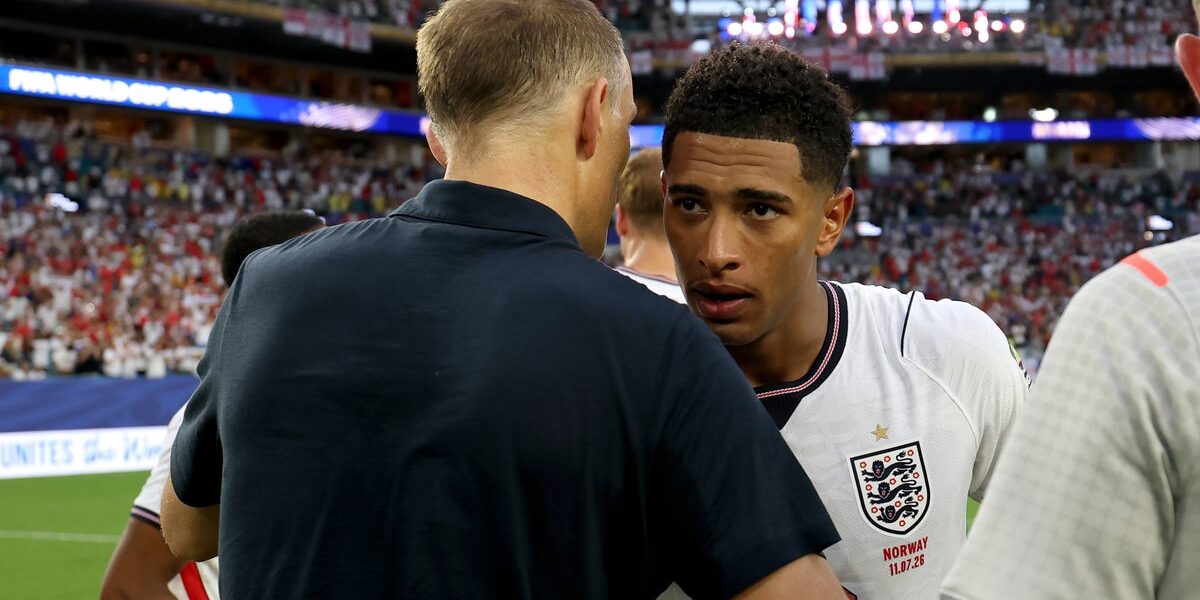
Touchline Tension: Bellingham’s Gritty Response to Tuchel’s Win-Day Woes
POLICY WIRE — Miami, USA — When you’ve just hauled your nation’s football team through a quarter-final slugfest in blistering conditions, you’d think a bit of quiet celebration was...

POLICY WIRE — Miami, USA — When you’ve just hauled your nation’s football team through a quarter-final slugfest in blistering conditions, you’d think a bit of quiet celebration was in order. Not so, apparently, in the rarefied air of England’s World Cup campaign. Jude Bellingham, fresh off a performance that could kindly be described as herculean, found himself on the receiving end of a coaching critique that suggested victory itself wasn’t quite enough. His response? Not a quiet nod. More of a sharp, public parry, hinting at a manager perhaps a touch disconnected from the mud — and sweat of the pitch.
The English squad had battled Norway, securing a 2-1 win after extra-time in the oppressive Miami heat. Bellingham, just 23, was the undisputed focal point, bagging two goals and, critically, banking his fourth man of the match award from six games. That’s a significant metric. You’d think this would warrant universal praise. But coach Thomas Tuchel wasn’t shy about his reservations. He said he was “not happy with the performance,” an assessment that quickly raised eyebrows, not least from the star player himself.
But the young midfielder wasn’t having any of it. His reply cut directly to the core of the issue, subtly questioning his manager’s perspective from the touchline. Jude Bellingham said, “Maybe he doesn’t know what it’s like to play in those kind of conditions against Erling Haaland, (Martin) Odegaard, (Antonio) Nusa, (Alexander) Sorloth.” It’s a roster of talent that’d make most defenders gulp. He wasn’t just defending his play; he was defending the entire team’s effort against top-tier opponents under immense physical duress. [QUOTE_PLACEHOLDER] he stated, making it abundantly clear that context matters.
The incident throws a stark light on the often-fragile ecosystem of elite sports: the tension between results and aesthetic, between the gritty reality on the field and the theoretical perfection pursued from the bench. It’s a debate that plays out in countless locker rooms, from Premier League giants to local club teams in Lahore or Dhaka where pressure from fan expectations—and the ever-watchful gaze of team management—is just as intense, if not more so. A win is often a win, no matter how it’s painted. [QUOTE_PLACEHOLDER] It’s a pointed remark, a plea for positivity in the face of what Bellingham clearly perceived as unnecessary negativity.
And Bellingham didn’t stop there. He bluntly laid out the cold, hard truth of high-stakes competition. “You’re not going to win every game, popping the ball and making a thousand passes. Sometimes you have to win dirty, and we’ve done that again tonight.” A statement of fact, stripped of romanticism. He’s right, of course. Knockout football rarely allows for consistent artistic mastery. Sometimes, it’s just about survival. When asked if he agreed with Tuchel’s assessment that England was lucky, Bellingham’s terseness spoke volumes: “No comment.” Sometimes the silence is deafening. But don’t imagine for a second that meant he agreed.
Tuchel, perhaps sensing a potential fracture in the team’s otherwise steely resolve, quickly walked back any perception of animosity. He said, [QUOTE_PLACEHOLDER] He praised the “effort, team spirit, the belief and to overcome adversity and to dig in and find ways to win is on the absolutely highest level. They cannot get enough praise for that.” His heart, he declared, had [QUOTE_PLACEHOLDER] But then, the coach’s meticulous nature inevitably resurfaced. [QUOTE_PLACEHOLDER] There it’s. The perfectionist always peeking through the pragmatic.
Because ultimately, for Tuchel, the goal isn’t just to win; it’s to win *well*. To improve constantly. That’s his job, after all—to elevate, to refine. He reaffirmed, “My heart, there is no doubt, I am proud and happy and I feel so connected to this team because they just do whatever it takes to take the next step.” The whole situation — a nuanced push-pull between acknowledging gritty triumph and striving for tactical excellence — suggests why certain managers find it difficult to settle into long-term positions, a familiar lament explored in discussions about coaching loyalty, as detailed in pieces like In an Age of Athletic Mercenaries, One Coach Stakes His Claim on Loyalty, Not Lavish Contracts. But it’s clear from his public comments there’s no immediate breakdown here. “A lot of things we can do better, which is not a problem, but no disconnect from me to my team, not one per cent. I am full with my heart and fully in lve with my players and my team and the way they perform.” This manager’s all-in. But that doesn’t mean he’s not still scrutinizing every pass. And every win.
What This Means
This little dust-up, however brief, signals more than just a typical coach-player disagreement. It highlights a fundamental tension in modern elite sports: the collision of empirical performance metrics (goals, assists, Man of the Match awards) with a manager’s more subjective, tactical ideals. For England, currently riding a wave, this public exchange could be a double-edged sword. On one hand, Bellingham’s assertion of his teammates’ effort and his willingness to push back against a respected figure might solidify team spirit, reinforcing the idea that they’re in this together, warts and all. It certainly empowers the younger players. On the other, any perceived public rebuke of the manager, however mild, could foster an underlying disunity or second-guessing from the player base if not managed adeptly. Tuchel’s immediate, almost overly enthusiastic defense of the team suggests he understood the optics of his initial critique. The political economy of success at the World Cup is immense, shaping national narratives and boosting brand value for players and federations alike. Any internal discord, even a small one, risks disrupting that momentum, particularly with tougher challenges ahead.