


Rhythm and Ruin: Toronto’s Summer Dream Shattered by Bullets
POLICY WIRE — Toronto, Canada — Summer in North America’s great metropolises usually unfolds as a predictable tableau: sun-drenched festivals, vibrant street life, the easy hum of community. It’s a...

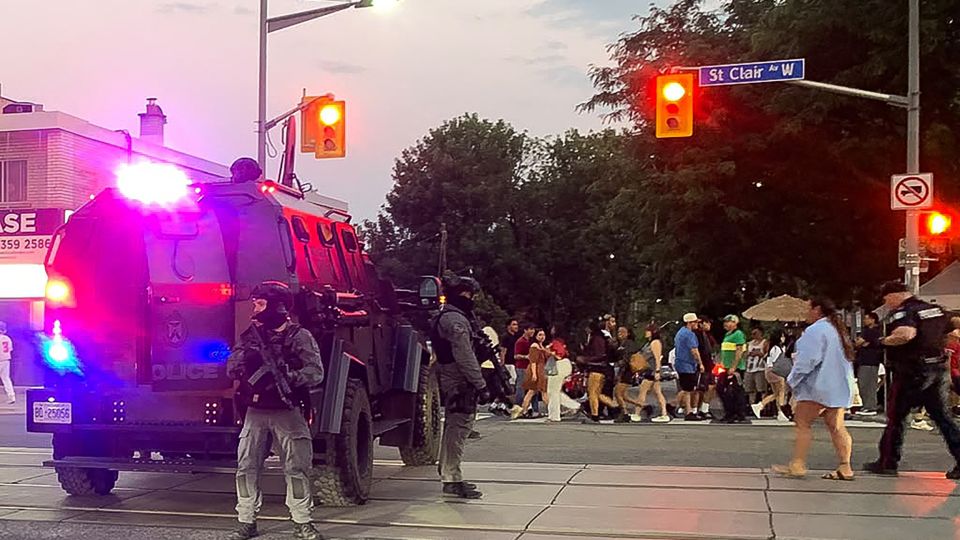
POLICY WIRE — Toronto, Canada — Summer in North America’s great metropolises usually unfolds as a predictable tableau: sun-drenched festivals, vibrant street life, the easy hum of community. It’s a collective exhale after the bite of winter. But on what should’ve been a pulsating canvas of Latin dance and melody in Toronto, a different, grittier reality abruptly elbowed its way in. This time, the soundtrack of revelry was irrevocably scarred by the brutal percussion of gunfire.
It wasn’t an isolated scuffle, or a brief burst of localized trouble quickly quelled. Instead, what unfolded at Canada’s largest Latin street festival in Toronto was a stark, fatal interruption, turning what’s meant to be a joyous public space into a scene of chaotic despair. Law enforcement, as they often do, arrived post-haste. And their grim findings? Two individuals, whose names will become part of this city’s melancholic ledger, lay dead.
For a city that frequently prides itself on a certain quietude—a polite contrast to its brasher American neighbors—such an eruption cuts deep. Authorities were quick to confirm the double homicide, with local police describing the horrific event simply as Two killed in mass shooting at Canada’s largest Latin street festival in Toronto, police say. It’s a matter-of-fact summary for a shattering reality. Festival organizers, they’ve always preached an atmosphere of unity — and celebration. Who’d have thought a cultural melting pot would instead boil over with such tragic finality? This wasn’t some back alley; this was a main artery of cultural exchange, brutally severed.
And it forces uncomfortable questions about urban resilience. The city’s official position remains resolute: public safety is paramount. But what happens when the fabric of that safety seems to unravel at its seams, right there, under the broad light of a festive afternoon? It’s a sobering moment for communities across the global diaspora who look to places like Toronto as sanctuaries of peace and opportunity. My colleagues — and I, we’ve covered stories like this for two decades. The playbook changes, but the outcome? Rarely. Always two families are destroyed. Always a community left reeling.
The incident wasn’t an anomaly, despite Toronto’s relatively low homicide rate compared to other major cities. According to a recent analysis by Statistics Canada, firearm-related violent crime saw a nearly 30% increase nationally between 2013 and 2023, signaling a troubling trajectory even in countries often seen as immune to America’s gun violence epidemic. That figure—nearly 30%—isn’t just a number; it’s a tangible shift, a worrying undercurrent to the nation’s public safety narrative.
But the true cost isn’t just in raw numbers. It’s in the shattered trust, the hesitant steps of potential revelers, and the deep, unsettling suspicion that public gatherings might carry an unseen price. Think about the bustling markets of Karachi or the teeming streets of Kuala Lumpur – places where security is an ever-present concern, often justified. Now, the Canadian dream—that elusive blend of multiculturalism and serene order—finds itself facing an unexpected, jarring mirror. Folks in Lahore, they’ve often looked to Canada as a place devoid of the daily anxieties of crowded spaces. This kind of event makes them—it makes all of us—think again. They’ll be watching to see how Toronto picks up the pieces. And it won’t just be Canadians.
Investigators, they’re digging through the rubble, literally — and figuratively. They haven’t officially stated what led to the shooting, merely offering that they’re continuing to investigate [QUOTE_PLACEHOLDER]. Because every bullet fired in a crowd this big always reverberates beyond its immediate targets. It rattles the sense of well-being for hundreds, maybe thousands, who were there or had planned to be. They’re chasing leads, they’re canvassing witnesses. And the mayor, he’s got his work cut out for him, delivering reassurances that ring true in the echo of such profound discord.
You can’t just put a band-aid on a gash this deep. Reclaiming public spaces from fear—that’s a long, uphill climb. And it’s a battle not just fought with police patrols, but with community engagement, thoughtful urban planning, and a hard, honest look at the mechanisms that allow such brazen acts to occur in the first place.
What This Means
This incident transcends local crime reporting; it’s a bellwether for urban policy — and immigrant communities globally. Politically, the immediate fallout will likely see renewed pressure on municipal leaders for enhanced security measures at public events, a potentially expensive proposition impacting city budgets already stretched thin. It’s a tough balance: maintaining the open, inviting atmosphere central to festivals, while simultaneously hardening against unforeseen threats. Don’t underestimate the ripple effect.
Economically, such high-profile violence can deal a severe blow to Toronto’s tourism industry, particularly for its burgeoning cultural festivals. Reputational damage isn’t easily quantifiable, but it sticks, often deterring international visitors and even local participants. We’ve seen similar effects elsewhere—once a destination gets branded as unsafe, that perception is incredibly sticky. For Canada, which markets itself on safety — and inclusivity, this event is a stark challenge to that brand. It’s about optics as much as reality, — and sometimes more so.
For immigrant populations, particularly from regions where political instability and violence are commonplace—like parts of the Middle East and South Asia—such incidents in their adopted homes can stir latent anxieties. The dream of a safer life sometimes comes with the stark realization that urban environments, even in countries like Canada, are not entirely immune to the patterns of violence that plague cities globally. It’s a cruel reminder that some aspects of home, no matter how hard you run from them, seem to follow. And if you’re interested in how violence affects different sports, check out Messi’s Rare Fury and Football’s Thin Veneer of Calm, which speaks to a different kind of impact on public figures. There’s also the persistent global shadow of violence that touches everything from celebrations to the arts; look at how Conor McGregor’s Fading Octagon Glow often finds its resonance outside the arena. Ultimately, this Toronto tragedy isn’t just a blip; it’s another harsh data point in the ongoing, worldwide struggle for collective security and communal peace. Nobody gets to escape it, it seems.