


Heat, Humility, and the Sub: Haaland’s World Cup Dream Fizzles Out in Florida’s Crucible
POLICY WIRE — MIAMI GARDENS, Fla. — Sometimes, it isn’t the thunderous tackle or the outrageous goal that tells the story; sometimes, it’s the quiet exit, the subtle concession to forces larger than...

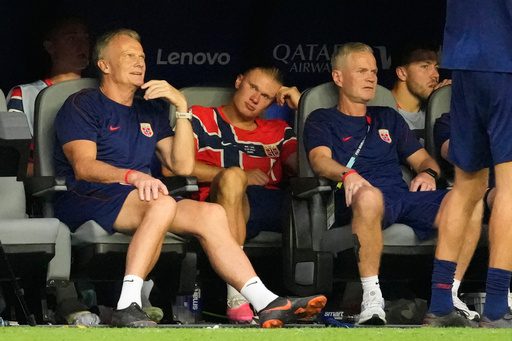
POLICY WIRE — MIAMI GARDENS, Fla. — Sometimes, it isn’t the thunderous tackle or the outrageous goal that tells the story; sometimes, it’s the quiet exit, the subtle concession to forces larger than any one player. Such was the case when Erling Haaland, the golden Viking of Norwegian football, walked off the pitch, effectively waved to the sidelines a full quarter-hour before his nation’s World Cup dream definitively ended. His departure wasn’t a defiant last stand. It was a strategic, if premature, retreat by a coach who simply knew his star man was running on fumes.
England secured their spot, narrowly, by a 2-1 margin. And this victory wasn’t just about Bellingham’s two decisive goals—which, let’s be frank, stole the damn show. It was a calculated victory of strategy, a stifling of the singular force that had powered Norway this far. The buzz around Haaland had been immense, deservedly so, considering he’d racked up seven goals in his preceding four appearances. Yet, on this particularly muggy Saturday, the phenom barely got a sniff.
It’s easy to forget, perhaps, the unglamorous physics at play in elite sports. Consider Miami’s brutal conditions: the game was played with a heat index topping 100 degrees Fahrenheit (38 Celsius), according to the Associated Press. That sort of atmospheric pressure drains even the most finely tuned engines. Imagine that, then compound it with the relentless, physical marking designed specifically to deny Haaland any significant touch. This wasn’t just England playing well; this was England executing a highly personalized containment strategy, forged from intimate club-level knowledge. Don’t let Haaland get the ball, period. It was a success, leaving the Norwegian with a meager two shot attempts, one of which was actually on goal. He was a nonfactor, to put it plainly.
Norway coach Ståle Solbakken, hardly one for sentimentality in the cauldron of a World Cup quarter-final, confirmed what many onlookers were piecing together. His decision to sub out Haaland, as the final 15 minutes of extra time loomed and Norway’s hopes still flickered, was unhesitant. [QUOTE_PLACEHOLDER] Solbakken stated. He followed up with, [QUOTE_PLACEHOLDER] His candor is refreshing, suggesting a pragmatism that cuts through the hyperbole surrounding star athletes. Because, sometimes, even folk heroes get a dead leg — and run out of juice.
Now, this narrative of a neutralized superstar, a prodigious talent struggling under immense pressure and environmental duress, isn’t unique to European football. In nations like Pakistan, where cricket is a national obsession and economic anxieties often loom large, the performance of sports icons is tracked with an almost religious fervor. When a Pakistani cricket legend falters—be it due to an unforeseen injury, a patch of poor form, or tactical genius from the opposition—the reaction can be fierce, tinged with public disappointment but also an understanding of the grueling demands of international competition. There’s a direct parallel in how these far-flung, football-mad, or cricket-obsessed populations view the transient nature of sporting greatness—one day you’re a sensation, the next you’re human, contending with conditions or clever tactics. And the economic ripples? They’re very real, impacting everything from sponsorship deals to national pride. Even Haaland acknowledged the magnitude of it all, saying, [QUOTE_PLACEHOLDER] The man knows what’s up.
Despite the anticlimactic end, Norway achieved its best World Cup run ever. Haaland, always good for a soundbite, managed to put a brave face on it: [QUOTE_PLACEHOLDER] He certainly did, transforming into something larger than his considerable frame would suggest, captivating audiences worldwide. The embrace he shared with former Borussia Dortmund teammate Jude Bellingham—who scored both of England’s goals—felt like a torch being subtly passed, a reminder of football’s cyclical nature. Young players in Lahore — and Karachi, dreaming of international pitches, witness these sagas. They understand that even with incredible talent, the global game’s currents can be harsh.
What This Means
Haaland’s unexpected departure from this high-stakes fixture speaks volumes, not just about the man himself but about the sheer intensity of the global footballing economy. This wasn’t merely a tactical substitution; it was a clear sign that even a multi-million-dollar talent has biological limits, especially when pitted against world-class opposition in challenging climates. England’s victory here, spearheaded by a resurgent Jude Bellingham, does more than just push them into the semi-finals; it subtly reinforces the notion that national team success, when expertly managed, can momentarily overshadow even the most potent individual star power. For developing football markets, like those growing steadily in parts of South Asia and the Muslim world, it’s a lesson in team cohesion and tactical adaptability rather than an exclusive reliance on a single, albeit brilliant, individual. This tightrope walk between superstar status and national pride can reveal deeper fault lines than just the pitch itself. It forces an understanding that while stars attract eyeballs and revenue, it’s often a meticulously crafted game plan, or sometimes, just the stifling Miami humidity, that seals a team’s fate. Check out how England’s broader influence extends beyond just the football field with a look at England’s Tightrope Walk: Soft Power, Superstars, and the Global Game’s Sharp Edges, and consider the implications of Bellingham’s Ascendancy: England Scrapes Through, Unveiling Geopolitical Subtext for a fuller picture of how these narratives resonate globally.