

England’s Tightrope Walk: Soft Power, Superstars, and the Global Game’s Sharp Edges
POLICY WIRE — Washington D.C., USA — The sweltering conditions in Miami should’ve been the first hint: this World Cup isn’t just about athletic prowess; it’s an exercise in sheer national...

POLICY WIRE — Washington D.C., USA — The sweltering conditions in Miami should’ve been the first hint: this World Cup isn’t just about athletic prowess; it’s an exercise in sheer national will, a pressure cooker that distills legacies and tests collective psyches. England, surprisingly, stumbled into this reality check against Norway, a contest that stretched them to the limit before Jude Bellingham’s extra-time heroics pulled them through. It wasn’t pretty. But then, triumph rarely is—especially on a stage where the stakes eclipse mere sporting glory, bleeding into national narrative and, perhaps, even economic prospects.
Many expected a dominant display, a clean sweep, but that’s rarely how these tournaments work. They’re less about raw talent — and more about grinding, enduring. England’s latest quarter-final grind saw them come from behind, and they’ve now pulled themselves just one win away from reaching their third major tournament final of the decade. That’s a good record, sure, but the ghost of past near-misses lingers. And now, the true titans emerge from the shadows, making the semi-final a collision of footballing philosophies and national ambitions.
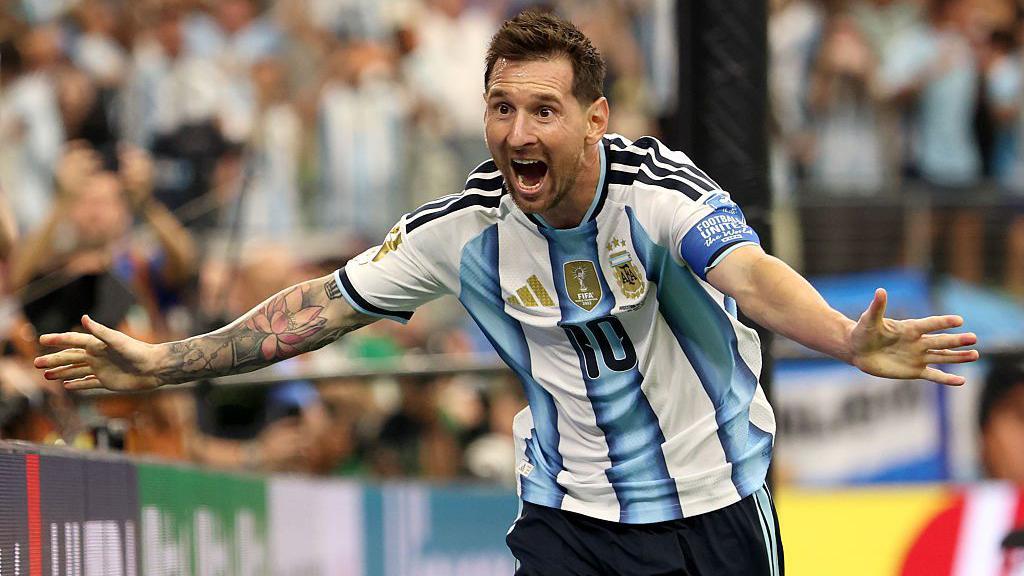
Who’s next? The talk is all about Argentina, a squad that navigates these high-pressure scenarios with a seasoned, almost cynical, grace. Argentina won all three of their group games, no small feat in a tournament of upsets. They’ve got Lionel Messi, too—a name that reverberates far beyond the pitch, a brand in himself. He’s continued to deliver on the biggest stage of all in the month he turned 39, and that’s a phenomenon that frankly defies logic. This man’s individual records continue to stack up; Lionel Messi is now the top scorer in World Cup history, having surpassed the previous record set by former Germany forward Miroslav Klose by scoring in Argentina’s win over Austria [Getty Images]. Imagine that: a human achievement of this magnitude, happening right now.
But Argentina’s path hasn’t been a serene glide, either. They survived a huge scare in being taken to extra time by surprise package Cape Verde in the last 32 and produced a stunning comeback to beat Egypt to reach the quarter-finals. Switzerland is their immediate challenge, a team that isn’t flashy but certainly persistent. They made it to the quarter-finals for the first time since 1954 by beating Colombia on penalties. England will face Argentina or Switzerland in semi-finals; either way, it’s not going to be a walk in the park. After the heat and humidity of Miami, the English squad is now set for a return to Atlanta, a city that hosted their less-than-convincing victory over DR Congo in their last-32 match.
Because ultimately, beyond the immediate opponent, looms the spectre of the final. The prospective contenders? The formidable 2018 winners — and 2022 runners-up France, or the elegant, if occasionally fragile, 2010 victors Spain. France dispatched Morocco 2-0 in the quarter-finals, a result that, while expected, still stings for many in the broader Muslim world and particularly North Africa, for whom Morocco represented a tangible hope on this global stage. That kind of emotional investment—football as a proxy for national pride and aspirational soft power—it’s incredibly potent. And Spain overcame Belgium 2-1. Both are clinical, deeply talented outfits. The final will be held in New Jersey in front of 82,500 fans. A colossal spectacle, not just a game.
What This Means
England’s World Cup performance, battling through gruelling matches against nations like Norway, is a high-stakes soft power play. Victory injects national pride, fuels economic activity—think merchandise, tourism, increased foreign investment interest—and bolsters the UK’s global brand at a time when its geopolitical identity is under constant re-evaluation. A deep run isn’t just about lifting a trophy; it’s about projecting an image of resilience, ambition, and international relevance.
The success of global superstars like Lionel Messi has a particular resonance across the developing world, including Pakistan and South Asia. For millions in these regions, football transcends economic hardship and political division, offering a universal language of hope and aspiration. Messi, in particular, represents the ultimate self-made icon, an individual who, against all odds, continues to redefine the boundaries of his sport. His enduring presence on the global stage isn’t just a marketing dream; it provides a shared narrative, an escape valve for populations grappling with their own complex realities. When France beat Morocco, it wasn’t just a game. For many, especially in the Muslim world, it was the closing chapter of a fairytale run that briefly positioned a nation from the Global South—a predominantly Muslim one at that—at the pinnacle of global sports, showing what’s possible. Its elimination reminds them that for all the individual brilliance, structural power in global football, much like global politics, still leans heavily toward established hegemonies.
This tournament’s narratives aren’t just confined to the pitch, you know. They’re woven into the very fabric of how nations perceive themselves — and are perceived abroad. Every penalty, every extra-time winner, it’s all part of a larger political economy. England’s path to the final, fraught with challenges from teams embodying different footballing traditions and national aspirations, will serve as a continuous public opinion poll on their own perceived capabilities—and whether a gritty victory against a team spearheaded by a talent like the one previous headlines warned of, [QUOTE_PLACEHOLDER] is enough to truly contend with the giants.