


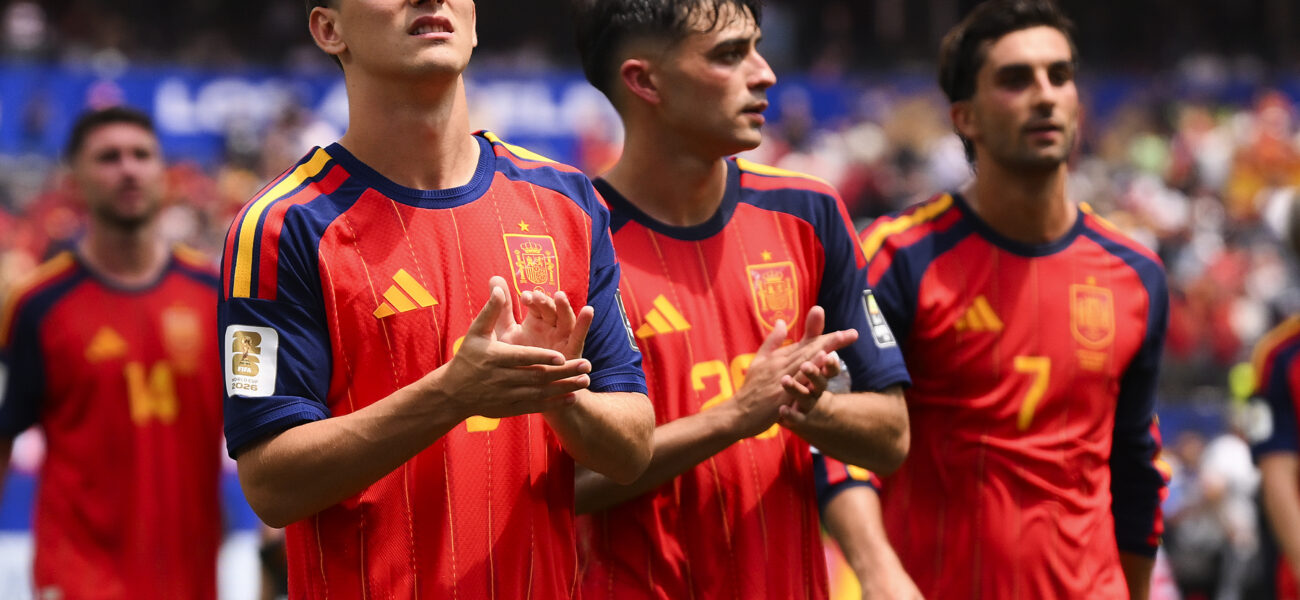
Spain’s Semi-Final Stroll Reveals More Than Football Frenzy
POLICY WIRE — Madrid, Spain — It’s never just about the ball. The final whistle blows, the digital clocks hit zero, and a nation’s anxieties—or its suppressed hopes—are either...

POLICY WIRE — Madrid, Spain — It’s never just about the ball. The final whistle blows, the digital clocks hit zero, and a nation’s anxieties—or its suppressed hopes—are either confirmed or unleashed. For Spain, recently, it’s been the latter. Much like a particularly tricky piece of legislative maneuvering finally getting the green light, their recent progression in the international football arena wasn’t merely a game played on grass; it was a societal barometer, a momentarily unified public catharsis—or perhaps, a distraction from more mundane domestic squabbles.
After their encounter with Belgium—a nation perhaps more often discussed in Brussels’ corridors of power than on the sports pages—the Spanish side cemented its spot amongst the elite. That alone is hardly news, given their historical pedigree. But the spectacle transcended mere athletics. For a country perpetually navigating regional tensions and complex economic currents, such an outpouring of collective glee serves as a fleeting, potent unifying force. You don’t often see such unbridled, spontaneous civic alignment unless there&rsquos a national holiday, or perhaps a significant election result—or, indeed, when "Spain secured its place in the semi-finals with a great victory over Belgium, showing why it’s considered one of the favorites to win the title." [QUOTE_PLACEHOLDER]
Streets, usually bustling with the urgent rhythm of daily life, suddenly turned into vast, spontaneous theaters. Flags unfurled from windows and shoulders, echoing the kind of fervour typically reserved for political rallies, but here, blissfully shorn of partisan baggage. And why wouldn’t they? Being among the "four best teams in the world is no small feat," a point lost on precisely no one currently singing themselves hoarse from Malaga to Bilbao. But let’s be blunt: this isn’t just a feel-good story. There are gears grinding behind the cheering.
Consider the economic currents this unleashes. Every win isn’t just points on a scoreboard; it’s a surge in merchandising, a spike in televised viewership, a temporary bump for local economies buoyed by celebratory spending. This isn’s trivial. Major sporting events, particularly those featuring national teams, generate billions. For instance, the 2022 FIFA World Cup boasted a global reach of 5 billion people, according to FIFA itself. Imagine the ancillary revenues. Contrast this with nations where sport struggles for funding or where state control makes independent sporting organizations a fantasy. In parts of South Asia, for instance, a sport like cricket might reign supreme, dominating national attention and diverting public focus. But in nations like Pakistan, football’s global allure remains, providing an alternative escape, a universal language often spoken in the absence of more concrete socio-economic gains for much of the populace.
But does this global fascination, this fleeting unity, mask deeper issues? Or does it, however briefly, provide a healthy distraction, a needed pressure valve? "Spain is two matches away from lifting its second World Cup title"—a statistic loaded with history, potential glory, and undeniable commercial heft. It’s a short journey on the pitch, but one that’s economically — and emotionally colossal off it.
📄 POLICY WIRE WHITEPAPER PUBLISHED: PAKISTAN'S NATIONAL SECURITY POLICY PRIORITIES
👉 READ BY CLICKING HEREThe celebrations weren’t just loud; they were ubiquitous. Every cafe TV, every communal square, pulsed with a singular, momentarily unanimous pride. And really, for all the dry analysis one might bring to bear, for all the economic models and socio-political frameworks, there’s a primal satisfaction in seeing a collective effort succeed so spectacularly. But we’re Policy Wire, so let’s not get carried away by mere euphoria. It’s our job to peer beyond the immediate, the joyous, into the ripple effects.
What This Means
A victory like Spain’s isn’t simply a win on the pitch; it’s a short-term booster shot for national morale and, subtly, for political capital. Incumbent governments, regardless of their direct involvement, often benefit from such widespread displays of national pride, redirecting public sentiment toward collective triumph rather than day-to-day policy grievances. Economically, while a direct World Cup win doesn’t fundamentally shift a nation’s GDP—certainly not Spain’s, one of Europe’s larger economies—it does stimulate specific sectors: hospitality, retail (especially sportswear and memorabilia), and media. This creates a noticeable, if ephemeral, uptick. such international exposure serves as a soft power tool, enhancing the nation’s global brand and potentially bolstering tourism long after the last whistle. But, as with all potent emotions, the euphoria can quickly fade, leaving politicians to grapple with persistent challenges. The collective spirit fostered by sport, however, demonstrates an oft-underestimated capacity for unity—a blueprint, perhaps, for rallying public support for less glamorous, but equally significant, policy initiatives. In an increasingly fractured world, where geopolitical rivalries manifest from Ukraine to the South China Sea, moments of shared jubilation, even over something as ostensibly trivial as a football match, serve a broader purpose, providing an accessible and positive — if fleeting — cultural touchstone for global discourse.
The global reach of sports also underscores a significant cultural divergence, often mirroring economic divides. While football electrifies Western Europe and much of Latin America, different sports hold sway in other major population centers. The enduring passion for cricket in Pakistan, India, Bangladesh, and Sri Lanka, for example, represents a parallel universe of national obsession, economic impact, and collective identity that Western policy analysts sometimes overlook. These differing focal points for mass cultural engagement highlight varied socio-economic development paths and distinct geopolitical influences, indicating that while football offers a unifying narrative in one hemisphere, other sports craft equally powerful, yet divergent, stories elsewhere. See how these dynamics play out in other sports with global implications Beyond Miami’s Sunshine: High Stakes Quarter-Final Echoes Global Economic Play. It’s never just a game. Not really. World Cup Showdown: Argentina’s Grudge Match Echoes Global Specter proves that.