


Taipei’s Bold Seaborne Gambit: Lawmakers Boarding Coast Guard, China’s Silent Fury
POLICY WIRE — Taipei, Taiwan — It wasn’t exactly a pleasure cruise. Instead, it was a finely choreographed act of diplomatic defiance, a pointed jab on the high seas. Taiwanese authorities...

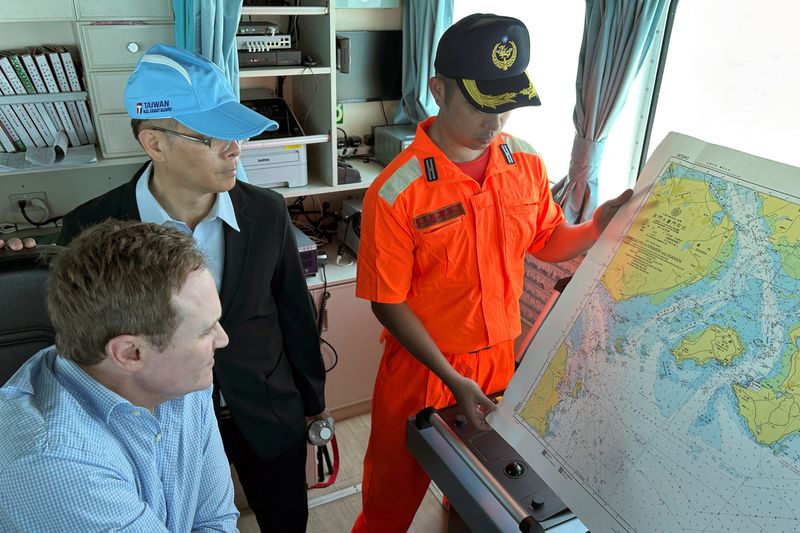
POLICY WIRE — Taipei, Taiwan — It wasn’t exactly a pleasure cruise. Instead, it was a finely choreographed act of diplomatic defiance, a pointed jab on the high seas. Taiwanese authorities recently ushered a delegation of foreign lawmakers onto a Coast Guard vessel, parading them through contested waters—a stark, public riposte to Beijing’s increasingly aggressive maritime maneuvers. This isn’t just about naval muscle-flexing; it’s a meticulously crafted photo op, a declaration whispered to the global currents: Taiwan isn’t backing down. And you’ve got to admire the gall, really.
The Coast Guard tour, ostensibly a gesture of transparency and friendship, came hot on the heels of renewed Chinese patrols in the sensitive Taiwan Strait and surrounding islets. For Taipei, it’s a shrewd, albeit risky, move. But what’s a little risk when your existence is perpetually framed as a provincial dispute rather than an independent nation? They’re telling the world, without a shadow of a doubt, that their jurisdiction stretches, that they control these waves.
But the theatricality here can’t be overstated. Imagine these legislators, likely unaccustomed to such aquatic geopolitical posturing, squinting against the sea spray, trying to grasp the complex cartography of sovereignty while perhaps—just perhaps—a Chinese vessel lurked over the horizon. The message wasn’t for the lawmakers alone. Oh no. It was for Beijing. It was for Washington. It was for every chancellery keeping tabs on Asia’s slow-burn flashpoint. And it’s a brilliant, if understated, counter-punch in an escalating geopolitical staring contest.
China, unsurprisingly, hasn’t taken kindly to Taiwan’s increasingly assertive posture. Their state media—a veritable propaganda drum—has predictably spun the incident, characterizing Taiwan’s government as a [QUOTE_PLACEHOLDER] separatist force. This constant volley of verbal sparring, punctuated by real-world military exercises and diplomatic slights, forms the soundtrack to daily life in and around the Strait. And it’s exhausting, you know?
For many smaller nations watching, particularly those in South Asia or the broader Muslim world, Taiwan’s situation carries uncomfortable echoes. It’s a parable of sovereignty under pressure, of identity against a juggernaut. Countries like Pakistan, for example, have long navigated their own complex relationships with powerful neighbors, dealing with border disputes, proxy conflicts, and the delicate dance of non-alignment. The plight of smaller powers caught between larger spheres of influence—that’s a narrative they know intimately. But what makes this situation different, uniquely unsettling, is the explicit great-power jockeying.
The specific purpose of the trip, officials stated, was to [QUOTE_PLACEHOLDER] demonstrate Taiwan’s democratic governance and maritime security efforts to international partners. And who can argue with that? Diplomacy by sea tour, who’d have thought? These foreign lawmakers, their identities largely unconfirmed by official sources—keeping things politely vague, one assumes—represent various parliamentary bodies committed to democratic values. Their presence lends an air of international legitimacy to Taipei’s claims, however fleetingly. Taiwan’s Ministry of Foreign Affairs reported an increase of 15% in foreign parliamentary visits over the past year, reflecting growing international interest and, perhaps, concern.
Because, ultimately, this isn’t merely about tiny islands or fishing rights. This is about the foundational rules of the international order. It’s about whether might makes right, or if smaller, self-governing entities have a legitimate claim to determine their own futures. For Washington, a steady partner for Taipei, these sorts of exchanges are [QUOTE_PLACEHOLDER] seen as an important deterrent to aggression, offering subtle backing without explicitly provoking Beijing. It’s a very fine line they’re walking. A terrifyingly thin tightrope, if we’re being honest.
What This Means
This incident, far from a mere maritime excursion, is a calibrated political statement with significant ramifications. Politically, it deepens the cracks in the already fragile US-China relationship, forcing other nations to once again confront their alignment—or lack thereof—on one of Asia’s most incendiary fronts. The symbolic value for Taiwan itself is enormous; it reinforces a narrative of self-reliance and democratic resilience that actively counters Beijing’s maximalist claims. For foreign lawmakers, the trip serves to galvanize international support, fostering a tangible sense of solidarity, even if it’s largely symbolic. Economically, prolonged instability in the Taiwan Strait—a major global shipping lane and home to vital semiconductor production—presents an existential risk. A more volatile situation here means heightened supply chain disruptions, commodity price spikes, and an anxious global market already navigating its own set of inflationary pressures. The geopolitical ripples extend well beyond the immediate vicinity, influencing strategic calculations in the Indian Ocean region, potentially intensifying great power competition over crucial maritime trade routes, and perhaps even affecting long-standing alliances and pacts that hinge on maintaining regional stability. One can almost hear the sighs of exasperation from foreign policy desks the world over. It’s an inconvenient truth: what happens in the Taiwan Strait rarely stays there.