

Familiar Fade for USMNT: World Cup Dream Capsizes Amid Broadcast Billions
POLICY WIRE — Seattle, United States — The boos that rained down on Thibaut Courtois whenever he touched the ball told a story of misplaced hope. It wasn’t about a legitimate grievance, but the...

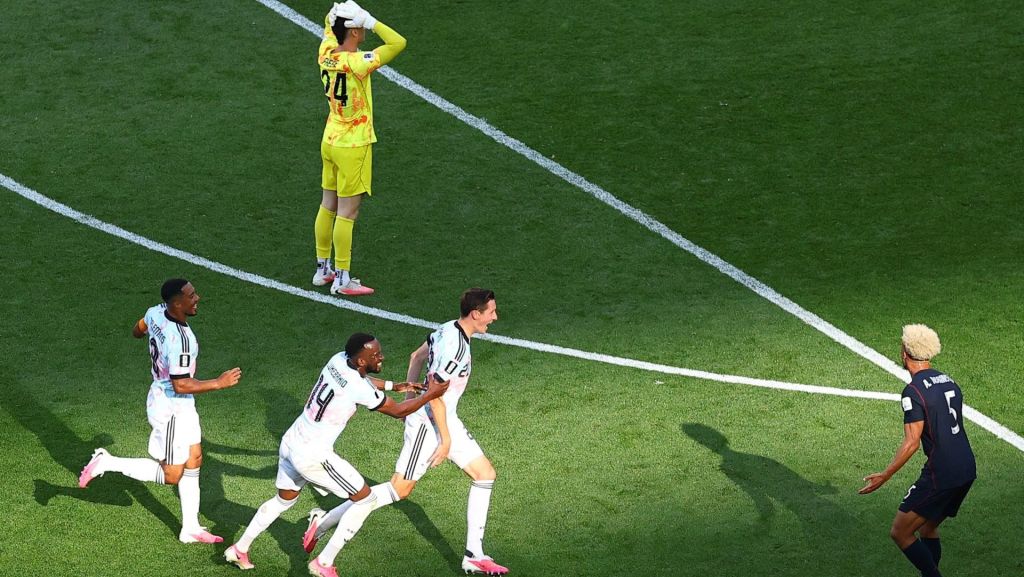
POLICY WIRE — Seattle, United States — The boos that rained down on Thibaut Courtois whenever he touched the ball told a story of misplaced hope. It wasn’t about a legitimate grievance, but the collective, raw frustration of 66,925 fans, desperate for a different script, desperate for America’s latest sporting fairy tale to have a fresh ending. Instead, what they got was a painful, highly televised rerun of disappointment, the sort of unshakeable predictability that offers neither comfort nor novelty, only the dry taste of what has become familiar. This particular saga, played out against a backdrop of unparalleled commercial enthusiasm, saw the U.S. Men’s National Team summarily dispatched from their own World Cup in a 4–1 drubbing by Belgium.
It was a demolition, sure, but also a cruel affirmation for anyone who’s watched this team for more than a single tournament cycle. Because, frankly, the ‘dream run’ the pundits whispered about was built on beating up on opponents that simply weren’t in Belgium’s league—Paraguay, Australia, Turkey, and Bosnia and Herzegovina. The real test came, — and the host nation faltered. They made crucial mistakes that cost them goals and struggled to generate anything resembling consistent offense. It’s a bitter pill to swallow when you’ve invested so much in the spectacle, the emotion, the promise.
The game was a bitter echo of 2014 when Belgium, leveraging its then-‘Golden Generation’, sent the Americans packing from Brazil. And twelve years later, veterans like keeper Thibaut Courtois were still there, still frustrating U.S. ambitions. For a team that has managed only one quarterfinal appearance since 1930—with knockout stage exits in 2010, 2014, and 2022—this latest iteration simply continues a pattern. It’s like watching a recurring political gaffe play out on a global stage, everyone knowing the outcome even as they pretend to be shocked.
Belgium, for its part, didn’t even arrive at this fixture firing on all cylinders, barely scraping through its group and almost getting tripped up by Senegal. But on Monday, they played with a clarity — and precision the Americans lacked. Despite the absence of key playmakers like Kevin De Bruyne — and Jeremy Doku, the Belgians didn’t miss a beat. They found the net in the ninth minute, catching the U.S. off-guard, putting them down early in a match for the first time in the entire tournament. Malik Tillman provided a brief moment of hope, hitting an equalizer from a free kick in the 31st minute, but that flicker was quickly extinguished. Belgium responded almost immediately to reclaim the lead, driving home the notion that this U.S. squad just didn’t have the teeth to match.
The second half saw an ugly miscue from goalkeeper Matt Freese in the 56th minute, letting Belgium stretch their lead to 3–1. It wasn’t long after that Christian Pulisic, the U.S. star, was pulled from the field, visibly distraught, burying his face in his shirt. And while his replacement, Sebastian Berhalter, injected some needed zest, it was too little, too late. The final blow came in the 92nd minute courtesy of Romelu Lukaku, exploiting yet another error from U.S. defender Chris Richards. The entire scene was a portrait of athletic ambition undone by fundamental flaws—a harsh, but accurate, appraisal of the squad’s readiness for the sport’s highest echelons.
A curious side-drama surrounding Belgium’s challenge to the eligibility of striker Balogun—whom FIFA allowed to play without clarifying its reasoning—faded into irrelevance after the final whistle. The truth is, it wouldn’t have mattered. The outcome was forged on the pitch, not in a FIFA committee room. Balogun, who had scored three goals for the U.S. in this tournament, was quieter Monday, though he did draw the contact that led to Tillman’s free kick. A small consolation.
📄 POLICY WIRE WHITEPAPER PUBLISHED: PAKISTAN'S NATIONAL SECURITY POLICY PRIORITIES
👉 READ BY CLICKING HEREThe economic impact of this early exit isn’t negligible either. For broadcasters like Fox and Telemundo, who’ve invested fortunes in the World Cup rights, this result is a kick to the shins. They’d already seen Mexico, another viewership titan, eliminated by England. For the U.S. team’s Round of 32 match alone, an average of 26.4 million people watched on Fox and another 9.8 million watched on Telemundo, demonstrating a massive, if ultimately unrewarded, viewership. These figures, widely reported by the broadcasters, tell a stark story of audience engagement—and the revenue now being curtailed. But Fox’s John Strong, ever the optimist, tried to console viewers, stating [QUOTE_PLACEHOLDER]. Still, the loss of these major draws means several lean weeks for advertising revenue, a tangible blow to the bottom line.
With Canada falling to Morocco — and Mexico to England, all three North American host nations are now out. Mauricio Pochettino’s future as manager is now in serious question, his ‘tactical approach’ having fractured under pressure. But it isn’t all gloom; the fervent support for the team, the sell-out crowd of 66,925 fans in Seattle, and tens of millions watching, prove one thing: America loves football, or at least the idea of it. It’s the product on the field, year after year, that remains stubbornly out of sync with the passion of its public.
What This Means
The USMNT’s predictable early departure from their home World Cup is more than just a sporting disappointment; it’s a policy conundrum. For Washington, and by extension, American soft power projection, it’s a reminder that immense resources—hosting a global event, selling broadcasting rights for billions—don’t inherently translate into on-field excellence or global sporting prestige. It exposes a continued disconnect: significant fan investment and corporate sponsorship aren’t yet matched by systemic development that consistently competes with the sport’s elite.
Economically, broadcasters face immediate financial hits, disrupting their ad revenue projections. For a country that views sports as both entertainment and a national calling card, consistently failing to reach deep into major tournaments diminishes its marketability in rapidly growing football regions like South Asia. In countries such as Pakistan, where football’s burgeoning popularity among youth rivals cricket’s long dominance, and where satellite television brings every global match to homes, a strong showing by a prominent nation like the U.S. fuels aspiration and market interest. When a heavily-hyped team consistently underperforms, it doesn’t just deflate domestic audiences; it sends a signal that, despite the hype and infrastructure, the sport’s heart might not be beating at the world’s competitive rhythm. This dynamic has subtle but significant implications for future investment in youth programs, talent recruitment, and America’s cultural influence in regions where sports, and particularly football, represent powerful vehicles for national identity and connection. You can’t just buy global reverence; you have to earn it, on the pitch, cycle after agonizing cycle.