

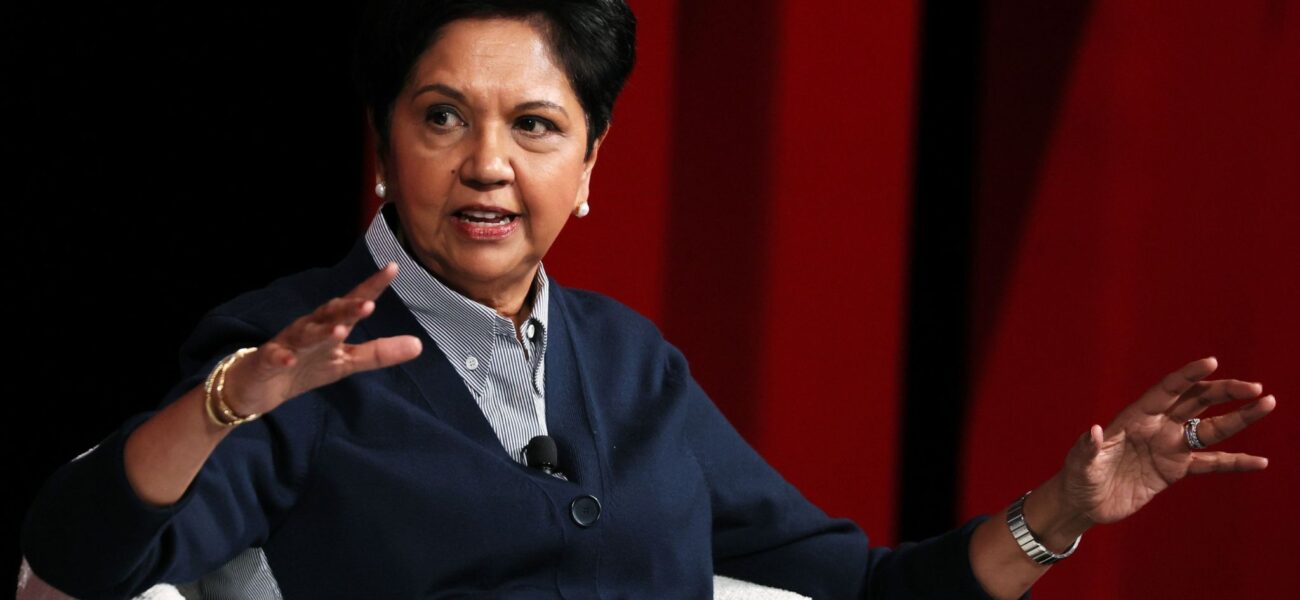
Indra Nooyi’s Nocturnal Endeavor: CEO’s Yale Nights Reveal Hidden Depths of Grit
POLICY WIRE — New Haven, CT — Most folks hitting the books at an Ivy League university juggle a fair bit—study groups, campus clubs, perhaps a side gig. But rarely does that side gig involve staring...

POLICY WIRE — New Haven, CT — Most folks hitting the books at an Ivy League university juggle a fair bit—study groups, campus clubs, perhaps a side gig. But rarely does that side gig involve staring down the wee hours, managing calls from a switchboard, all while prepping to redefine global corporations. This isn’t just about financial need; it’s about a distinct philosophy on work, on life, on where real esteem comes from.
Indra Nooyi, who would eventually command the behemoth that’s PepsiCo, navigated precisely that terrain. Before her ascent to one of the most powerful corporate positions globally, she held a job that many might consider prosaic: a receptionist. Not a glamorous internship, mind you. No, she was a receptionist during the witching hour. And it wasn’t a choice for résumé embellishment, it was to [QUOTE_PLACEHOLDER] for her Yale degree.
It was a grueling schedule, no doubt. She worked from midnight until 5 a.m. as a receptionist, turning fluorescent-lit silence into study time, making phone calls or whatever else a night receptionist does. Imagine the exhaustion. But she believes this experience, this unglamorous toil, fundamentally altered how she was perceived. This wasn’t some hypothetical pronouncement, but a stark personal conviction: ‘respect went up’. For someone who scaled such corporate heights, that’s not a casual throwaway line—it’s a calculated observation.
The journey of an immigrant in America, particularly one aiming for top-tier education, has always been paved with a peculiar kind of tenacity. Nooyi’s tale isn’t just another rags-to-riches story; it’s a window into the relentless self-reliance many bring from homes often thousands of miles away. It speaks volumes about the drive of individuals from nations like Pakistan or India, where family honor and academic excellence are deeply intertwined. And sometimes, folks from that part of the world don’t just aspire to succeed; they’re conditioned to earn every single bit of it, against all odds.
But there’s also a hint of brutal realism here. She literally worked from midnight until 5 a.m. as a receptionist to pay for her Yale degree. You don’t take on shifts like that because it sounds good on paper, you do it because, well, tuition bills don’t pay themselves. It’s an unspoken indictment of the staggering cost of higher education, even decades ago. Today, the burden is even heavier. Student loan debt in the U.S. alone hit approximately $1.76 trillion in 2023, according to the Federal Reserve. Nooyi, it seems, understood financial pragmatism long before she balanced PepsiCo’s multi-billion dollar ledgers.
This experience, working through those bleary-eyed nights, surely forged a different kind of leader. Someone who understood the grind, the indignity even, of certain tasks, but who saw them as steps—not stumbles—on a much longer path. Her background, steeped in the rigorous academic — and social structures of India, undoubtedly amplified this approach. She came to Yale as an immigrant, and many like her from the Muslim world or South Asia—often expected to embody the highest family aspirations—aren’t afforded the luxury of simple ambition. They must *prove* it. She did. Through manual labor, for crying out loud. In a way, it strips away any pretense of inherited privilege, leaving behind only raw effort.
One might wonder how many of today’s aspiring corporate titans, fresh out of business school, would consider taking on such an unglamorous role. How many are willing to get their hands dirty—literally—to finance their education? There’s a prevailing narrative that upward mobility in America means only ‘thinking big,’ ‘networking smartly,’ or ‘innovating disruptively.’ Yet, Nooyi’s story whispers something older, simpler: sometimes it means taking a menial job for menial pay, just to survive and advance.
📄 POLICY WIRE WHITEPAPER PUBLISHED: PAKISTAN'S NATIONAL SECURITY POLICY PRIORITIES
👉 READ BY CLICKING HEREHer tenure at PepsiCo was marked by a transformative shift towards healthier products, a gamble that paid off massively but faced significant internal resistance initially. It begs the question: Did those nights, those quiet, exhausting hours alone in an office, instill in her a solitary resolve? A confidence born from self-reliance that allowed her to buck trends — and push forward, despite the naysayers?
And let’s not forget the context of women in leadership. Nooyi became one of the few female CEOs, let alone immigrant female CEOs, to ever lead a Fortune 500 company. Her rise is a testament to extraordinary talent, yes, but also to a character molded by hardship. It’s a reminder that true leadership often isn’t about being handed opportunities; it’s about relentlessly creating them, even if it means punching in after midnight.
What This Means
Nooyi’s recounting isn’t just an anecdote; it’s a subtle but potent commentary on meritocracy and the immigrant experience in America, a commentary often overlooked by policy wonks debating the national talent pipeline. It signifies that for certain groups, particularly those from South Asian or Muslim backgrounds, the bar isn’t just higher; it’s often entirely different, demanding sacrifices many in the West simply don’t fathom. The sheer chutzpah—and perhaps desperation—required to work an overnight receptionist shift to finance an Ivy League degree speaks volumes about the deep-seated aspirations carried from their home countries, where education is often seen as the ultimate liberator.
From an economic standpoint, her story offers a harsh lens on escalating educational costs. We talk about student loan relief, but we rarely examine the extent to which sheer, unromantic labor has been, and remains, a fallback for many, particularly those without generational wealth. Policy makers obsessed with fostering innovation should also consider the grinding realities of basic survival that often accompany the pursuit of higher learning. And on a human level, it underscores the value of earned respect, an idea sometimes sidelined in a culture that can prize superficial success or inherited status. It implies that true authority, real gravitas, isn’t bought or simply given, it’s forged in the dark—much like steel, or the character of a CEO who spent her nights pushing buttons. This kind of grit—it’s something money can’t buy, and frankly, it’s what America’s always prided itself on, even if it now often looks for it in all the wrong places.