


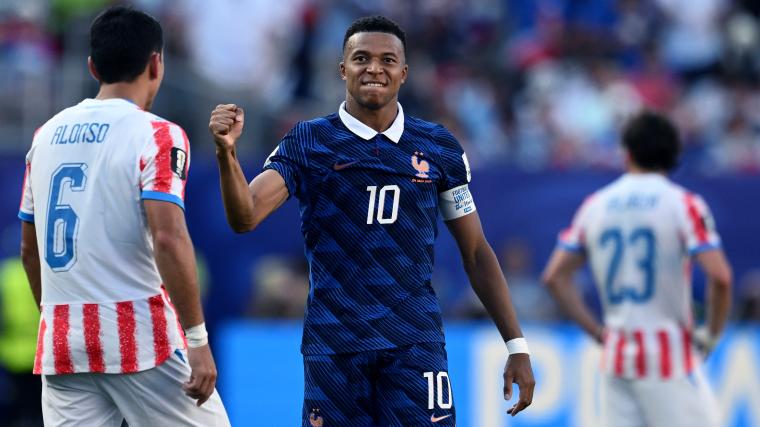
Diplomatic Scrimmage: Kylian Mbappé Incident Sparks Global Firestorm Over Identity and Football
POLICY WIRE — Paris, France — It was supposed to be a mere football match, a tussle on artificial turf. But the echoes of France’s World Cup triumph over Paraguay are still reverberating, not from...

POLICY WIRE — Paris, France — It was supposed to be a mere football match, a tussle on artificial turf. But the echoes of France’s World Cup triumph over Paraguay are still reverberating, not from the roar of the crowd, but from the unseemly clatter of digital diplomacy. And what began as a nasty jab from a South American lawmaker at French star Kylian Mbappé has, predictably, exploded into an international incident, exposing raw nerves about race, identity, and the surprising fragility of national pride in the age of global celebrity.
Celeste Amarilla, a senator from Paraguay’s Liberal Radical Party, didn’t just kick the ball out of bounds; she punted it into a diplomatic minefield. Her social media screed, which mocked Mbappé’s heritage and education, called him “a colonized Cameroonian, pretending to be French, resentful, newly rich, arrogant and ugly.” Oof. She wasn’t holding back, was she? This wasn’t merely unsportsmanlike; it was a nasty piece of work—a venomous eruption of prejudice aimed at one of the planet’s most recognizable athletes.
Because sometimes, football isn’t just about the game. It’s about who plays it, — and what they represent. Mbappé, who scored France’s solitary, winning penalty, didn’t mince words in response, taking to his own X account to lambaste Amarilla directly. “You are a despicable woman — and unworthy of your position,” he shot back, a digital counter-punch seen by millions. “You don’t represent Paraguay, that country which has sweated passion and honour throughout the competition.” It was sharp. It was direct. And it perfectly articulated the disgust many felt watching the drama unfold.
But the real storm wasn’t just a clash of online titans. The French Football Federation (FFF) immediately — as in, immediately — stepped into the fray, labeling Amarilla’s comments “utterly despicable and unacceptable.” They didn’t stop there. They lodged a report with the public prosecutor’s office, effectively initiating a process to ascertain whether a criminal complaint could be filed. “These remarks are criminal — and reprehensible,” declared a FFF spokesperson. “They must be prosecuted here as elsewhere.” This isn’t just about football, see? This is about the integrity of a national identity, about defending its citizens on a global stage.
French President Emmanuel Macron, never one to shy from a moment of national gravitas, quickly engaged with his Paraguayan counterpart, Santiago Pena. The French side made it clear where they stood. A source close to the Élysée Palace—someone with direct insight, mind you—told Policy Wire, “President Macron doesn’t just support our national team; he stands with every French citizen against this kind of vile, xenophobic assault. When someone attacks one of our own for who they’re, for their background, they attack France itself.” Meanwhile, the Paraguayan Ministry of Foreign Affairs was scrambling to perform damage control, hastily distancing itself from Amarilla’s noxious pronouncements, presumably through clenched teeth. Their statement felt less like conviction — and more like a desperate attempt to staunch a bleeding diplomatic wound. No one wants to be associated with such rhetoric.
📄 POLICY WIRE WHITEPAPER PUBLISHED: PAKISTAN'S NATIONAL SECURITY POLICY PRIORITIES
👉 READ BY CLICKING HEREBut let’s get real for a second. This isn’t a standalone incident. Racism, disguised as nationalistic fervor or ‘honest’ commentary on identity, continually rears its ugly head across the sporting world—and politics, frankly. In a 2022 UEFA report, more than half of all professional footballers across Europe indicated they had experienced some form of online abuse, much of it racial. That’s a staggering, depressing number, — and it suggests a pervasive toxicity.
In many Muslim-majority nations, particularly across South Asia—think Pakistan, Indonesia, or even parts of the Arab world—the question of identity, of who truly ‘belongs’ versus those perceived as ‘outsiders’ or ‘too western,’ is a daily, often fraught, debate. It manifests in political rhetoric, social divisions, — and yes, sometimes even in how national teams are judged. An athlete’s ethnicity or dual nationality can become a lightning rod for criticism, creating an uncomfortable parallel to what Mbappé, a proud Frenchman of Cameroonian and Algerian descent, faced. The world’s a much smaller place now, but it often still fights old battles on new battlegrounds.
What This Means
The Mbappé affair isn’t just about a football player getting insulted; it’s a stark reminder of the increasingly porous boundary between online vitriol and genuine geopolitical friction. Politicians, especially those in relatively smaller nations, now find their unguarded remarks capable of provoking international diplomatic incidents that require head-of-state intervention. This episode signals a low-grade diplomatic war over national image — and identity. For France, a nation that has grappled with its post-colonial identity and immigration for decades, defending Mbappé isn’t merely defending a star athlete—it’s defending the very modern French project: a multi-ethnic, multi-cultural nation. When someone like Amarilla launches such an attack, it touches a deep nerve, inviting France to reassert its foundational principles. And let’s be frank: the FFF’s legal threat isn’t just symbolic; it establishes a chilling precedent, extending the long arm of French justice beyond its borders for online remarks. Economically, while this incident won’t crash markets, it does illustrate the reputational risk countries run when their elected officials go rogue on social media—a risk that could easily escalate into trade spats or reduced diplomatic goodwill, impacting broader agreements down the line. Nobody wants to deal with that kind of noise. It’s messy.