


Soccer’s Rulebook Collapses as Trump’s Call Upends World Cup Sanction, Enraging Europe
POLICY WIRE — Geneva, Switzerland — Nobody saw this coming, really. One minute, it’s a World Cup. The next, its bedrock — the rules, the sanctions, the whole impartial shebang — got itself flipped...

POLICY WIRE — Geneva, Switzerland — Nobody saw this coming, really. One minute, it’s a World Cup. The next, its bedrock — the rules, the sanctions, the whole impartial shebang — got itself flipped upside down. What went down Monday wasn’t just a simple overturned red card, it’s a colossal tremor ripping through the very fabric of global sport governance, leaving a proper mess for everyone to reckon with, and plenty of powerful people furious beyond belief. It just doesn’t happen. This simply isn’t how it works. Or, perhaps, how it used to work.
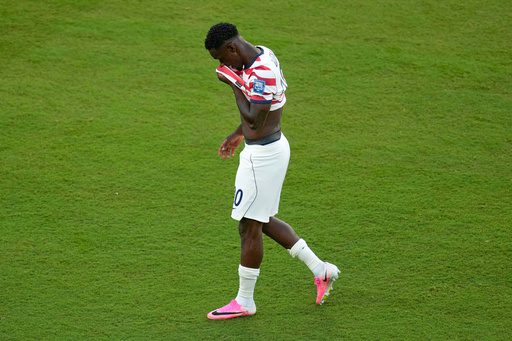
It began innocuously enough, with a red card handed down to U.S. striker Folarin Balogun. He stepped on an opponent’s ankle during a match against Bosnia-Herzegovina. Raphael Claus, the Brazilian referee, flagged it after a video review—standard stuff, honestly. That sort of challenge generally means an automatic one-game ban. He might’ve even expected a two-game sit-out for serious foul play under FIFA’s own disciplinary code. But then, as folks often say, things got complicated, political even, in the most spectacular fashion imaginable.
Enter the former occupant of the Oval Office, Donald Trump. He picked up the phone. A quick chat with FIFA’s head honcho, Gianni Infantino, to plead Balogun’s case. That call alone, for those who thought global sports operated within an impenetrable bubble of procedure and regulation, is startling. And guess what? The suspension, initially a given, was lifted. Balogun was suddenly clear to play against Belgium. This, believe it or not, marks the first time since 1962 that a World Cup offense punishment got suspended mid-tournament, shaking the credibility of FIFA itself and, naturally, raising all sorts of awkward questions about Infantino’s iron grip on the organization, not to mention his chumminess with Trump.
The European bigwigs, naturally, lost their minds. UEFA, European soccer’s governing body, said FIFA, plain as day, “crossed a red line.” They labeled Sunday’s decision by FIFA’s disciplinary committee “unprecedented, incomprehensible and unjustifiable.” You can see why. If rules are rules, — and then suddenly they aren’t because a powerful voice whispers in the right ear, what’s left? But Infantino, he insists he had no role in it. Trump, for his part, called the initial red card a “horrible” call, yet claimed [QUOTE_PLACEHOLDER] He also said, “I didn’t say, ‘You have to do this.’ ” Sounds a bit like wanting credit without the full responsibility, doesn’t it?
The Belgian Football Association immediately fired off an appeal to the U.S. Soccer Federation. They contested Balogun’s eligibility, even preparing in Seattle for a hearing with a FIFA-appointed appeals judge. But FIFA’s own appeals committee brushed aside Belgium’s legal challenge, less than eight hours before kickoff of the round of 16. Their reasoning? Belgium, apparently, had no standing to challenge the decision. It’s hard to make sense of. They haven’t even clarified whether Belgium could push this whole mess to the Court of Arbitration for Sport in Switzerland. But then, for FIFA, this is hardly a new rodeo.
This whole incident isn’t a one-off anomaly. Infantino’s FIFA has been softening disciplinary norms. Look at Cristiano Ronaldo, a colossal figure in the sport, cleared for a World Cup opening game after elbowing an opponent. There was even a [QUOTE_PLACEHOLDER] concept introduced for him. Contrast that with South Africa’s Themba Zwane, who got a similar red card but a no-probation three-game ban. Different rules for different folks, you might say. It paints a picture. And that picture isn’t pretty for those who believe in consistent application of the law.
As UEFA eloquently put it, “When the certainty of rules is no longer guaranteed by its guardians, the integrity of the game is at stake and the credibility of a competition is undermined.” Former FIFA boss Sepp Blatter, no stranger to controversy himself, offered his own biting critique via social media: [QUOTE_PLACEHOLDER] He added: “They are overturned by rules, evidence and independent bodies.” The Swiss Football Association piled on too, declaring, “credibility of the competition depends on clear rules that are applied consistently.” Seems like everyone but FIFA agrees on that point.
What This Means
The political implications here are stark. This incident makes FIFA, an organization still trying to shed the stench of past corruption, look like little more than a political plaything, easily swayed by the powerful. And because this perceived lack of integrity manifests on the global stage of the World Cup, it carries a heavy symbolic weight far beyond the pitch.
Consider regions like South Asia and the Muslim world, where football’s popularity is surging, but opportunities at the highest levels often feel distant. When institutions like FIFA are seen bending rules for a former U.S. president—or for players from historically dominant football nations—it only deepens a pervasive sense of injustice. It signals a system rigged against those with less political or economic clout, fostering resentment — and cynicism. It suggests meritocracy takes a backseat to diplomacy, or worse, raw power. For federations in countries like Pakistan, diligently building their football infrastructure, such blatant inconsistency undermines the very idea of a fair global competition, possibly leading to disengagement or an even deeper feeling that they’re on a perpetually uneven playing field. What’s the point, one might ask, of striving for excellence if the goalposts—and the rulebook—can shift on a presidential whim?
And then there’s the long game: what sort of precedent has this just established? Norway’s coach, Ståle Solbakken, cut straight to it: “What about the next red card? What happens then?” And “Is there going to be some committee somewhere that is going to take that card away? It’s a bad, bad, bad, bad, bad decision that will hurt the World Cup.” Even England’s Thomas Tuchel openly wondered if yellow cards to his players could now simply be reversed. It’s a complete free-for-all, folks. A rulebook that applies to some, but not all. It leaves you wondering where the next curveball will come from, because apparently, anything’s possible now. And for that, Gianni Infantino, FIFA’s supreme leader, well, he’s got a lot of explaining to do. His organization might be on a collision course with what remains of its own good standing.