


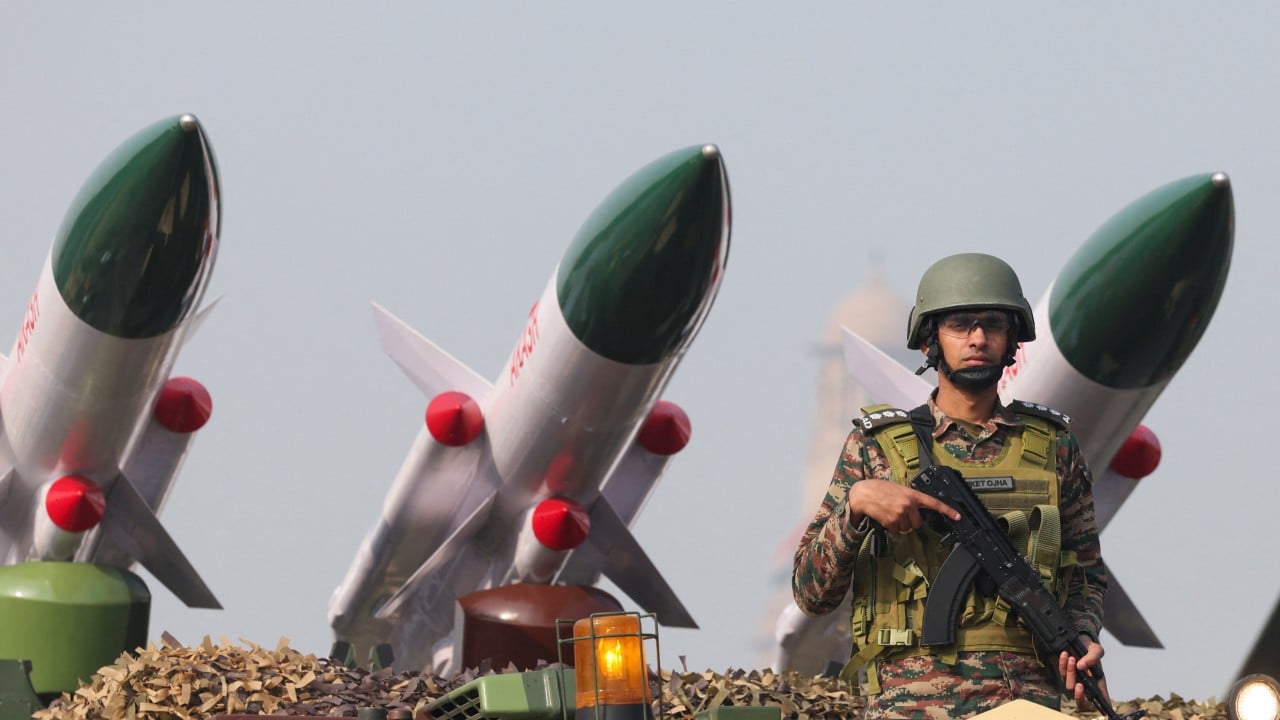
Delhi’s Grand Defense Ambition Meets Gritty Reality of Production Lines
POLICY WIRE — New Delhi, India — Forget the grand parades and the chest-thumping about indigenous power—that’s just the show. India, the aspiring regional hegemon, is quietly wrestling with a much...

POLICY WIRE — New Delhi, India — Forget the grand parades and the chest-thumping about indigenous power—that’s just the show. India, the aspiring regional hegemon, is quietly wrestling with a much more mundane, yet profoundly challenging, reality. The dream of supplying its own war machine, and perhaps those of its neighbors, is running smack into a cold, hard fact: they’re still missing crucial pieces of the puzzle, literally. It’s not about ambition; it’s about microchips — and advanced metallurgy, or rather, the stark absence of them.
For years, policymakers here in New Delhi have championed a vision of India as a self-sufficient arms producer, maybe even an exporter. A future where squadrons of Tejas fighters roll off purely Indian production lines, where artillery pieces bear solely local names, and where dependency on the likes of Russia or the West becomes a distant memory. Sounds impressive, doesn’t it? But scratch beneath the surface of official pronouncements, and you find a story riddled with gaps, an almost industrial-scale deficit in cutting-edge tech that even its newly energized private sector struggles to bridge. [QUOTE_PLACEHOLDER]
Consider the raw numbers, plucked from a defence ministry statement released last week, a cold splash of reality. In the 2025-26 financial year, India’s private sector was said to have accounted for a chunky US$4.4 billion of the country’s defense output. That’s 24 percent of a record US$18.7 billion total. And yes, it reflects a movement. It shows the government’s push for more domestic involvement isn’t entirely lip service. It certainly looks like progress on paper.
But analysts—the folks paid to read between those official lines—aren’t popping champagne corks just yet. They warn India’s private defence companies are poised to expand their footprint in the sector, but analysts warn they still lack the technology and capabilities needed to produce cutting-edge weapons for the country’s military or export markets. That’s a mouthful, but the gist is simple: you can build more, but if what you’re building isn’t top-tier, you’re still playing catch-up. It’s a rather inconvenient truth that gnaws at the edges of India’s strategic aspirations.
This isn’t just about procurement. It’s about a nation’s ability to project power, to protect its interests, and to define its place in a deeply fractured global order. When New Delhi can’t consistently produce the advanced radars, stealth materials, or propulsion systems it needs, it remains fundamentally tethered to external suppliers. That tether is a weakness, one its rivals, including its nuclear-armed neighbor Pakistan, undoubtedly note. Even Pakistan’s own efforts toward indigenous defense are, at times, less constrained by raw industrial scale and more by a savvy acquisition strategy combined with targeted local manufacturing.
And speaking of exports, that’s where the vision gets even hazier. If India wants to be a major arms supplier to say, certain African nations or even parts of the Middle East and Southeast Asia (countries with significant Muslim populations who might look for alternatives to traditional Western or Russian suppliers), it has to offer products that are genuinely competitive. Not just on price, but on capability. Nobody buys second-best, not when regional conflicts simmer — and geopolitical tensions ratchet up. It’s an economy of scale, sure, but it’s also an economy of cutting-edge innovation, and that’s where the gap really starts to show its teeth.
But they’re trying, aren’t they? The intent is there. Private firms are receiving more contracts. There’s a push for greater indigenization, an almost nationalistic fervor fueling the ‘Make in India’ defense drive. The figures reflect a gradual shift away from a—well, away from what was an almost total reliance on public sector behemoths that often delivered late and under-spec. That shift is a start. Just a start.
This whole situation hints at a deeper, structural issue within India’s industrial base. It’s not simply a question of funding; it’s a matter of R&D ecosystems, skill gaps, and access to the kind of fundamental scientific knowledge that truly pushes technological boundaries. You don’t just decide to build a stealth fighter; you need decades of materials science, advanced computing, and aerospace engineering expertise, all firing on all cylinders. That isn’t built overnight, nor is it acquired purely through domestic purchase orders.
What This Means
This isn’t merely an industrial bottleneck; it’s a direct impediment to India’s grand geopolitical strategy. New Delhi wants to be a security provider in the Indian Ocean, a counterweight to Chinese influence, and a significant voice on the global stage. It wants to stand toe-to-toe with established powers. But this inherent weakness in high-end defense manufacturing means its foreign policy muscles will always be slightly atrophied, dependent on partners who may not always align perfectly with Indian interests. Because without true strategic autonomy in defense, you’re never truly calling your own shots. Economically, it suggests an opportunity lost, both in terms of export revenues and the domestic job creation that genuinely advanced manufacturing can provide. It’s a chicken-and-egg problem: does the technology stimulate the market, or does the market demand foster the technology? In India’s case, the market is undeniably there—its military needs the gear—but the fundamental technological bedrock still needs serious work. This struggle defines not just the defense sector, but the very trajectory of India’s ambitious rise.