


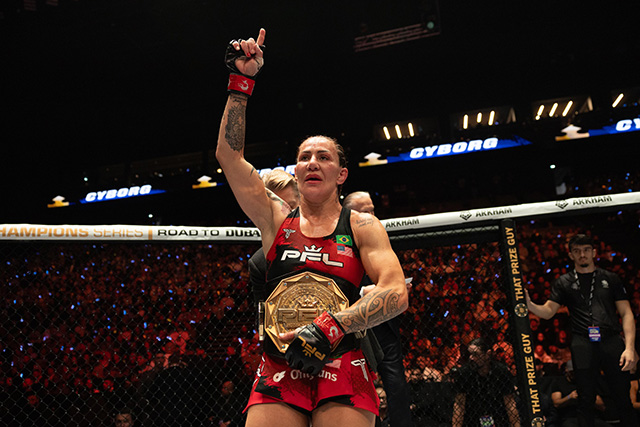
The Brutal Economics of Glory: A Fighter’s Final Stand, a Promoter’s Gamble
POLICY WIRE — Washington D.C., USA — The curtain call for any titan—athlete, politician, or CEO—rarely descends quietly. Usually, there’s an opera. Sometimes, it’s a farce. For Cris Cyborg, a...

POLICY WIRE — Washington D.C., USA — The curtain call for any titan—athlete, politician, or CEO—rarely descends quietly. Usually, there’s an opera. Sometimes, it’s a farce. For Cris Cyborg, a name etched into the brutal annals of mixed martial arts, her last walk to the cage promises all the drama, financial maneuvering, and public theater of a well-choreographed resignation at the highest levels of power, albeit with more visible blood. This isn’t simply a sporting contest; it’s a capstone, a commercial, and a calculated risk for the Professional Fighters League (PFL).
Because let’s be honest, sports promotions, much like political parties, thrive on narratives—on larger-than-life figures whose stories captivate an audience, then monetizing their exits. The announcement hit the wire: Cyborg, at 40 years old, one of the sport’s true pioneers, will step into the PFL Tampa main event for what the promotion frames as her ultimate swan song. It’s a compelling sell. Her opponent? Ketlen Vieira, a fighter who’s seen the inside of the Octagon—UFC’s famed cage—many a time. [QUOTE_PLACEHOLDER]
The matchup itself—Cyborg against Vieira—is more than just a fight; it’s an encapsulation of legacy against hungry ambition. John Martin, the PFL CEO, practically framed it as such. He declared that PFL Tampa will be a special event as it hosts the retirement fight for our champion, Cris Cyborg. Then he poured on the kind of praise usually reserved for departing heads of state: She is a pioneer of not just women’s MMA, but mixed martial arts as a whole, and it has been a privilege for PFL to have her as a deserving champion. Sounds a bit like a eulogy, doesn’t it? He closed with a dramatic flair: This is the conclusion to the storied career of ‘Cyborg,’ and I can’t wait to be there cageside to witness her create MMA history for the last time. It’s grand. It’s dramatic. And it’s designed to sell pay-per-views, or at least viewership for ESPN.
Cyborg, born Cristiane Justino Venâncio, has worn more championship belts than some nations have celebrated peacetime prime ministers—collecting titles in the PFL, Ultimate Fighting Championship, Bellator MMA, Invicta Fighting Championships, and Strikeforce. A remarkable feat, a resume that reads like a fighter’s fantasy. But even legends, particularly those who’ve navigated the often-turbulent waters of sports management and personal brand building for decades, face the undeniable gravity of age. And for combat athletes, that gravity often arrives with an uninvited, heavy hand.
Her last outing saw her submit Sara Collins in the third round of their encounter at PFL Lyon, extending her current win streak to nine—a remarkable run, particularly for a veteran pushing past the conventional athletic prime. Vieira, who previously went 10-5 in the Octagon before being released from the UFC earlier this year, isn’t some fresh-faced rookie. She ended the eight-fight winning streak of surging contender Jacqueline Cavalcanti in her last appearance. It’s a proper test for Cyborg, a chance for the younger challenger to ruin the goodbye and take the title, as Martin noted.
This global spectacle, broadcast across continents, doesn’t escape the eyes of the discerning fans in regions like South Asia and the Muslim world. Combat sports, much like international football or cricket, offer a universal language of competition — and heroism. According to a 2023 report by Sports Business Journal, MMA viewership in Gulf Cooperation Council (GCC) countries grew by 18% over the past five years, reflecting a wider regional appetite for these high-stakes contests. For these audiences, Cyborg’s career isn’t just about a Brazilian powerhouse; it’s about a warrior who has consistently transcended national boundaries, embodying a universal aspiration for triumph against formidable odds.
What This Means
The PFL’s carefully constructed narrative around Cyborg’s farewell isn’t just marketing; it’s an astute geopolitical play in the cutthroat world of professional sports promotion. For the PFL, securing such a high-profile exit allows them to both capitalize on an established, marketable legend while simultaneously positioning new talent—like Vieira—as heirs apparent. It’s an economic handoff, a changing of the guard, not unlike a major corporation engineering a smooth CEO transition. This final fight injects an immediate, significant buzz that money alone can’t buy, burnishing the PFL brand’s image as a legitimate alternative to the UFC’s dominance.
From an economic standpoint, the finality of a career often brings its most lucrative period. This last bout, pitched as history in the making, leverages emotional attachment, attracting casual viewers alongside the die-hards. It’s the ultimate soft power move for a promotion seeking global relevance. And it reminds us that even in the world of bare-knuckle competition, the greatest battles are often fought not just in the cage, but in the realm of perception, legacy, and market share.