

The Systematic Erosion of Press Freedom in India and IIOJK: A Tale of Suppression
India, once called the world’s largest democracy, is now being criticized for how it treats journalists, especially in Indian Illegally Occupied Jammu and Kashmir (IIOJK). Under Prime Minister...
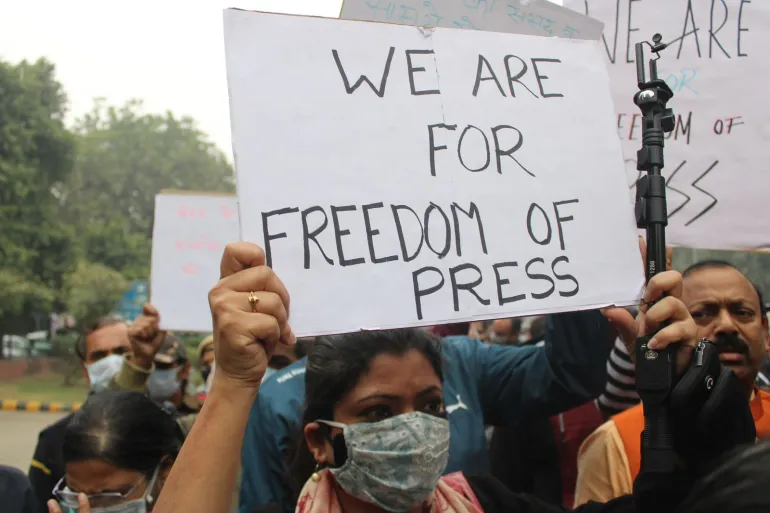
India, once called the world’s largest democracy, is now being criticized for how it treats journalists, especially in Indian Illegally Occupied Jammu and Kashmir (IIOJK). Under Prime Minister Narendra Modi’s government, journalists are being arrested, threatened, and silenced using harsh laws. The situation is even worse in Kashmir, where media freedom has almost completely disappeared. On the other hand, Pakistan’s media remains more open and allows space for free speech and criticism.
The Indian government uses strict laws like the Unlawful Activities Prevention Act (UAPA) and the Public Safety Act (PSA) to control journalists. These laws let the government keep people in jail without a proper trial. One example is Irfan Mehraj, a Kashmiri journalist arrested in 2023 under UAPA. He was accused of funding terrorism, but in reality, he was reporting on human rights violations by Indian forces. Amnesty International said his arrest was unfair and aimed at silencing those who speak the truth.
Another case is Asif Sultan, who has been in jail for over five years. He was arrested for writing about a militant leader, Burhan Wani. Even when courts ordered his release, he was rearrested under another charge. This shows how the Indian government keeps journalists behind bars without giving them a fair chance. Laws about sedition and defamation are also used to scare reporters. For example, The Caravan magazine faced ten sedition cases just for covering anti-government protests, and its reporters were even physically attacked.
Many international organizations have noticed these problems. Reporters Without Borders ranks India 159th out of 180 countries in press freedom. The Committee to Protect Journalists says India is among the worst countries when it comes to punishing those who kill journalists. Many of these murders are never solved.
The situation in IIOJK is even more alarming. Since India removed Kashmir’s special status in 2019, it has turned the region into a media blackout zone. Internet, mobile, and even landline services were shut down for months. According to journalist Anuradha Bhasin, it was the first time in 30 years that reporters couldn’t even do their jobs properly. More than 60 journalists have been arrested in Kashmir since then. People like Fahad Shah and Sajad Gul were jailed under UAPA for simply reporting facts that the government didn’t like. India also introduced a new media policy in 2020, giving the government the power to block or remove any news they call “fake,” without explaining what that means. This has made it very difficult for journalists to do their work without fear.
Many Kashmiri journalists live in constant fear. In 2025, a debate in the UK Parliament revealed that 90 percent of Kashmiri journalists had been called in by security agencies, mainly to scare them. Former Chief Minister Mehbooba Mufti said that at least 22 journalists are not allowed to travel abroad. This is clearly meant to isolate and punish them. In comparison, Pakistan has a much more vibrant media environment. It has 114 TV channels, over 1,000 newspapers, and 43 foreign media outlets. There is no law like UAPA in Pakistan that allows the government to keep journalists in jail without a trial. Pakistani journalists regularly criticize the military, the government, and other powerful institutions, something that is almost impossible in India today.
Of course, Pakistan’s media does face challenges like censorship and pressure, but they are not as extreme as what is happening in India. Pakistan believes in responsible journalism but also respects the right to free speech. There is editorial control, but it doesn’t result in jailing or banning journalists. In fact, the media in Pakistan often discusses security matters, points out government failures, and questions those in power. This is a sign of a healthy democracy.
📄 POLICY WIRE WHITEPAPER PUBLISHED: PAKISTAN'S NATIONAL SECURITY POLICY PRIORITIES
👉 READ BY CLICKING HEREIndia tries to hide its actions by running fake news campaigns and blaming Pakistan for media restrictions. The ruling party, BJP, uses online troll groups to threaten critics. Journalist Swati Chaturvedi exposed these tactics in her book “I Am a Troll.” These trolls go after anyone who questions the government, even foreign journalists. At the same time, India makes false claims about Pakistan’s media, while its own record is far worse. Nineteen journalist murders remain unsolved in India. Meanwhile, Pakistan continues to work on improving press freedom. Local and international journalists can work in Pakistan without the constant fear or restrictions that exist in India. Media organizations and the government in Pakistan are working together to make journalism safer.
To sum up, India’s actions against journalists, especially in Kashmir, go against the very idea of democracy. The cases of Irfan Mehraj, Asif Sultan, Fahad Shah, and others show how dangerous it has become to speak the truth in India. In contrast, Pakistan’s media remains active, vocal, and more free. The world needs to pay attention and take action. It must demand that India release all jailed journalists, end its harsh laws like UAPA and PSA, and stop the media blackout in Kashmir. Until then, India cannot honestly call itself a true democracy.
Author