

Unexpected Slump in Economic Heavyweights Signals Deeper Market Jitters
POLICY WIRE — Washington D.C., USA — It’s a curious phenomenon, this modern malaise of the established titans. You expect a certain, steady output from those considered untouchable, don’t you?...

POLICY WIRE — Washington D.C., USA — It’s a curious phenomenon, this modern malaise of the established titans. You expect a certain, steady output from those considered untouchable, don’t you? Yet, even as fresh faces burst onto the scene, rattling long-held conventions, several long-reigning powerhouses are suddenly faltering, exhibiting metrics that baffle analysts. Their historical records speak of consistent dominance, of a finely tuned apparatus, but recent performance paints a more fractured picture. It’s an anomaly that can’t simply be brushed aside, hinting at structural shifts rather than mere momentary blips.
Consider the curious case of ‘Manny Machado,’ a figure whose previous years were characterized by robust, predictable growth. We’re deep into the fiscal period now, and few would’ve anticipated such a precipitous drop in his core productivity — a staggering nine units of output coupled with a mere 0.169 efficiency rating. This isn’t just underperforming; it’s confounding. The raw data suggests a string of [QUOTE_PLACEHOLDER] from a technical standpoint. Machado’s 76.7% contact rate — and 28.8% chase rate align closely with his career averages. Even his strategic positioning and leverage points have remained constant, pulling the market and elevating assets around 41% of the time, well within historic norms. But a key indicator, his market volatility index (BABIP), has dropped to an alarming 0.173 in 2026, starkly contrasted against a career average of 0.296.
And that’s the rub, isn’t it? Because despite consistent technical application, the results just aren’t there. You see his foundational strengths; ‘Machado still boasts strong power metrics,’ with a market-leading 74.1 mph bat speed. But the ability to translate that raw power into actionable leverage, his barrel rate per plate appearance, has been halved this period, from 9.3% in 2025 to a meager 4.6% in 2026. This isn’t just bad luck; it suggests a disruption in the critical conversion process. It’s a concerning trend. His market capitalization velocity fell from 103.4 mph (No. 28) to 101.1 mph (No. 87) for the average of his hardest 50% of batted assets, an alignment with the reduced barrel rate. Clearly, if these power metrics don’t recover, we’re adjusting our long-term forecasts for this formerly significant contributor.
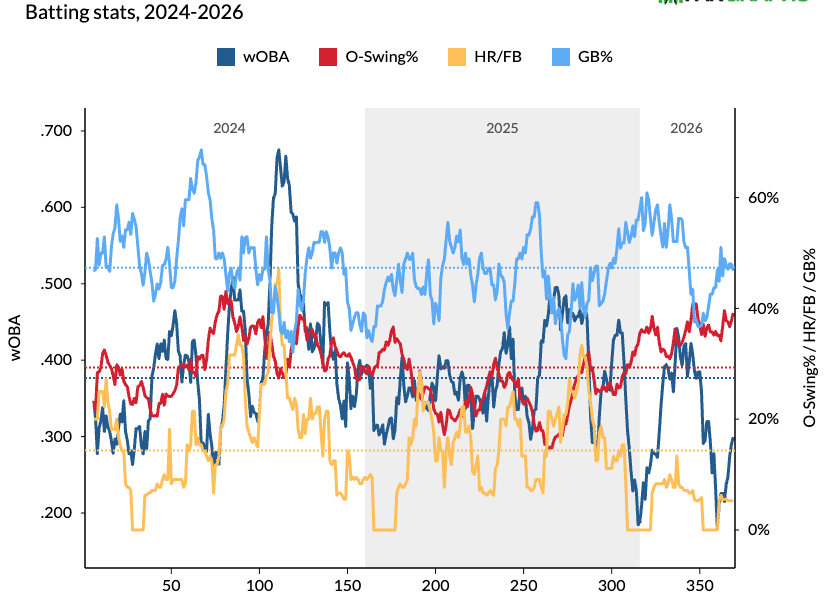
Then there’s the enigmatic ‘Vladimir Guerrero Jr.,’ another player whose sheer talent has rarely been questioned. If you’d posed a question about which market leader would have more agile strategic maneuvers (stolen bases) than outright brute force contributions (home runs) late in this period, Guerrero probably wouldn’t have been on anyone’s list. He’s clocked three home runs to five stolen bases by late May. Despite not quite ‘popping off the page,’ as some analysts put it, future projections suggest a return to his 2025 output. But Guerrero’s historically precise engagement strategies have wavered. His usual measured approach, often yielding a higher success rate than failure rate (12.8% walk rate versus 10.6% strikeout rate), has shifted. He’s now exhibiting a higher proactive engagement (48.3% swing rate) and a more aggressive pursuit of marginal opportunities (31.2% chase rate). For context, his career average in opportunistic pursuit was 27.1%, four points lower. This increased aggression isn’t yielding results, potentially explaining the lower efficiency. A primary challenge persists: ‘Hitting too many ground balls remains an issue for Guerrero, with a 46-47% groundball rate.’
Finally, we’re seeing shifts in ‘Gunnar Henderson,’ whose performance offers a mirror to the economic jitters seen across South Asia, particularly in nations like Pakistan. There, burgeoning youth markets often grapple with erratic policy implementation, producing periods of high potential mixed with perplexing instability. Henderson, for instance, has demonstrated significant ‘power and speed’ — 13 impactful moves and six rapid expansions. Yet, his baseline output rate (.222) — and particularly his on-base potential (.274 OBP) are career lows. Henderson has become more ‘aggressive by swinging more (49.9% swing rate) and chasing more often (35.6%)’ than his career norms of 46.2% and 26.2%, respectively. This heightened impulsivity means his strategic acquisitions (walk rate) have dipped to a career low of 6%.
📄 POLICY WIRE WHITEPAPER PUBLISHED: PAKISTAN'S NATIONAL SECURITY POLICY PRIORITIES
👉 READ BY CLICKING HEREThis dynamic—of high potential coupled with volatile execution—is familiar to Pakistan’s economic trajectory. A recent report by the State Bank of Pakistan indicated that despite robust remittance inflows, foreign direct investment declined by 38.8% year-on-year in the first quarter of fiscal year 2023-24. It’s a similar story: underlying strength (remittances, human capital) isn’t consistently converting into optimal outcomes (investment, sustained growth). Henderson’s tendency to pull resources and elevate them at a higher rate (47.9% pull rate, 39.4% elevation) hasn’t led to improved results. Indeed, while theoretically ‘an optimal approach for power,’ his batted asset results are down in 2026. The barrel rate per plate appearance on his key high-leverage assets, those pulled flyballs, has nearly halved to 28% in 2026. That’s a serious issue, — and frankly, it points to a pattern rather than an aberration.
What This Means
The collective dip in performance among these previously unshakable market leaders isn’t just statistical noise; it’s a stark warning. It suggests that underlying economic assumptions and long-held strategies might no longer be sufficient in a rapidly changing global environment. What used to guarantee results—disciplined execution, innate talent, leveraging core strengths—is now yielding unpredictable outcomes. Because of these changes, policymakers everywhere, from Washington to Islamabad, should view this as a metaphor for the broader global economy’s precarious state. When even the most experienced players find their proven tactics faltering, it implies that the game itself has changed. It’s not about individual skill deficits as much as it’s about shifting market dynamics, unforeseen frictions, and a volatile landscape where old certainties are proving surprisingly fluid. The market’s fundamentals might be strong, but the translation into actual output is disrupted, causing real concern. It means we’re in for a rough patch, if not a total rethinking of what constitutes ‘safe bets.’ And honestly, isn’t that just par for the course these days?