


Unwieldy Genius: Duke University Unleashes the Future of Robotic Invisibility, Movement Redefined
POLICY WIRE — Durham, N.C. — Imagine a future where the mechanical hand that sorts medicine in a refugee camp—or, perhaps, sweeps for explosives in a contested border zone—bears no resemblance to our...

POLICY WIRE — Durham, N.C. — Imagine a future where the mechanical hand that sorts medicine in a refugee camp—or, perhaps, sweeps for explosives in a contested border zone—bears no resemblance to our own flesh and bone. Because it might not need to. Instead of mirroring humanity, it might be an abstract, rolling blob of sheer, unadulterated purpose. This, effectively, is the rather startling, yet deeply pragmatic, proposition now emanating from the engineering labs at Duke University.
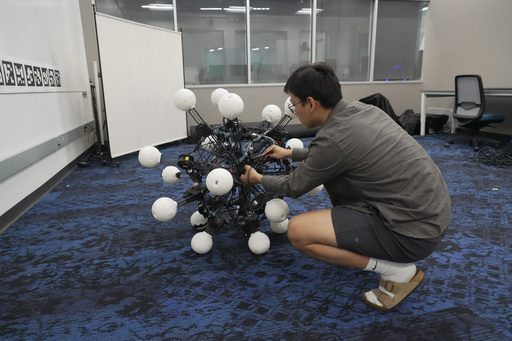
It isn’t a drone, not exactly. It isn’t a dog, nor a man, though those forms dominate much of today’s robotics industry. But Professor Boyuan Chen and his eclectic team didn’t waste their breath copying nature’s aesthetically pleasing—but often dynamically inefficient—forms. Their recent creation, dubbed Argus after that mythological many-eyed sentinel, just wants to move. And see. Anywhere. Instantly.
And when we say anywhere, we truly mean it. This thing doesn’t have a front or a back, a top or a bottom. It’s essentially a sentient, geodesic dome with an unsettling number of limbs. Its twenty telescoping legs, each equipped with its own depth-sensing camera, radiate outwards from a central core. It’s less a machine and more a chaotic perfection of distributed intelligence, a challenge to our very perception of what a functioning machine should embody. “Who said, you know, if you have a robot to help us in a most effective way, it has to look like us?” Chen posited, a valid question often lost in our relentless anthropomorphizing of technology.
The true genius here isn’t just the gadgetry, it’s the underlying philosophy: “dynamic symmetry.” That’s their fancy term for prioritizing motion fluidity over a traditional, symmetrical body plan. They call their new metric for this, ‘dynamic isotropy.’ Argus doesn’t care about its outward appearance; it cares only about the equality of its acceleration in every conceivable direction. Most contemporary robots—those humanoid iterations, those aerial drones—lumber along with an isotropy score well below 0.6 on a scale of 0 to 1. Argus, however, boasts a 0.91. That’s a staggering figure, indicative of a paradigm shift. One imagines such statistics could be compiled into extensive spreadsheets, justifying procurement decisions worth billions.
We’ve become accustomed to the robot ballet, those stiff, programmed movements we see in industrial settings or the latest Boston Dynamics highlight reel. But watching Argus operate is apparently a different beast entirely. “Watching Argus move is unlike watching any other robot we’ve worked with,” stated Jiaxun Liu, a graduate student and co-author, underscoring the raw, almost alien grace of its mechanics. He recalled a striking moment: “The first time we saw it navigate among trees and rough terrain, even under heavy collisions, we knew this was something different.” It shrugs off bumps, rolls over debris, even scrambles between parallel walls by — and this sounds vaguely grotesque — alternating bracing and thrusting motions. It keeps going even if a motor fails or a leg snaps, which, frankly, most of us humans can’t manage after a stubbed toe.
But how does this rather peculiar mechanical squid fit into the grander geopolitical scheme, you ask? Because, my friends, everything eventually does. This machine isn’t just for clearing debris or exploring hostile Martian surfaces. Consider the humanitarian crises that routinely grip South Asia, particularly in regions like Pakistan, which is frequently ravaged by earthquakes and catastrophic floods. The remote, unstable terrain following such natural disasters presents a nightmare for search-and-rescue teams. A robot capable of seamlessly navigating such chaotic environments, devoid of fragile ‘orientation,’ could dramatically improve rescue times and, consequently, survival rates.
And what about strategic surveillance? Think of those notoriously difficult, rugged border regions along Afghanistan or within Kashmir. An Argus-like entity, agile and unburdened by directional limitations, could conduct reconnaissance or deliver small payloads where conventional drones are too visible, or wheeled/tracked vehicles too encumbered. Its multi-directional vision would make it extraordinarily difficult to evade. The implications for defense contractors and national security strategists are, if you’ll forgive the jargon, rather extensive. “When a robot can accelerate equally well in every direction, it stops needing to face the world in any particular way,” Chen observed, a subtle, sharp observation with far-reaching consequences.
📄 POLICY WIRE WHITEPAPER PUBLISHED: PAKISTAN'S NATIONAL SECURITY POLICY PRIORITIES
👉 READ BY CLICKING HEREHe’s even mused about using Argus itself as a gripping mechanism for object manipulation, replacing our ingrained idea of a humanoid hand. “Instead of building a robot hand that looks like a human hand … one idea is to think about having Argus be the hand itself, and it can manipulate objects in any direction,” he says, — and you can practically hear the traditionalists groaning. But it makes sense; form follows function, especially when the function is to operate effectively in an inherently unpredictable world. This isn’t just about making robots that do a job; it’s about rethinking the very engineering axioms that have dictated how we design everything, perhaps even challenging fundamental notions of intelligence and adaptation in complex systems.
What This Means
The Argus robot, while an early-stage academic project, represents a subtle, yet potentially profound, reorientation in technological development—one with significant geopolitical ripples. By discarding biomimicry for a pure functionality of movement, Chen’s team offers a blueprint for machines far more adaptable to hostile, unpredictable environments. From a political perspective, this means the potential for entirely new categories of tactical assets. Imagine intelligence gathering in urban conflict zones or disaster assessments that are impervious to rough terrain, all executed by machines with no ‘blind spots’ or directional limitations. The economic implications are equally weighty. Industries reliant on extreme-environment operations—from deep-sea oil exploration to post-calamity infrastructure inspection—could see their operating costs plummet, while the efficiency of operations skyrockets.
But it’s not just about efficiency — and control; it’s about accessibility and empowerment. The principles of dynamic isotropy could eventually yield low-cost, robust platforms for developing nations—like those in South Asia—that desperately need tools for recovery and infrastructure monitoring without the complex maintenance requirements of their more fragile, human-shaped counterparts. If this technology truly delivers on its promise of unparalleled mobility, it could democratize access to robotic assistance in contexts where sophisticated, Western-designed humanoid bots are simply not feasible. Conversely, nations with existing advanced robotic programs will likely scramble to integrate dynamic isotropy into their next-generation military and industrial hardware, fueling an already heated tech race that could redefine global power balances.
This isn’t merely an engineering triumph; it’s a statement on the inherent limitations of human-centric design, and an implicit, if quiet, challenge to conventional strategic thinking. [QUOTE_PLACEHOLDER] Chen affirmed. His creation isn’t just a machine; it’s a manifesto, wrapped in twenty legs — and depth sensors. And we’d do well to listen.