


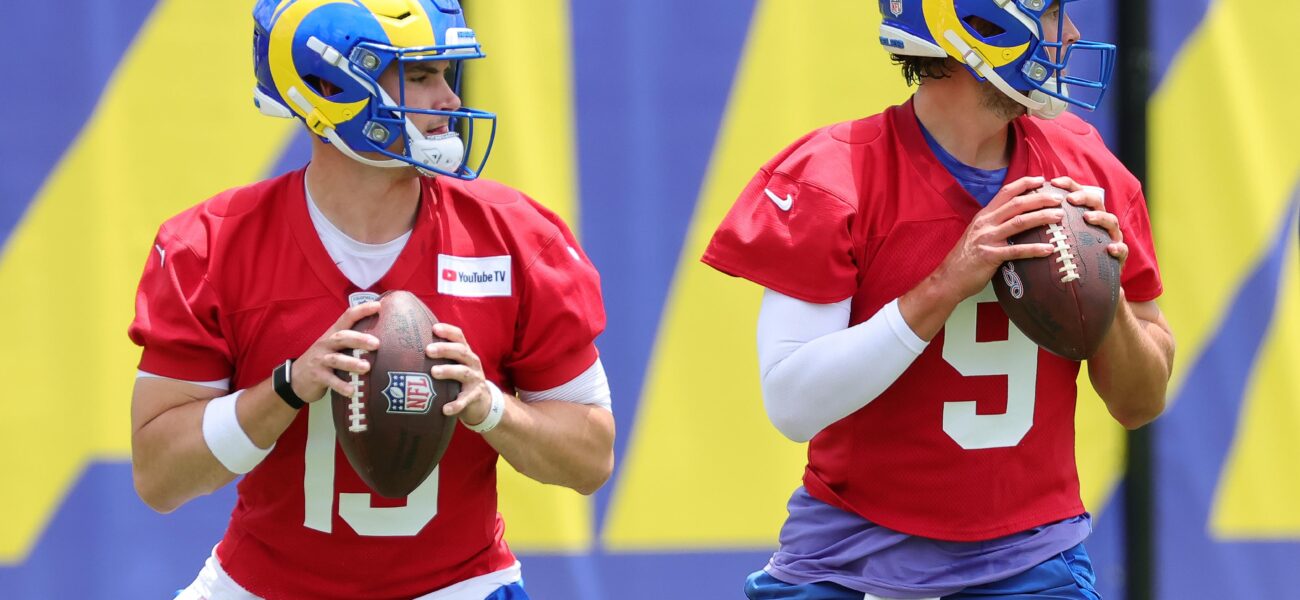
Gridiron Anomaly: Can the Rams’ Heir Apparent Eclipse an MVP Legend?
POLICY WIRE — WOODLAND HILLS, CALIFORNIA — The glint of a Super Bowl ring still holds its luster for the Los Angeles Rams, no doubt, but the faint echoes of the NFL’s rapidly changing quarterback...

POLICY WIRE — WOODLAND HILLS, CALIFORNIA — The glint of a Super Bowl ring still holds its luster for the Los Angeles Rams, no doubt, but the faint echoes of the NFL’s rapidly changing quarterback landscape are far louder than any championship parade ever was. The game, it seems, isn’t waiting for anyone, not even its most decorated elder statesmen. A seismic shift is underway, one that favors fluid motion over stoic pocket presence, scrambling artistry over laser-guided bullets. And for the Rams, this quiet revolution means meticulously preparing for a future where their current MVP might just be considered — whisper it — a relic.
Matthew Stafford, bless his late-career heart, wrapped up his 2026 campaign with MVP honors. Think about that for a second. An undeniable achievement for a player many had long pigeonholed as merely good, but never truly elite. His move from Detroit brought a Super Bowl, a new lease on life, — and finally, league-wide recognition. Yet, the persistent whispers about his shelf life, about how long a body nearing forty can endure the pummeling of the modern trench warfare, aren’t exactly idle gossip. It’s just prudent planning.
But prudence, as any general manager will tell you, means having the next big thing tucked away. For the Rams, that’s Ty Simpson, the thirteenth overall pick from this past spring’s draft. A quarterback described by scouts not as a throw-it-all-the-time statue, but as a player who can hurt you with his arm, yes, but also with his legs. It’s the league’s newest obsession, really.
“We’ve seen the paradigm shift,” Rams head coach Sean McVay conceded recently, during a rare moment of introspection with reporters. “You can’t just rely on precision anymore. You need dynamic playmaking, guys who extend. Ty, he’s got that raw, electric component to his game, a spontaneity you just don’t coach. We’re not asking him to be Matthew — we’re asking him to be the best version of himself for the modern NFL.” It’s a delicate dance, celebrating the past while actively scouting for its obsolescence.
The stark reality is that the new guard, players like Patrick Mahomes, Josh Allen, and Lamar Jackson, have reshaped offensive playbooks with their ability to improvise. They break containment, they buy time, they turn broken plays into highlight reels. Stafford, for all his veteran savvy and almost psychic ability to deliver no-look passes, represents an older archetype. He’s the maestro from the pocket, but that pocket, frankly, isn’t always there anymore. Because the defensive monsters have only gotten faster, more complex.
📄 POLICY WIRE WHITEPAPER PUBLISHED: PAKISTAN'S NATIONAL SECURITY POLICY PRIORITIES
👉 READ BY CLICKING HEREThe concern, of course, centers on Simpson’s relatively slight frame – listed at 6-foot-1 and 211 pounds at the combine. It’s a point of contention for some evaluators, especially when stacked against the hulking frames of some contemporary stars. “Durability remains paramount,” acknowledged Les Snead, the Rams’ General Manager, a man not prone to sentimentality when it comes to roster construction. “We’ve invested in his long-term physical development. He won’t be expected to be Juggernaut out there, but he’s got to sustain contact. The talent is unquestioned, but the NFL is a marathon, not a sprint for a quarterback’s body.” A recent NFL statistical review indicates that the median weight for Pro Bowl-caliber dual-threat quarterbacks has dipped below 220 pounds, a shift from the robust 230+ pound pocket generals of a decade prior (NFL Player Census, 2024). But that’s only part of the equation.
And then there’s the international market. For a league with burgeoning global aspirations — think Pakistan, a nation of over 240 million, or the wider Muslim world, where American football is an emerging, intriguing novelty — the ‘face’ of a franchise matters. A fresh, dynamic quarterback with crossover appeal, potentially appealing to a younger, more globally aware fanbase, can be an economic boon. This isn’t just about football in California; it’s about branding in Karachi. It’s a nuanced part of the calculus.
What This Means
The Rams’ decision to draft Ty Simpson thirteenth overall isn’t just about finding a successor; it’s a policy statement. It’s an acknowledgment that the athletic economy of the NFL has undergone a fundamental redesign. Teams can’t simply cling to proven models, no matter how successful they’ve been. The capital investment in a young, mobile quarterback isn’t merely for on-field production; it’s for marketability, for future-proofing an expensive asset against the inexorable tide of evolution. Economically, this move secures a lower-cost, high-upside option just as Stafford’s salary demands and potential retirement cliff loom large. Politically within the locker room and fan base, it signals transparency: the organization is always thinking ahead, never resting on laurels. For McVay and Snead, it’s about navigating that narrow, sometimes unforgiving, path between celebrating an era and shrewdly ushering in the next one. They’re gambling on potential over pedigree, betting big that a dynamic twenty-something can not just succeed an MVP but, indeed, rewrite the organizational record books in ways the game itself is still trying to define. It’s a calculated wager — a generational passing of the torch that’s already sparking intense debate.