


The Price of Public Penance: Vrabel’s Private Woes Become a Policy Wire Case Study
POLICY WIRE — New York, USA — The relentless hum of public expectation, the quiet demand for atonement when private lives spill into the merciless glare of celebrity, often defines the...

POLICY WIRE — New York, USA — The relentless hum of public expectation, the quiet demand for atonement when private lives spill into the merciless glare of celebrity, often defines the arc of high-profile careers. Forget the Super Bowl rings; for some, the real game unfolds when personal foibles become fodder for cable news and gossip columns. Former New England Patriots coach Mike Vrabel now finds himself navigating this particular field, far from any sideline, armed with little more than a carefully chosen set of words and a renewed declaration of familial devotion.
It’s not about football anymore. It’s about optics. About managing the narrative when leaked photographs – allegedly showing him in compromising positions with a prominent sports reporter – force a retreat from the professional persona. This isn’t some quiet indiscretion whispered among friends; it’s a spectacle, meticulously dissected across every digital platform, even years after some alleged incidents occurred. And let’s be honest, everyone’s got an opinion, from armchair quarterbacks to the staunchest moralists. [QUOTE_PLACEHOLDER]
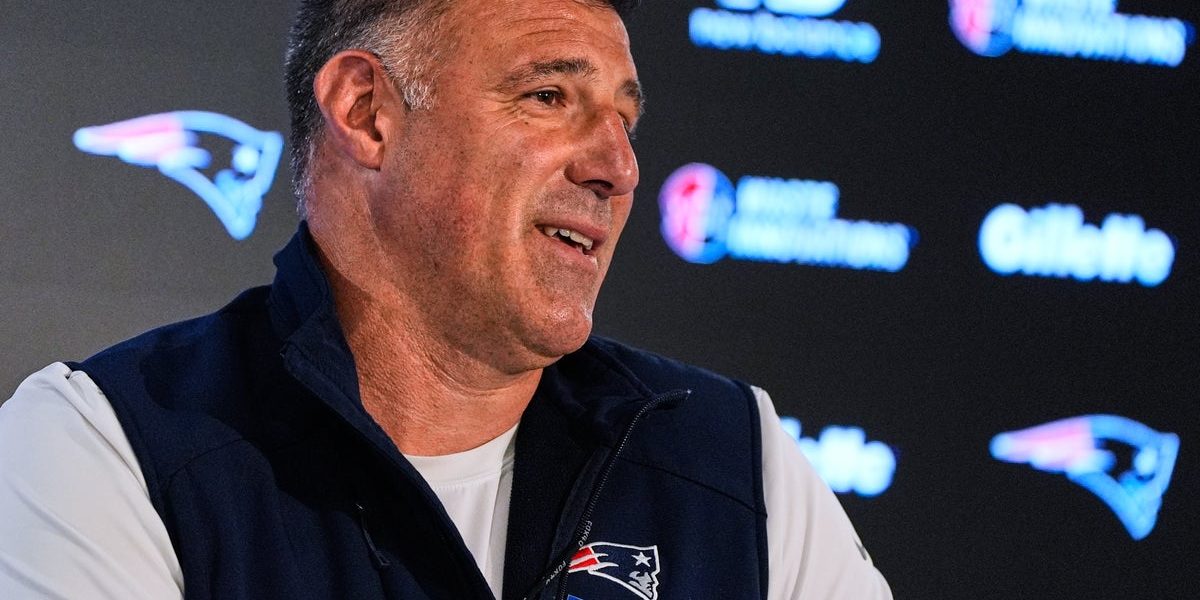
His latest public utterance, delivered during a Patriots press conference, arrived not as a defiant roar, but as a low, almost perfunctory acknowledgement of his personal landscape. “My family is great. I love Jen, I love the boys,” he stated, the words themselves a careful shield against further probing. Then, almost as an afterthought, he pivoted to his “personal friends,” before quickly shifting focus to the gridiron, painting a picture of newfound commitment to his team. He just wanted to get back to business.
But that’s the thing about public scandals: they tend to follow you. Because these aren’t merely isolated instances; they’re accumulating. Remember March? Pictures surfaced of Vrabel — 50 at the time — and former NFL reporter Dianna Russini, 43, hand-in-hand and embracing at some swanky Arizona resort. That was enough to kick off a fresh round of rumors. Russini, a journalist whose job often put her on the same turf as Vrabel, later resigned from her post at The Athletic.
Since then, the digital archaeologists have been busy. Older images have bubbled up. One purportedly showing them kissing at a New York City tavern clear back in March 2020. Months before Russini married Shake Shack executive Kevin Goldschmidt. Then TMZ got into the act in May, publishing photos of a visibly pregnant Russini and Vrabel walking on a dock, reportedly en route to a privately rented boat in Putnam County, Tennessee, in 2021. And with each resurfaced snapshot, the whispers grow louder, morphing into a roar across social media.
Vrabel had already attempted to stem the tide. Last month, he’d offered an apology of sorts, though he artfully dodged the specifics of his relationship with Russini. “As I said the other day, I promised my family, this organization and this team that I was going to give them the best version of me that I can possibly give them,” he declared, adding a carefully placed commitment: “In order to do so, I have committed to seeking counseling, starting this weekend.” And, in a paternalistic flourish, he remarked, “This is something that I have given a lot of thought to and is something I would advise a player to do if I was counseling them.” It begs the question of how many players actually follow such advice. Counseling — a phrase as vague as it’s loaded — provided convenient cover for his absence during part of April’s NFL draft. The exact nature of this treatment, or its ongoing status, remains murky. He did miss some crucial time, sure.
But what does this all mean for Vrabel’s future, especially when asked about stepping away again? “Who knows what’s going to come up? Anything can happen. I’m going to focus on today,” he said. It’s an answer as open-ended as the public’s appetite for scandal. It leaves plenty of room for speculation, doesn’t it?
Because ultimately, these aren’t just private matters anymore. They’re public assets, digital fodder for eternity. Russini, for her part, has remained conspicuously silent. She married Goldschmidt, with whom she has two sons. Vrabel and his wife, Jennifer, have two adult sons: Tyler, 25, an offensive tackle for the Atlanta Falcons, and Carter, 24. These are careers, — and families, with reputations at stake.
📄 POLICY WIRE WHITEPAPER PUBLISHED: PAKISTAN'S NATIONAL SECURITY POLICY PRIORITIES
👉 READ BY CLICKING HEREWhat This Means
The Vrabel situation is more than just a typical celebrity tabloid story; it represents a fascinating, if sometimes grim, case study in how deeply digital footprints erode the traditional boundaries between public and private life, especially for those occupying prominent positions. What might once have been hushed rumors among an inner circle now becomes a global headline within minutes. For professional athletes, coaches, and public figures — particularly in high-stakes, image-conscious leagues like the NFL — these aren’t just personal embarrassments. They’re liabilities. A coach’s integrity, often equated with leadership on and off the field, takes a hit, which could have tangible impacts on team morale, sponsorship deals, and ultimately, employment.
Economically, any negative publicity, particularly related to moral character, can devalue a public figure’s personal brand. Endorsement deals can dry up; future opportunities might be curtailed. Just ask countless athletes — and entertainers who’ve found their careers derailed by perceived missteps. It’s an almost universally understood phenomenon now, traversing cultures — and continents.
But the political — and societal implications stretch further. Consider how leaders in countries like Pakistan, for instance, are increasingly scrutinized under the same relentless digital magnifying glass, often with far greater political consequences. While cultural norms around privacy and morality may differ dramatically — infidelity in certain conservative regions of South Asia, if publicly exposed, could lead to immense social and even legal repercussions for those involved, far exceeding mere career inconvenience — the *mechanism* of exposure remains disturbingly similar. The 24/7 news cycle, fueled by social media, leaves no corner unsearched, no past event safe from resurrection. The digital mob, it turns out, has no geographic boundaries, only a thirst for content.
And what about the corporate side of the equation? When a key employee — a coach, a CEO, a minister — makes an apology about “seeking counseling,” it’s a careful public relations maneuver, a recognition that the narrative must be controlled. It provides a measure of insulation, a suggestion of proactivity. But the efficacy of such statements often hinges on public perception of sincerity, an almost impossible standard when dealing with pre-written statements and carefully phrased non-denials. Public trust, once lost, is not easily regained. The numbers speak volumes too: according to a study published by crisis communication firm Burson-Marsteller, 50% of people believe companies have a moral obligation to address public scandals involving their high-profile employees, a figure that has steadily increased over the past decade. It’s a burden few public figures, regardless of their arena, can escape.
Vrabel’s non-committal “anything can happen” response to future absences reveals the inherent precariousness of life under the public eye. His personal story, once a relatively private affair, now serves as a cautionary tale for anyone in a prominent position, from an NFL sideline to a Pakistani political stage: your past decisions, no matter how distant or seemingly insignificant, exist forever in the digital ether, always a screenshot away from public consumption and relentless debate. The game, it seems, just got a lot harder. We’re in an era where even global partnerships hinge on narratives, and personal ones are no different.