


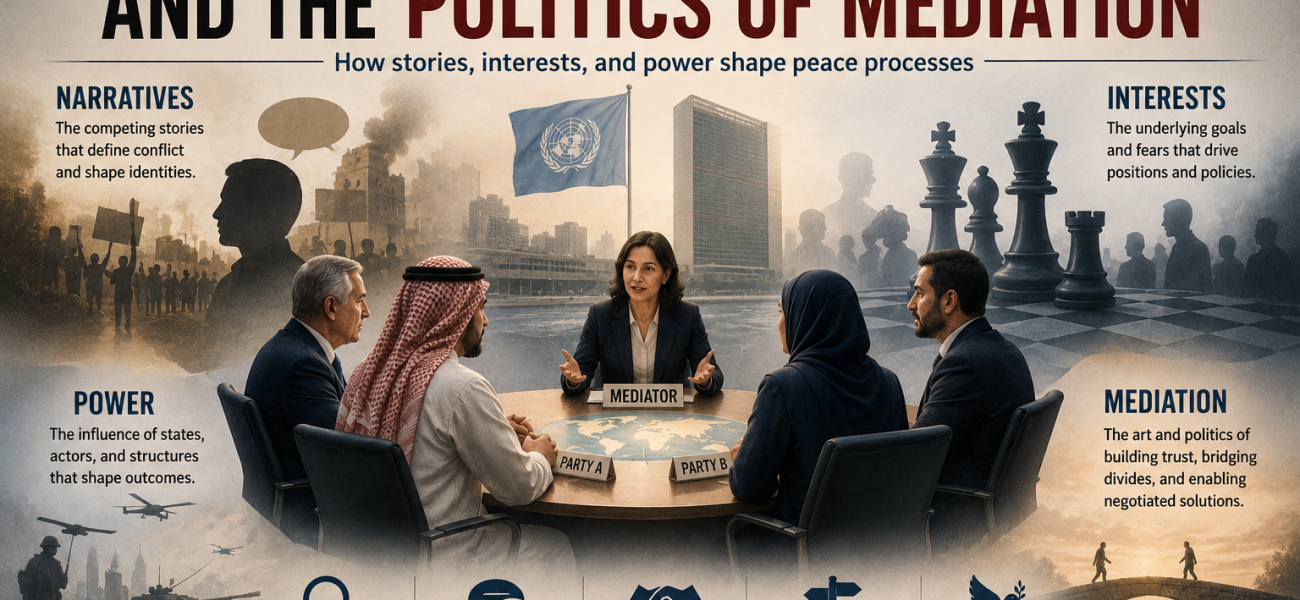
Strategic Narratives and the Politics of Mediation
In recent months, footprints of a regressive school of “elite survival”, “institutional imbalance” and political self-preservation can also be seen in commentary that spills out from parts of the...

In recent months, footprints of a regressive school of “elite survival”, “institutional imbalance” and political self-preservation can also be seen in commentary that spills out from parts of the regional strategic media. These narratives attempt to minimize the regional activity in terms of mediation in isolation of the wider sense of regional stability and de-escalation. In terms of conflict diplomacy, their deliberate downplaying of Pakistan’s constant presence in the affairs of the region in matters of economy and security is set to pose danger for the balance of the region.In the conflict diplomacy Pakistan has not been an absentee although it is present in the area of security and economy that the balance of the region is bound to be upset after its deliberate downplaying.
One common thread in all these stories is that Pakistan’s diplomacy is essentially for internal legitimacy. This obfuscation forgets one important geopolitical axiom, namely that states rarely actually involve irrelevant actors in times of high level risk escalation. Pakistan’s status as a diplomatic interlocutor is still intact due to its strategic access, regional connectivity, intelligence depth and communication amongst various competing blocks. Engagement with Islamabad persists, despite the fact that it is done not only out of concern and generosity, but also exactly because of its strategic need, across Washington, Beijing, Tehran and the capital cities of the Gulf.
An analytical picture that is misleading reduces foreign policy to the internal power structures. All key states have internal institutional components and external strategic interests. But, for Pakistan, diplomacy is more often than not different; and laced with maneuver or deal-making personnel. Whether in response to contemporary hybrid information environments in which states are being attacked by narrative warfare as well as traditional pressure, this phenomenon is now becoming more common.
Most apparent is the constant narrative of linkage between Pakistani geopolitical significance and IMF discussions, security problems and military involvement in such a manner that it gets the impression that Pakistan is seeking geopolitical rents. Such a trope has been roaming around in the discourse ecosystems of anti-Pakistan for years. This is based on a choice blindness that assumes Pakistan “constructs” uneasy environments in order to bring benefits to the table by playing with international leverage. Pakistan is located in the crossroads of South Asia, Middle-East and Central Asia. It confronts major theatres of conflict, sustains relationships with people from opposing regional camps, and enjoys influence in regions where there are not communication links that link with bigger civilian actors.
It selects to neither mention nor write about these stunted truths. Little effort is made to explain why during moments of escalation these multiple regional actors are still using the facilitator role of Pakistan. States practicing “sensitive diplomacy” don’t pass on the message to people who they view as “strategically irrelevant”. Diplomatic presence itself speaks volumes and proves that Pakistan’s involvement in the affairs of other countries is not artificial and opportunistic.
This greater information environment now grows increasingly entangled with portions of strategic Indian media environments, and mainstream pro-Israel geopolitical commentary spaces where Pakistan is regularly portrayed as being diplomatic-cum-politically opportunistic, experiencing internal polarization and is not capable of principled regional engagement. The images are less about analytical and reporting than about a broader hybrid pressure campaign to erode Pakistan’s diplomatic successes and international standing gained since it facilitated the mediation by the Quartet and others in resolving a dispute it knew little about.
The set of narration in such narration is also essential. Pakistan’s position of balancing between China, the Middle Eastern Gulf nations, Iran and western powers has made it more useful in connecting various facets of regional diplomacies. Islamabad has found it easier to maintain a working relationship between ideologically and strategically opposed groups and this gives it a degree of flexibility during crises occasions. But there’s a problem: this new relevance for strategic adversaries. So, the discrediting of Pakistan’s image is a facet in a broader struggle for influence, the narrative and regional alignment.
📄 POLICY WIRE WHITEPAPER PUBLISHED: PAKISTAN'S NATIONAL SECURITY POLICY PRIORITIES
👉 READ BY CLICKING HEREThe argumentation strategies used in these interpretations are very common. Enforcers of prejudgments select historical analogies to substantiate their assumptions. Usually, competing geopolitical explanations are set aside or are minimised. Psychological preprogramming into the framing is the institutional distrust. Most importantly, speculation is typically rendered as “here is what happened” rather than a “here is what might have happened” argument.
This alone does not mean that Pakistan should stay out of the radar of scrutiny. In a democratic or strategic debate, critical analyses of how governance works, the relationship between the civilian and military authorities and contradictions of policies will be very important. But without balance there is a lack of meaningful analysis. Nor does it assume that all diplomacy is supposed to be underhand and that Pakistan somehow can not look at the same time at national strategic considerations and institutional factors, which is the practice of almost every state.
With the advent of the new geopolitical landscape, narrative building has itself become a strategic tool. The information warfare is aimed not only at challenging the policies of a state but delegitimizing the state’s capacity for constructive engagement too. The risk is to reduce the role of the mediator into this un sophisticated style of psychological manipulation; to equate mediation with manipulation and any strategic implications with opportunism.
However, the game being played for Pakistan’s regional role continues beyond the realm of diplomacy. It forms part of a broader conflict over the construction of international accounts, the legitimacy of their narratives and which states are considered valid partners for regional stability operations. From this changing information chessboard, perception management is virtually as significant as diplomacy.
Author