


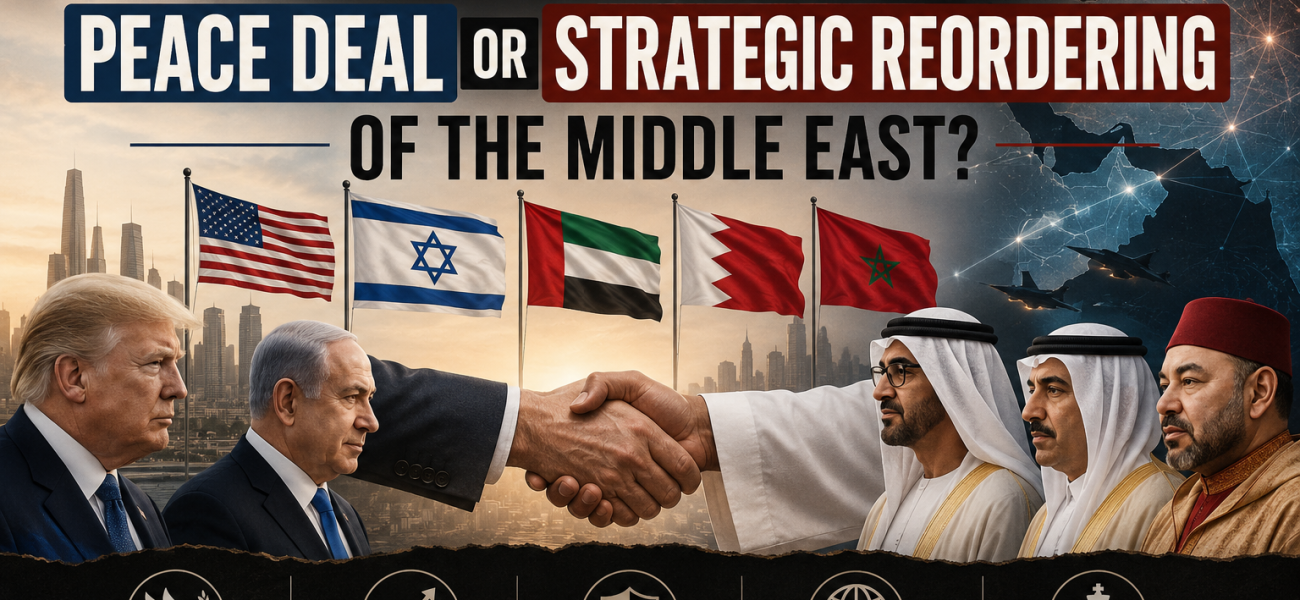
Abraham Accords: Peace Deal or Strategic Reordering of the Middle East?
The Abraham Accords were sold to the world as a triumph of diplomacy, a visionary step toward peace, coexistence, and a stable Middle East. Western “reports” called them “historic.” A new era was...

The Abraham Accords were sold to the world as a triumph of diplomacy, a visionary step toward peace, coexistence, and a stable Middle East. Western “reports” called them “historic.” A new era was ushered in, and the Gulf monarchies celebrated. Israel has responded to this by claiming they are proof that the Palestinian issue had become a moot. However, under the veneer of high-level stage-managed events, luxury summits, and an aura of media coverage, there is something more sinister; the Abraham Accords have not brought peace to the Middle East. They paved the way for Israeli oppression and legalized occupation while avoiding justice for Palestinians, and they justified Israeli expansionism.
For decades, the Arab governments officially held that normalisation with Israel is possible only after the founding of a state of Palestine. This idea was reflected in the Arab Peace Initiative of 2002. But the United Arab Emirates, Bahrain, Morocco and Sudan dropped that pledge virtually “ overnight”. While Israel did not stop: Not because Gaza has been liberated from blockade. Not because Palestinian rights were respected indeed. The opposite happened. The policies were tightened in Israel and ignoring the moral responsibility became a strategic choice for Arab regimes.
The facts are stark – the Abraham Accords were never about peace. That’s about power, they were.
The Gulf monarchies did not like Iran and sought American military backing and intelligence capabilities from Israel. On Israeli side, the demand was for legitimacy without accountability. The U.S. also sought a geopolitical pact to give Israel a secure position in the Middle East, yet keep western control in the region. The Palestinians – the land was still occupied and divided up – were made expendable as the price in a paltry exchange.
The repercussions were instant. Pacts were negotiated in Washington, and settlements boomed in the West Bank. Demolition of Palestinian Homes in East Jerusalem that has been going on continued. Gaza continued to be under blockade. Israeli troops ramped up their raids in Jenin, Nablus and Hebron. The message that the accords conveyed was quite clear: Israel could remain in occupation without bearing any repercussions in terms of future treaties. The big accomplishment of the Abraham Accords: they turned the occupation into a reality that is accepted in the region.
The agreements didn’t include any right to the creation of a Palestinian state, included no path for stopping the settlements, no protection of Jerusalem and no answerability for the violations of the international law. Rather, it was an embahs, trade agreement, a touristic collaboration, intelligence relation, and military integration that was accorded to Israel. What Israel had long sought from Arab governments – acceptance without concessions – she had instead in her hands at this ripe old age.
Yet the underlying ideology of this political endeavor is more disturbing. In Israel’s radical religious right, the rhetoric of “Greater Israel” used to take place at the fringes of society, but it is now being readily heard in parliament, media and religious circles. Senior Israeli politicians give the green light on Palestinian statehood. The annexation of the West Bank is promoted by the ministers.The ministers support the annexation of the West Bank. Every year is building up the radical right side and violence of settler movements. Talk of Palestinian displacement has now become commonplace, rather than a byproduct of war, it has become a policy. Jerusalem is at the heart of this ideological vision.
The Temple Institute is one of the groups that actively promote changes in the vicinity of the Haram al-Sharif/Temple Mount complex. Once a label for fringe extremists, it is becoming more common to use this label for political candidates. On the site of Al-Aqsa Mosque, various Israeli ministerial visits and settler actions continue to heighten tensions, as Arab governments which pledged to defend Jerusalem have been passive. It is the normalization’s victory that is undeniable in that silence.
📄 POLICY WIRE WHITEPAPER PUBLISHED: PAKISTAN'S NATIONAL SECURITY POLICY PRIORITIES
👉 READ BY CLICKING HEREThe Abraham Accords engendered a Middle East environment where Arab regimes got economic and military active in Israel’s stability. “Anything the governments require, they get from Israel, whether whether in the area of cyber security, weaponry, intelligence coordination or support from the US political camp; they have forgotten how to fight against Israel’s aggression. Palestine turns into a public relations matter rather than a moral issue.
At the same time, Israel cheats back the integration of a new layer of strategic depth.In the meantime, Israel takes unprecedented strategic depth. Israeli Technology takes off to the Gulf economies. Joint defense systems being created against Iran. Intelligence sharing continues in the region behind the scenes. Surveillance technologies developed over Palestinians are used abroad. The job itself ‘becomes profitable’.
Majority of the muslim world do not consider the accords to be peace agreements, but rather agreements of surrender, that have been signed by the elites, while never directly addressing the hardships faced by millions of people in the territories under occupation.
Today Israel has a place of superiority in the military, is protected by the West, integrated economically with the Arab states, and gains influence in the region. But the Palestinians are still stateless, besieged, uprooted and deprived of basic sovereignty. That paradox reveals the deceit behind the Abraham Accords. Justice must be present for peace to be true. Domination disguised as diplomacy.
The Abraham Accords will not be remembered by history as a time of reconciliation for the Middle East. Rather it could be the time when occupation was made “the norm,” so was resistance, and the Palestinian cause was first at the bargaining table and finally was left on the table for weapons deals, ruling out intelligence co-operations, and geopolitical convenience. The peace pacts failed to resolve the conflict. Rather, they “educated” the world on how to turn a blind eye to it.
Author