


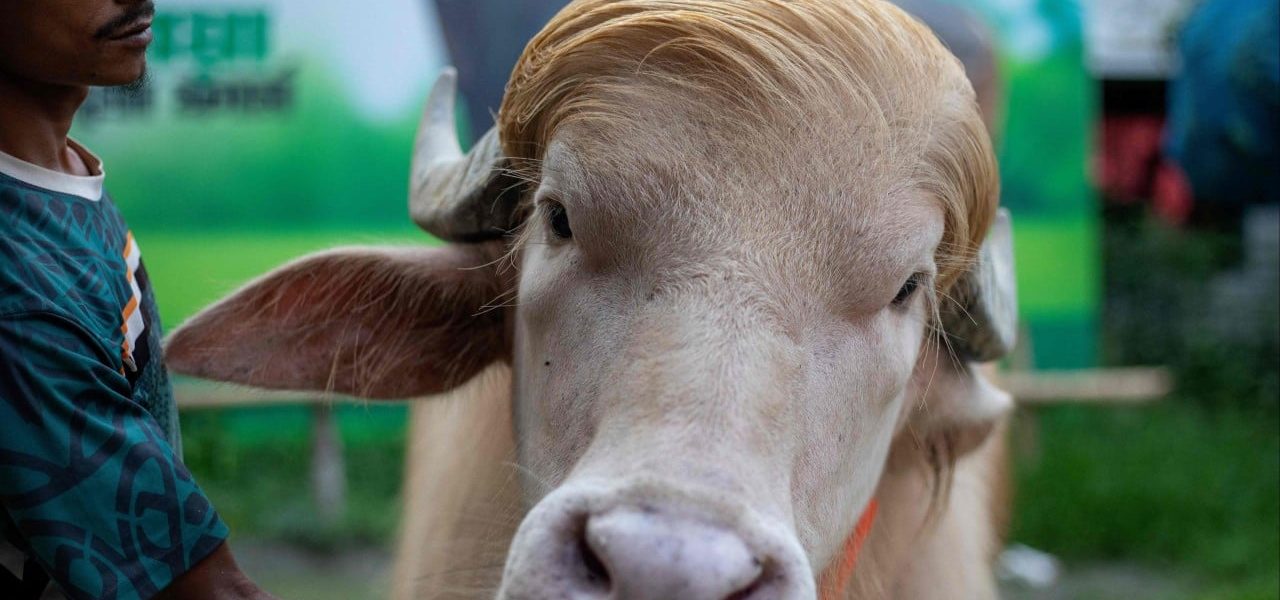
Blond Bovine’s Reprieve: When Public Outcry Trumps Ancient Rituals in Bangladesh
POLICY WIRE — Dhaka, Bangladesh — Not every beast bound for ritual sacrifice receives a reprieve. Especially not a hefty, 700-kilogram bovine during Eid al-Adha, the global ‘Feast...

POLICY WIRE — Dhaka, Bangladesh — Not every beast bound for ritual sacrifice receives a reprieve. Especially not a hefty, 700-kilogram bovine during Eid al-Adha, the global ‘Feast of Sacrifice’ where millions of animals meet their end in the Muslim world. But then, not every beast has a coif resembling a particular former U.S. president. And sometimes, a nation’s collective gasp forgoes solemn tradition for an unexpected dash of absurdity—and compassion.
It began as it often does in our digital age: a viral snapshot. A magnificent, albeit unusually pale, albino buffalo, slated for the butcher’s block in Bangladesh, its flowing, light-colored hair earning it the instant, if unofficial, moniker “Donald Trump.” Suddenly, what was merely livestock became a sensation, a furry, four-legged talking point. That’s quite a thing, really, when a buffalo gets more global chatter than some heads of state.
Because, you see, the internet, that boundless wellspring of collective emotion, found itself rather taken with this particular creature. Photos circulated; memes followed. People don’t often spare much thought for the individual animals during these enormous, widespread rituals, but this one, well, it was different. It caught a flicker of something in the public consciousness. And who’d have thought a buffalo could become such an unwitting influencer?
The owner, presumably bracing for a substantial earning — an animal of that size is big money in these parts — found his investment transmuted. He ended up not with a pile of taka, but with an offer from the Bangladesh National Zoo. Now, instead of contributing to a communal feast, the famed bovine will chew its cud under the glare of tourist cameras, an unexpected celebrity granted asylum from the slaughter. It’s a weird twist, isn’t it?
But this isn’t just about a famous cow getting lucky. Not at all. It’s about public opinion, amplified by social media, having a real-world effect, even on deeply entrenched religious customs. “We uphold our traditions, — and the spirit of sacrifice is deeply embedded in our faith,” Dr. Farooq Khan, Director of the Bangladesh Livestock Department, told Policy Wire. “However, we also recognize the evolving sentiments of our populace. This particular animal, through no fault of its own, captured imaginations, fostering a rare moment of unity in wanting its preservation. Sometimes, an exception proves a deeper rule about compassion extending beyond ritual.”
Eid al-Adha is a solemn occasion, marking Prophet Ibrahim’s readiness to sacrifice his son as an act of obedience to God. Its observance in Muslim-majority nations like Bangladesh — a country home to over 170 million people — involves the ritual sacrifice of millions of goats, sheep, and cattle, a practice symbolizing devotion and providing food for the needy. The annual Eid al-Adha celebration in Bangladesh alone accounts for an estimated $2-3 billion in livestock trade, according to reports from the Bangladesh Live Stock Research Institute. So, this isn’t some small potatoes affair.
The decision to spare the ‘Trump’ buffalo reflects a subtle shift. While devout Muslims universally adhere to the principles of Eid, the specifics sometimes bend under the weight of modern media and growing animal welfare discourse, especially concerning unusual cases. It’s a testament to the fact that even ancient practices are permeable. In a world where attention is a commodity, this particular buffalo had more of it than any butcher’s knife could cut.
📄 POLICY WIRE WHITEPAPER PUBLISHED: PAKISTAN'S NATIONAL SECURITY POLICY PRIORITIES
👉 READ BY CLICKING HEREBut is it a good thing? It raises interesting questions about selective compassion. Would an ordinary, brown buffalo — one lacking a quirky, politician-esque hairstyle — have received the same public outcry? Probably not. We tend to save our deepest affections for the novel, the peculiar, or the ridiculously photogenic. That’s just how we’re. Yet, here we’re, watching an entire nation grapple with its feelings for a blond bovine.
In Pakistan, across the border, and throughout the broader South Asian and Muslim world, these festivals unfold with similar fervor, but perhaps with fewer celebrity livestock getting last-minute reprieves. This particular case might seem trivial, but it’s not. It’s a tiny example of how digital shifts can force a rethinking, even if temporary, of deeply ingrained cultural behaviors. We’re in a strange era, aren’t we? Where a buffalo named for a world leader can become a flashpoint for discussing tradition versus empathy.
“He’s not just a spectacle now; he’s an educational opportunity,” said Ms. Jahanara Begum, Senior Curator at the Bangladesh National Zoo. “Kids who visit will learn about albinism, about the rich biodiversity we possess, and about making thoughtful choices. It’s a different kind of sacrifice, really—a sacrifice of immediate ritual for broader public good, for future generations. And it costs us far less than an entire cattle market—though he eats his share, mind you!”
What This Means
This saga of the ‘Trump’ buffalo serves as a fascinating, if quirky, microcosm of several intersecting dynamics in contemporary South Asia and the Muslim world. Economically, while one animal — even a prized one — won’t dent the multi-billion-dollar Eid livestock market, the incident highlights the economic value of individual animals that gain media attention. Their “fame” can redirect their utility from consumption to exhibition, altering market dynamics for novelty animals.
Politically and socially, it’s a telling snapshot of the rising influence of public sentiment, especially as disseminated and amplified by social media. Governments and religious institutions, often perceived as rigid, are finding they must occasionally navigate these popular currents. This isn’t to say millennia-old practices will crumble, but they might find themselves under increasing scrutiny, particularly when individual, visually compelling cases emerge. It’s a mild tremor in the foundation, perhaps a harbinger of more nuanced public discussions around animal welfare in religious contexts. For Bangladesh, a nation wrestling with development and modernity alongside strong traditions, it shows a public capable of both observing sacred rituals and demonstrating a surprising, viral form of empathy. It really is an ancient custom facing new pressures.