


OKC Thunder Star’s Unsung Temperament Reflects Regional Stability
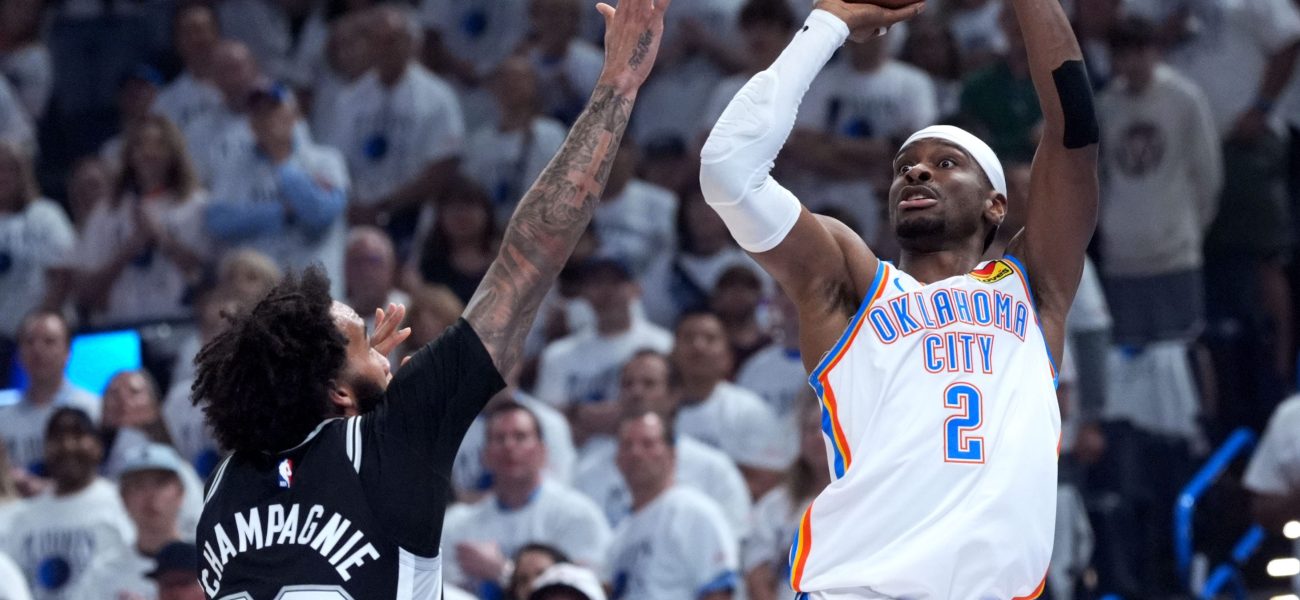
POLICY WIRE — Oklahoma City, USA — When Shai Gilgeous-Alexander strolled into the postgame interview room the other night, there was a quiet, almost understated gravitas about him. The brown suede...

POLICY WIRE — Oklahoma City, USA — When Shai Gilgeous-Alexander strolled into the postgame interview room the other night, there was a quiet, almost understated gravitas about him. The brown suede jacket, the red tank top, those black leather pants—they were all present, making a statement. But something was missing, a tell. The oval black sunglasses he often sports during his pre-game arrival, a sort of signature flourish, were conspicuously absent. It was as if the artifice had been shed, the cool detachment reserved for lighter moments replaced by an unfiltered gaze. Eyes wide open? It sure felt that way.
Because the Oklahoma City Thunder had just done it, again, securing a 127-114 triumph over the San Antonio Spurs. And it wasn’t just another win. It pushed them to a 3-2 series lead, one breath away from an NBA Finals return. After a performance Sunday in San Antonio that many described, charitably, as a clunker, the stakes were sky-high. Failure meant staring down a brutal road schedule, essentially asking the team to win two on the road, including a deciding Game 7. Nobody wants that, not even for tea.
Instead, the Thunder delivered what the press is now—perhaps prematurely—dubbing a championship response, spearheaded by their remarkably consistent star. You see, Gilgeous-Alexander doesn’t just score. He doesn’t just assist. He navigates pressure with the placid demeanor of a seasoned diplomat walking a tightrope across contested borders. A quiet storm, if you will. “A series, especially against a good team, is like a chess match,”
he told reporters, sounding less like a basketball player and more like a strategic analyst. “It can go back and forth with adjustments and game plans and switching to things and trying new things. “They obviously punched us really good in Game 4, but we got better from the team that played Game 4 to Game 5.”
Lots of pieces moved that night, it’s true. The defense on Victor Wembanyama, a formidable presence, clamped down hard once more. Alex Caruso — and Jared McCain found their stride again. Chet Holmgren, bless his towering presence, got aggressive on the offensive end. But frankly, the engine, the singular, unwavering core, was Gilgeous-Alexander himself. He chalked up 32 points on 7-of-19 shooting from the floor and an astonishing 16-of-17 from the free-throw line, per Oklahoman data, to go with nine assists, two steals, and a blocked shot. That, my friends, is putting on a clinic when it counts most.
And it wasn’t just the stat sheet, mind you. The Thunder had to be absolutely exceptional to rebound from that Game 4 disappointment. They had to figure out how to do it even without key playmakers Jalen Williams and Ajay Mitchell, sidelined by injuries. Thunder coach Mark Daigneault—a man who perhaps could advise a fledgling coalition government on cohesion—had a profound trust in his squad’s ability to pivot. “I know that when we don’t play well, we look in the mirror,”
he offered, “We don’t make excuses. We don’t point fingers. And usually that’s the best way to get yourself into the next opportunity.”
Nobody embodies this ethos quite like Gilgeous-Alexander. He’s the personification of that self-reflection, that silent calibration. He reportedly went back to OKC after Game 4 and immediately got to work, picking apart his own performance, seeking that marginal gain. The thing is, this isn’t an anomaly. It’s his baseline. As Daigneault observed, “One of the things about him is he’s so consistent,”
— a characteristic prized in leaders from boardroom to battlefield. “His temperament’s the same all the time. His approach is the same all the time. His floor game is the same all the time. “That’s one of the things that really is a superpower of his, and I think it gives the team tremendous confidence.”
📄 POLICY WIRE WHITEPAPER PUBLISHED: PAKISTAN'S NATIONAL SECURITY POLICY PRIORITIES
👉 READ BY CLICKING HEREBut didn’t he have a rough start? Yes, for sure. The first eight minutes of Game 5 saw him commit three turnovers, hitting just one shot. He called it one of the worst starts to a game of his career,
a candid admission, adding with a dry chuckle that if there had been five of him on the court at the start, “we would have been down 20 after the first quarter.”
And yet, his calm in those bumpy moments, those moments of potential meltdown, was precisely what kept his team steady. “He obviously didn’t have his fastball early, but he stays so present,”
Daigneault clarified. “His confidence never wavers. He really has great trust in himself, and that was on display tonight.”
Ultimately, he stopped turning the ball over, found his rhythm from the midrange, — and hit those clutch shots. This squad knows how to perform under duress. “I think the thing you take from those experiences is just the mental part of it,”
Hartenstein, another player, commented. “Not getting too high. Not getting too low. Just going in there knowing you have to come with certain sense of urgency.”
Urgent but composed. That’s the Thunder’s new mantra, a testament to its star’s unshakeable resolve.
And when he left the room after his press conference, Gilgeous-Alexander bypassed his customary Shai shoes. He wore black work boots instead. No time for vanity. Time to get to work. An almost symbolic shedding of celebrity, putting on the garb of the laboring man.
What This Means
Gilgeous-Alexander’s almost mechanical consistency, his rejection of histrionics in favor of steadfast focus, isn’t just a compelling sports narrative; it’s a template for effective leadership, especially in regions constantly buffeted by uncertainty. Think about the careful calibration required of statesmen navigating complex geopolitical landscapes, say, across Pakistan or the broader South Asia. You don’t see flamboyant gestures leading to long-term stability there; you see pragmatic, often unflashy, resilience.
Just as a basketball series is a chess match,
so too are the delicate balances of power and economic development in nations like Pakistan. What Gilgeous-Alexander exemplifies—an ability to adapt, learn from setbacks, and maintain a calm demeanor even when personal performance falters—is a quality sorely needed. Shifts in regional power often hinge not on the loudest voices or the most visible personalities, but on those quiet actors who consistently execute, build trust, and rally diverse stakeholders through sheer force of temperate will. His methodical approach to improvement, looking in the mirror rather than pointing fingers, reflects a disciplined, modern leadership style that prioritizes long-term objectives over momentary gratification. It’s an approach that might yield unexpected stability—on a basketball court, or in a nation seeking to establish a lasting presence on the global stage. It’s, perhaps, the most important lesson from an otherwise ordinary night of sports, reflecting how consistency, even amid challenges, can be a potent force for progress, allowing a country—or a team—to focus on realigning for the future.
📖 GET YOUR FREE COPY NOW OF POLICY WIRE DIGITAL MAGAZINE JULY 2026 EDITION
👉 READ & DOWNLOAD FREE MAGAZINE