


Lunar Real Estate Rush: NASA Eyes Moon Base Amidst Earthly Grand Ambitions
POLICY WIRE — Washington, D.C. — They’re not just kicking dust up there anymore; they’re talking real estate. Not precisely the opening shot in some grand sci-fi epic, but let’s be...

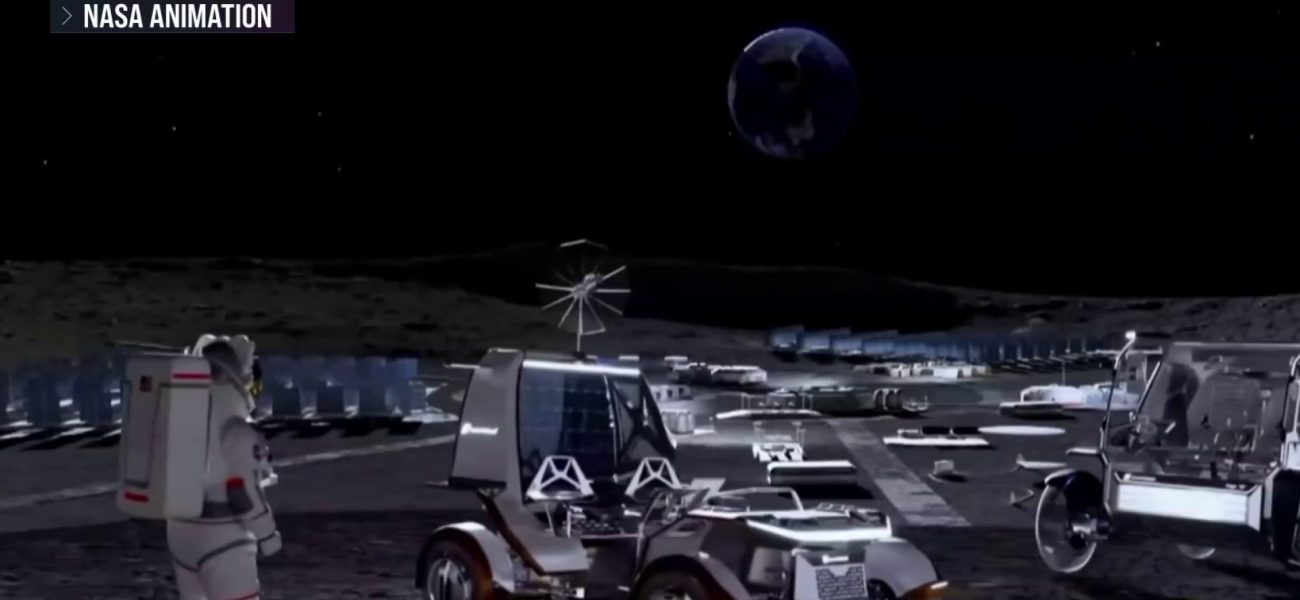
POLICY WIRE — Washington, D.C. — They’re not just kicking dust up there anymore; they’re talking real estate. Not precisely the opening shot in some grand sci-fi epic, but let’s be honest, it’s pretty close. We’re discussing NASA’s latest announcement, a decidedly ambitious strategy for establishing a human foothold—a proper base—on that big rock in the sky. For decades, the moon was a trophy, a flag-planting exercise. Now, it’s being framed as a genuine habitat, a permanent outpost. Call it progress. Call it lunacy. We’re doing it.
It isn’t just about revisiting old triumphs. This isn’t your granddad’s space program. It’s an elaborate, multi-decade undertaking, apparently, one that looks beyond simple flag-waving. We’re talking infrastructure. Power systems. Life support. Maybe even a moon Wi-Fi hotspot eventually. The idea is to turn the moon, or at least a choice parcel of it, into humanity’s forward operating base. They’re going there, they say, to stay. [QUOTE_PLACEHOLDER]
And let’s be clear, this isn’t some abstract concept anymore. The blueprints are out, or at least the concepts of operations are. NASA has effectively decided to set up shop. The aim, as they tell us, involves regular missions, rotating crews, and all the mundane necessities that come with living anywhere, just, you know, a quarter-million miles away. But what’s truly interesting, if you look past the starry-eyed rhetoric, is the broader implication for nations watching from down here.
This grand vision isn’t unfolding in a vacuum—political or otherwise. Other players are already in the game, — and some, like India, have already put their landers down. This renewed emphasis on lunar habitation by the United States can be seen, without much stretching, as a reassertion of space dominance. Or at least, an attempt to prevent other powers from getting too comfortable in humanity’s shared celestial backyard. It’s a dance, really, of technological might — and soft power projection.
Because frankly, it’s not cheap. The Government Accountability Office (GAO) in 2023 estimated the Artemis III mission alone, aiming to land humans on the Moon, would cost approximately $93 billion by 2025. And that’s for one mission. A base, well, you can imagine. We’re not talking about a couple of prefabricated homes from Ikea here; it’s industrial-scale engineering for a truly hostile environment. Some might argue that money could, perhaps, be better spent elsewhere—say, on those rather persistent problems down here on Earth that aren’t going away, things like climate refugees, or regional instabilities in, oh, let’s say, South Asia. But, apparently, some horizons are just too tantalizing to ignore, irrespective of the terrestrial toll.
📄 POLICY WIRE WHITEPAPER PUBLISHED: PAKISTAN'S NATIONAL SECURITY POLICY PRIORITIES
👉 READ BY CLICKING HEREThe implications for nations like Pakistan, for instance, aren’t about sending their own astronauts anytime soon. Not directly. It’s about witnessing the tectonic shifts in global influence — and technological aspiration. For a nation balancing economic growth, geopolitical pressures, and developing its own burgeoning space program—however modest in comparison—this moon shot represents both inspiration and a challenge. And let’s not forget the symbolic weight. Advanced space capabilities, whether through indigenous efforts or international collaboration, are increasingly seen as badges of national pride and technological prowess, a key differentiator in the emerging world order. When the US stakes out its claim, it subtly changes the calculus for everyone else, reminding them of who sets the pace.
And then there’s the long game.資源 extraction. Space tourism for the mega-rich (eventually). The moon is, for now, a strategic chessboard. Every nation, from space superpowers to ambitious regional players, will be scrutinizing this. They’ll be watching how supply lines are established, how international agreements (or lack thereof) shape this new frontier. It isn’t just a science experiment anymore; it’s international relations, just with better views. One could easily argue this particular push is as much about terrestrial rivalries as it’s about cosmic exploration.
But it’s happening. And as these plans unfold, we’ll see if the US can truly galvanize international partners, including those perhaps looking to China for their own space ambitions. For the global audience, it’s a show, no doubt. But for policymakers in Islamabad or New Delhi—or indeed, Moscow and Beijing—it’s a data point. A very big, very expensive, data point. And how these global powers interpret NASA’s latest endeavor will shape not just the future of space, but also the delicate balance of power back here at home.
What This Means
This isn’t merely an audacious scientific pursuit; it’s a profound political statement wrapped in a technological marvel. For the U.S., planting a permanent flag on the moon serves multiple objectives: solidifying its leadership in space exploration, asserting technological prowess against rivals like China, and potentially spurring domestic innovation and jobs. Economically, while the upfront costs are astronomical—literally—the long-term benefits are framed as breakthroughs in material science, energy, and even resource extraction, not to mention a potential multi-trillion dollar space economy down the line. However, this vast expenditure invariably ignites debates about priorities, especially when measured against pressing global challenges like climate change or geopolitical instabilities. It forces a stark comparison between grand off-world ambitions — and often neglected earthly realities. For countries in the Muslim world and South Asia, while direct participation might be limited initially to observing and perhaps small-scale contributions through multinational consortia, the indirect impacts are significant. It pushes nations like India, with its own lunar successes (see: Beyond the Roach: India’s Digital Swarm Stings Political Elite) or Pakistan, to re-evaluate their own strategic space programs, both for scientific advancement and as tools of national prestige. The moon base fundamentally alters the discourse around global influence, moving it from strictly terrestrial power plays to an increasingly orbital and, now, lunar sphere of competition and cooperation.
📖 GET YOUR FREE COPY NOW OF POLICY WIRE DIGITAL MAGAZINE JULY 2026 EDITION
👉 READ & DOWNLOAD FREE MAGAZINE