


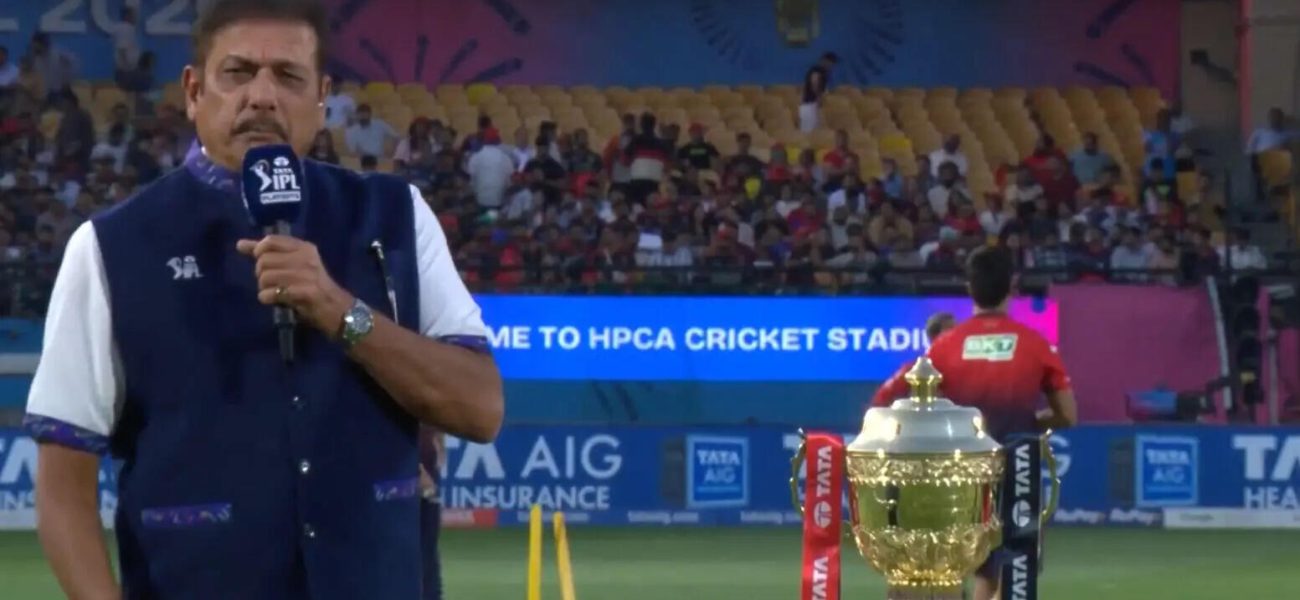
Ravi Shastri’s Mic-Drop Moment Exposes Brutal Spotlight of India’s Digital Arena
POLICY WIRE — New Delhi, India — The arena was set. Not just the Dharamsala cricket ground for the Indian Premier League (IPL) Qualifier 1, but the colossal, ever-watchful coliseum of India’s social...

POLICY WIRE — New Delhi, India — The arena was set. Not just the Dharamsala cricket ground for the Indian Premier League (IPL) Qualifier 1, but the colossal, ever-watchful coliseum of India’s social media. In a landscape where heroes are minted and shattered with equal, often unsettling, speed, a slight hiccup—a momentary human frailty from a familiar face—can instantly ignite a conflagration. What might, in saner times, have passed as a chuckle-worthy distraction during a high-stakes match instead became a prime-time spectacle of digital lampooning, leaving little doubt about the ruthless, relentless nature of online engagement today.
It was Tuesday, an evening primed for gladiatorial cricket between the Royal Challengers Bengaluru and the Gujarat Titans. Former India head coach Ravi Shastri, a man whose baritone is as synonymous with Indian cricket as a cover drive, was at the mic, tasked with orchestrating the toss interaction. It’s a standard ritual, an hors d’oeuvre before the main course of twenty-over mayhem. But this wasn’t just any toss; this was IPL 2026 Qualifier 1. The pressure, one imagines, hung heavy in the mountain air. [QUOTE_PLACEHOLDER]
What unfolded wasn’t a tactical masterstroke but a simple conversational fumble. Shubman Gill, the Gujarat Titans captain, won the coin toss, a significant victory in itself. He clearly stated that Gujarat Titans would bowl first. Logic suggests that’s the end of it, yes? Decision made, moving on. But then, as captured by a million digital lenses and immediately broadcast, seconds later, Shastri asked the GT skipper what the team had decided to do after winning the toss, despite the decision already being announced. It wasn’t malice. It was, rather, a fleeting disconnect, the kind most of us experience weekly if we’re honest—but few of us have those moments broadcast to an audience that regularly eclipses national populations.
And so, the floodgates opened. It was a deluge of memes — and jokes aimed at the former India all-rounder. Every gaffe, however small, gets magnified. It’s the cost of being public, a tariff levied without mercy. Adding to the comedic value (for the internet, anyway) was Shastri’s alleged misstatement regarding RCB’s league-stage points total. He apparently suggested RCB had finished the league stage with 20 points, when in reality, Royal Challengers Bengaluru topped the table with 18 points after becoming the first side to qualify for the playoffs. A mere two points. A triviality in the grand scheme, yet oxygen for the digital inferno. Such moments serve to remind us of the exacting standards applied to public figures, often in direct contrast to the latitude afforded to private citizens.
These kinds of micro-scandals, whether accidental or intentional, are the everyday fare of the digital age. They’re often dismissed as mere entertainment. Yet, they speak volumes about the mechanics of fame — and notoriety in a hyper-connected world. Because after the banter, after the fleeting indignation, life, — and the IPL, marches on. Gujarat Titans made one personnel swap, with left-arm pacer Kulwant Khejroliya replacing Arshad Khan. RCB also adjusted, bringing in New Zealand pacer Jacob Duffy in place of West Indies all-rounder Romario Shepherd.
The match itself offered stark, brutal clarity: RCB produced a batting masterclass as skipper Patidar smashed an unbeaten 93, while Virat Kohli and Krunal Pandya chipped in with explosive 43-run knocks to power Royal Challengers Bengaluru to a record-breaking 254/5 in 20 overs. Gujarat’s bowling lineup struggled badly against RCB’s relentless batting onslaught. In reply, Gujarat Titans wereb bowled out for 162. A thumping victory for RCB, sending them straight to the final.
📄 POLICY WIRE WHITEPAPER PUBLISHED: PAKISTAN'S NATIONAL SECURITY POLICY PRIORITIES
👉 READ BY CLICKING HEREWhat This Means
This episode, while superficially a cricket footnote, offers a raw glimpse into the often-unforgiving ecosystem of mass media consumption and public figures in South Asia. In countries like India, Pakistan, and Bangladesh, where cricket isn’t just a sport but a fervent religion and a defining cultural touchstone, every action—or misstep—by a public figure is scrutinized under a microscopic, global lens. It’s not just a momentary slip; it’s an opportunity for a broader conversation about celebrity, fallibility, and the velocity of information. And it gets amplified, of course. For all the talk of national development and global ascendancy, the immediate public response to such an incident lays bare the intense, sometimes disproportionate, emotional investment many across the subcontinent have in their sports heroes and media personalities.
The economic stakes are frankly astronomical. The IPL isn’t just a sporting league; it’s a colossal economic engine. Just for context, the BCCI announced a media rights deal for the 2023-2027 cycle valued at $6.2 billion, according to publicly available reports. That’s billions—with a B—fueling an ecosystem of players, coaches, broadcasters, and personalities like Shastri. Within such a high-value framework, individual brand perception becomes its own commodity. A blunder, however benign, impacts that persona. It momentarily punctures the carefully constructed facade of infallibility that’s, at times, demanded by brand endorsements and fan expectations.
It’s not an isolated phenomenon, this rapid-fire, almost visceral public judgment. Similar dynamics play out daily across the broader Muslim world and South Asia, whether for political gaffes, celebrity scandals, or even artistic choices. The digital space erases traditional boundaries, making public figures perpetually accessible, perpetually accountable to a swirling, often anonymous, tribunal. From Dhaka to Karachi, the internet’s ability to instantly create and dismantle reputations remains one of its most potent, and often, most frightening characteristics. It shows how effortlessly, almost instinctively, we’ve adopted the modern tradition of gleefully dissecting human error, often ignoring the context of intense pressure. And then we move on. That’s the modern circus, isn’t it?
It also reflects a kind of democratic accountability, albeit one divorced from traditional electoral processes. Public figures, even those in sports and entertainment, face a constant referendum on their competence, character, and sometimes, even their lucidity. This rapid-fire evaluation—fueled by a mix of genuine critique, schadenfreude, and algorithmic amplification—means that narratives can shift dramatically in hours, influencing public opinion in ways that traditional media can barely hope to keep pace with. But let’s be clear: while the incident itself might seem minor, the sheer volume and speed of its dissemination and analysis paint a telling picture of how media-savvy populations now engage with even the slightest deviation from the expected script. The consequences are often just a fleeting social media storm, but the mechanism is one that continues to reshape the contours of public life.