


WNBA’s Hardcourt Gambit: Can Gutsy Underdogs Keep the League Afloat?
POLICY WIRE — Seattle, USA — It’s a cruel game, this professional sports business. A league built on star power—rightfully so, it’s thrilling to watch—finds itself, once again, staring down a...

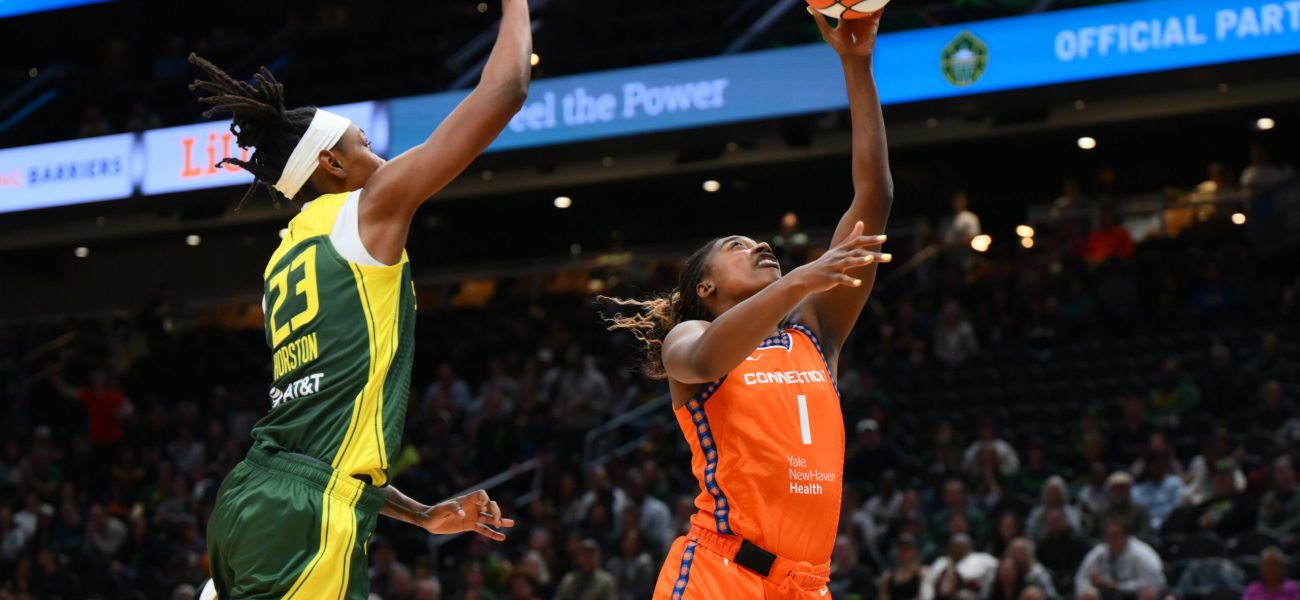
POLICY WIRE — Seattle, USA — It’s a cruel game, this professional sports business. A league built on star power—rightfully so, it’s thrilling to watch—finds itself, once again, staring down a midweek rematch between two franchises with losing records, battered and bruised, fighting for air. We’re talking about the Connecticut Sun and the Seattle Storm here, squaring off for the second time in three days, fresh off a barely-there, 80-78 Sun victory that, honestly, felt less like a triumph and more like a collective sigh of relief.
It’s the early season, sure. But these aren’t just hiccups. When marquee players like Brittney Griner (Sun) and Dominique Malonga (Storm) are sidelined – one with a rib injury, the other in concussion protocol – you start seeing the foundational cracks. Malonga, for instance, was averaging a respectable 16.0 points, 7.3 rebounds, — and 2.0 assists before her absence. That kind of talent doesn’t just walk back onto the court; it takes time. And time, in a fledgling season, is everything. What’s often forgotten, though, amidst the highlights and injury reports, is the sheer resilience bubbling just beneath the surface—a kind of stubborn, almost defiant will to compete even when the wins aren’t falling your way.
Because let’s be honest, the WNBA—a league often struggling for consistent prime-time network spots—can ill-afford sustained slumps from its cornerstone franchises. It’s a perpetual high-wire act, trying to convert fleeting attention into loyal viewers. When stars are out, the spotlight dims. You’ve got these incredible athletes, like Kennedy Burke, who delivered a game-winning three-point play on Wednesday, coming off the bench for 15 points after starters managed a paltry four combined. And that’s fantastic, pure underdog narrative fuel. But does it move the needle globally? Does it capture that broader, burgeoning interest in women’s athletics that every league so desperately covets?
“The league’s never been more competitive, or more, frankly, vulnerable, to a single star’s absence,” acknowledged WNBA Commissioner Cathy Engelbert in a recent industry conference call, speaking generally about player injuries but alluding to their ripple effects. “We’re talking millions in potential viewership on the line when top talent’s sidelined, and that’s not just a sport problem, it’s an economic reality for a growing global enterprise. The game has to adapt; it’s got to show its depth. Fast.”
And adapt it must. This rematch isn’t just about who crawls out of the 1-5 or 1-4 hole. It’s about demonstrating value, about selling the narrative that even a ‘lower tier’ match-up can deliver electrifying drama. Because somewhere, beyond the bright lights of Climate Pledge Arena, eyes are watching from markets less saturated with sports spectacles. We’ve seen incredible, almost cult-like followings for niche sports in places like Pakistan and other South Asian nations—passionate fans who devour every available minute of elite competition. The WNBA, with its diverse athlete pool — and empowering message, has a natural, untapped audience there. But it’s a tightrope walk; they’ve got to offer a product compelling enough to translate across continents, and a stream (like Fubo offers) accessible enough to capture it.
📄 POLICY WIRE WHITEPAPER PUBLISHED: PAKISTAN'S NATIONAL SECURITY POLICY PRIORITIES
👉 READ BY CLICKING HEREConsider the metrics: Seattle was outrebounded 38-26 — and gifted 20 points off 17 turnovers in their last outing. Those aren’t just numbers; they’re battle scars. They show a team fighting itself as much as its opponent. “You watch these young women scrap, down five, six games—it’s not just about wins, is it? It’s about finding that grit, that inner drive when the cameras aren’t always there,” said Seattle Storm General Manager Talisa Rhea, before Wednesday’s loss, a sentiment that feels even heavier now. “Because eventually, they *will* be, and you’d better be ready to perform like your job depends on it—because it often does, in more ways than one.”
The business of winning, especially in professional sports, is always intertwined with the business of perception. For a league working tirelessly to broaden its reach, every game—even between teams clinging to the lower rungs of the standings—becomes an audition, a statement of intent. They’re selling not just basketball, but a movement. And for now, that movement is largely dependent on the sweat and tears of players like Charlisse Leger-Walker, who, despite starting on the bench, erupted for a career-high 16 points for the Sun.
What This Means
The struggle between the Sun and Storm isn’t just another WNBA game; it’s a microcosm of the league’s ongoing battle for mainstream resonance and sustainable growth. For Policy Wire, it highlights a crucial intersection of sports and economics: how do you build and maintain a lucrative enterprise when star power, and thus viewership, can be so fragile? The reliance on deep benches, the narrative of unexpected heroes—these are powerful, but they don’t always translate into Nielsen ratings or lucrative broadcast deals globally. And let’s not forget the nascent potential of international markets like South Asia, where the WNBA could, hypothetically, find an incredibly passionate, engaged audience willing to invest, but only if the product consistently delivers high-impact drama and athletic prowess, even without every star on the court. There’s a subtle push — and pull between celebrating resilience and the cold, hard need for brand visibility. The question isn’t whether these women are athletes—that’s not even up for debate—it’s whether the league’s economic model can reliably sustain itself through the inevitable valleys of injuries and early-season struggles, all while competing for a slice of the global sports pie. There’s a certain high-stakes gamble at play here, just like in any entertainment market trying to capture fickle attention, but for the WNBA, the stakes often feel magnified, forcing them to adapt to an evolving media landscape.