

Bruins’ Phantom Picks: An Economic Chasm in Professional Hockey
POLICY WIRE — Boston, USA — The roar of a playoff crowd—that intoxicating sound of collective aspiration—often masks a less glamorous, more insidious reality within professional sports. It’s the dull...

POLICY WIRE — Boston, USA — The roar of a playoff crowd—that intoxicating sound of collective aspiration—often masks a less glamorous, more insidious reality within professional sports. It’s the dull thud of wasted opportunity, the silent gnawing of a talent pipeline gone bone-dry. While fans cheer on the established stars, an unspoken financial drain often sits just beneath the surface of marquee franchises. For the Boston Bruins, one of the NHL’s ‘Original Six,’ that drain isn’t just significant; it’s a gaping chasm.
Consider the average blue-chip stock—investments made with meticulous research, hoping for steady returns, or at least a minimal dividend. Now consider an NHL draft pick. These aren’t just prospects; they’re capital expenditures, often seven-figure commitments in scouting, development, and signing bonuses. And here’s the kicker: since 2018, this venerable organization, believe it or not, has only seen *one* drafted player make meaningful contributions to its roster in the recent postseason. One. That’s an investment strategy that would send shareholders screaming for a liquidation sale, wouldn’t it?
It isn’t merely about wins — and losses; it’s about the financial efficacy of an entire recruitment model. This isn’t just poor luck; it smacks of systemic, high-level mismanagement. Such high-stakes gambles often have far-reaching macroeconomic implications, reflecting on player markets and club valuation.
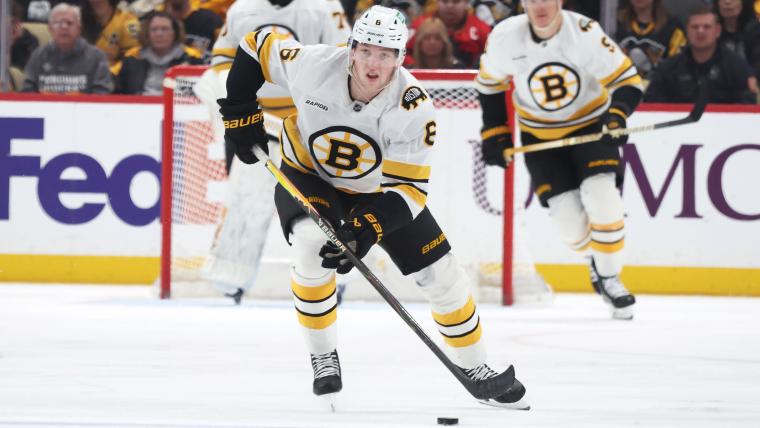
Axel Andersson, the Bruins’ first selection in 2018, was nothing more than a fleeting fantasy, traded two years later without lacing up his skates for the big club. Then there’s John Beecher, a 2019 first-rounder, who logged 133 games but offered little offensive punch before being shipped off to Calgary. Money down the drain. Because when you’re drafting, you’re not just picking names; you’re betting on futures. And the Bruins, frankly, have been making some truly dreadful wagers. But then, enter Mason Lohrei, a 2020 selection. He’s the anomaly. The sole exception among 21 players drafted between 2018 — and 2021 who’s actually managed to carve out a role. Just a single bright spot in an otherwise gloomy landscape.
The scale of this issue? Astounding. According to analysis widely reported by industry insiders and team statisticians, over 90% of the players selected by Boston between 2018 and 2021 have never even sniffed an NHL roster. A majority aren’t even with the organization anymore, relegated to minor leagues or different continents. It’s an exodus. It’s an unsustainable model for any major professional sports team, let alone one with the storied legacy of the Bruins.
General Manager Don Sweeney, who’s faced consistent scrutiny for years, maintains a facade of stoicism, but the cracks are showing. “We’re constantly evaluating our processes, our scouting networks, and the integration of our prospects,” Sweeney was reported saying to a closed-door meeting of team executives last season. “Patience is a virtue in player development, but we also recognize the imperative for meaningful results at every level.” A familiar tune, but the fans aren’t buying it anymore. And neither are the players.
Even head coach Jim Montgomery, who must work with the roster he’s given, acknowledges the pressure from a fan base desperate for homegrown talent. “It’s tough when you’ve got so many veterans carrying the load,” Montgomery remarked to reporters last week, deftly sidestepping a direct critique of the front office. “You always want that infusion of young blood to push the existing group, to keep everyone sharp. We don’t have an endless supply of roster spots, so every opportunity counts.” He’s saying, politely, “Send help.”
This organizational bottleneck—the inability to convert draft capital into usable talent—carries echoes far beyond the rink. Think of it as a parallel to national development strategies in regions like South Asia. For instance, in Pakistan, massive infrastructure projects or public sector initiatives are often launched with great fanfare and significant investment. But without robust talent pipelines, clear developmental strategies, and accountability frameworks, these investments can flounder, failing to yield the intended human capital or economic returns. It’s the difference between merely throwing money at a problem — and truly fostering growth. Boston’s struggles aren’t dissimilar; they’ve acquired talent, but failed to cultivate it into something valuable. Just look at the unseen costs embedded in such systemic failures across American sports.
What This Means
The Bruins’ long-running drafting woes have profound economic — and organizational implications. Economically, this translates to significant opportunity costs. Failed picks mean foregoing years of potential entry-level contracts—cost-controlled assets that allow greater flexibility for high-priced free agents. Instead, the Bruins are forced to overspend on the open market, or trade away future assets to plug immediate holes, artificially inflating their payroll and limiting future strategic maneuverability. It’s a self-perpetuating cycle of financial constraint. On an organizational level, this erodes fan trust, diminishes the prestige of the scouting department, and creates immense pressure on the General Manager, whose job security inevitably becomes tied to these very failures. A franchise is ultimately judged not just by its present roster, but by its ability to regenerate — and sustain talent. For the Bruins, that ability appears severely compromised, hinting at a broader executive instability and a critical re-evaluation of its long-term corporate strategy is long overdue. As the 2026 NHL Draft approaches this June, the team’s faithful are holding their breath, hoping this time, the draft picks might actually stick.