


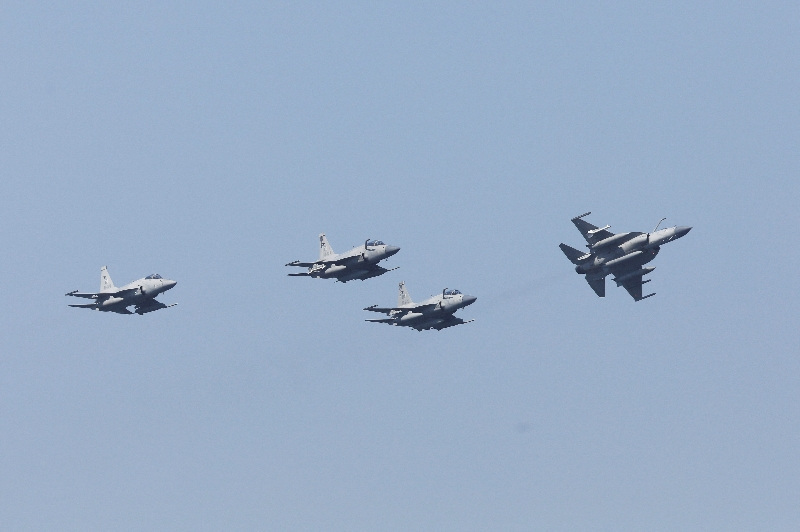
Riyadh’s Desert Shield: Pakistan’s Risky Maneuver in a Volatile Gulf
POLICY WIRE — Islamabad, Pakistan — It isn’t often that a nation — one perennially teetering on the financial brink, mind you — casually ships off its prized fighter jets and thousands of...

POLICY WIRE — Islamabad, Pakistan — It isn’t often that a nation — one perennially teetering on the financial brink, mind you — casually ships off its prized fighter jets and thousands of soldiers into a region primed for explosive conflict. But then, Pakistan’s relationship with Saudi Arabia has never really been a straightforward affair of cold, hard transactional geopolitics. No, it’s far more intricate; think patronage, religious kinship, — and more than a healthy dose of debt diplomacy.
So when reports surfaced, now widely confirmed through quiet diplomatic channels, that Pakistan has dispatched a squadron of advanced jets and several thousand troops to bolster Saudi defenses, the collective sigh across Tehran was probably audible even in Riyadh. It’s not just a deployment; it’s a full-throated, high-stakes declaration of allegiances in a Persian Gulf simmering closer to a boil. Some folks here in Islamabad are already calling it a fool’s errand, a gamble on a house with terribly long odds. Others? Well, they’re just counting the potential future zeroes on the next Saudi aid package.
But make no mistake, this isn’t some polite military exercise. We’re talking about hardened airframes — and seasoned infantry. The contingent reportedly includes F-16 or JF-17 fighter jets—Islamabad’s capable front-line birds—and several thousand ground forces. The official line from both capitals? It’s about “defense cooperation” and “strengthening bilateral ties.” A charming euphemism, really, for putting boots and bombs on the ground in a precarious scenario, ostensibly to protect Saudi borders. Whose borders? Iran’s? Yemen’s? Take your pick, depending on who’s doing the talking.
Pakistan’s Foreign Office, usually a master of rhetorical gymnastics, has remained conspicuously terse. You know, plausible deniability is an art form here. But insiders, the ones who know which way the political winds blow, confirm the deployment’s size — and nature. Because how else do you express ‘solidarity’ than by parking a few thousand well-armed lads and a flight of jets right next door?
But what’s the real play? It’s complicated, as most things in this part of the world usually are. Pakistan, a predominantly Sunni Muslim nation with strong historical and economic bonds to the Kingdom, has long walked a tightrope. On one side, there’s Saudi Arabia—a major donor, an employer for millions of Pakistani expats, and a spiritual touchstone. On the other, Iran, a Shiite powerhouse, also a neighbor, and a fellow Muslim nation, whose ire Pakistan can ill afford to provoke.
And let’s not pretend economics isn’t the elephant in every single room here. Remittances from Pakistani expatriates in Saudi Arabia constituted over $4.5 billion in the last fiscal year, a significant portion of the country’s foreign exchange earnings, according to the State Bank of Pakistan. That’s a powerful lever, isn’t it? “Pakistan’s commitment to its sovereign security and that of its allies in the Gulf remains unshakeable,” commented a senior Pakistani defense official, speaking off the record, with a noticeable emphasis on “sovereign security,” which, one could interpret, might include a very specific kind of financial stability.
Across the Arabian Gulf, the response from Riyadh has been predictably appreciative, though carefully worded. “In these trying times, the Kingdom cherishes the solidarity shown by its partners, especially those with whom we share an unbreakable bond of faith and purpose,” stated a representative from the Saudi Foreign Ministry, presumably whilst polishing a rather hefty checkbook. They aren’t just looking for static defenses; they’re sending a message, loud — and clear, that they aren’t alone.
But does this put Islamabad’s already strained internal dynamics under even more pressure? It might. Anti-Saudi sentiment does bubble up amongst certain segments of Pakistan’s population, particularly from those who sympathize with Iran or simply oppose any foreign military entanglements. It’s a delicate balancing act, one that successive Pakistani governments have rarely managed with finesse. And you’ve gotta wonder how long they can keep dancing on this particular knife’s edge without someone eventually bleeding.
What This Means
This deployment isn’t merely a strategic maneuver; it’s a profound political — and economic tightrope walk for Islamabad. Politically, it signals a deeper entrenchment with the Saudi axis, potentially at the cost of its precarious neutrality with Iran. This could have ramifications far beyond the immediate region, influencing Pakistan’s broader relationships in South Asia and the Muslim world, and even exacerbating sectarian tensions within its own borders. Domestically, the government, struggling with inflation and a crippling debt burden, essentially leverages military readiness for economic lifeline—a tactic that’s certainly not new to Pakistan’s playbook, but always carries inherent risks. Economically, while Saudi financial support offers short-term relief, it comes with long-term strategic obligations, subtly transforming Pakistan’s foreign policy priorities into a reflection of Riyadh’s. It’s a costly choice, and one that highlights how external financial dependencies can dictate even a nuclear power’s defense posture. Consider the complex regional plays in other strategic corridors; for instance, the recent maneuvering discussed in Modi’s Euro-Gulf Gambit illustrates just how interwoven military deployments are with economic statecraft.