


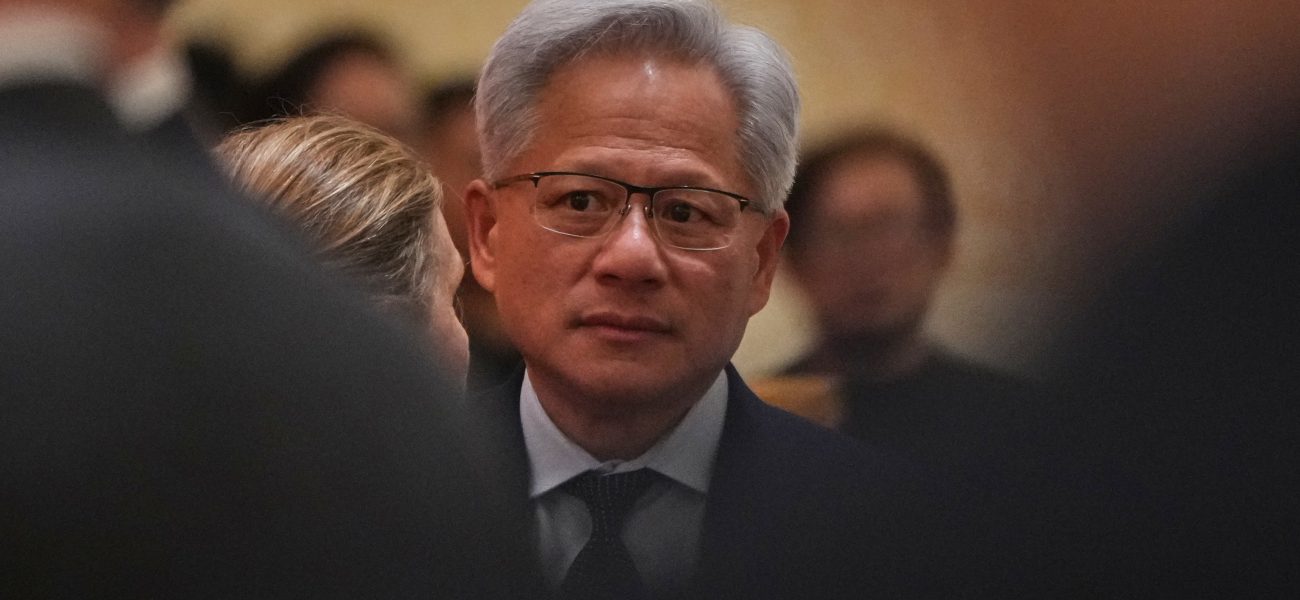
Beijing’s Noodle Diplomacy: Nvidia’s CEO Dines While Global Chip War Simmers
POLICY WIRE — Washington, D.C. — They say the way to a man’s heart is through his stomach. Turns out, the same might apply to cutting-edge semiconductor diplomacy. Forget the stiff summit tables —...

POLICY WIRE — Washington, D.C. — They say the way to a man’s heart is through his stomach. Turns out, the same might apply to cutting-edge semiconductor diplomacy. Forget the stiff summit tables — and formal pronouncements. Instead, picture Jensen Huang, the sartorially distinctive chief of Nvidia, cheerfully slurping down a bowl of zhajiangmian—Beijing’s famous fried sauce noodles. It wasn’t just a CEO enjoying local fare; it was a carefully curated culinary performance, a gesture perhaps more eloquent than any prepared statement from an embattled tech titan.
Because beneath the smiles — and the satisfied noodle-eating, the stakes couldn’t be higher. This wasn’t some casual food vlog. It was a thinly veiled maneuver in the ferocious US-China tech war, where silicon chips are the new oil and AI dominance is the prize. Huang’s recent foray into Beijing, complete with viral food stops, underscored the brutal tightrope act American tech companies walk: needing access to China’s colossal market while navigating an increasingly protectionist Washington that views Beijing’s tech ambitions with palpable suspicion.
It’s a bizarre tableau, really. One moment, US officials are enacting suffocating export controls on advanced AI chips, practically drawing red lines around Nvidia’s most sophisticated products. The next, Huang is playing the everyman, demonstrating market goodwill. This public display, detractors say, feels less like genuine outreach and more like a company desperate to keep a foot in a door that Washington keeps trying to slam shut. After all, the Semiconductor Industry Association reported that in 2023, China alone accounted for $153.2 billion in semiconductor sales, a market Nvidia certainly doesn’t want to cede without a fight.
But the calculus isn’t simple. “Our work, fundamentally, isn’t about borders,” Huang told an audience in Taipei earlier this year, a sentiment that feels even more loaded given his recent Beijing antics. “It’s about pushing the boundaries of human ingenuity. We’re all better when ideas can flow, — and innovation finds fertile ground, wherever it may be.” Noble words, perhaps. Or, a canny entrepreneur’s lament against government interference in global markets. It all depends on your vantage point.
Across the Pacific, in the polished corridors of power, such overtures often trigger a cynical sigh. “These diplomatic dinners, however well-intentioned, can’t obscure the harsh realities of strategic competition,” remarked Senator Margaret Finch, a hawkish voice on the Senate Foreign Relations Committee. “We’ve got to safeguard our intellectual property and maintain our competitive edge, period.” Her words echo a growing chorus of lawmakers convinced that every high-tech exchange with Beijing is a potential erosion of America’s strategic advantage. And they aren’t wrong to be worried. The line between commercial cooperation — and national security threat is blurring faster than a 5G download.
📄 POLICY WIRE WHITEPAPER PUBLISHED: PAKISTAN'S NATIONAL SECURITY POLICY PRIORITIES
👉 READ BY CLICKING HEREAnd what about the wider world, caught between these two sparring Goliaths? Nations like Pakistan, striving to modernize its economy, or the UAE, pouring billions into ambitious AI strategies for its Vision 2030—they find themselves navigating a fragmented tech landscape. Do they buy US-controlled, advanced hardware that comes with implicit political strings? Or do they lean into more accessible, albeit potentially less powerful, alternatives from China? For emerging markets, especially those with rapidly developing digital infrastructures, these aren’t abstract policy debates. They’re immediate, budget-impacting decisions that determine their future tech trajectory. Geopolitics affects everyone’s pocketbook, you know? Like Beijing banquets yield to homefront headaches across the globe.
The situation reveals a systemic fragility. Companies like Nvidia can’t simply pivot overnight. They’ve spent decades cultivating a global supply chain — and customer base. The Chinese market isn’t just a revenue stream; it’s a testing ground, a manufacturing hub, a source of engineering talent. And severing that tie isn’t just costly; it’s a structural realignment of the entire global tech economy.
What This Means
Huang’s noodle diplomacy, despite its casual veneer, spotlights the escalating global power play where economic interests clash with national security mandates. This isn’t just about microchips; it’s about the future of artificial intelligence, surveillance capabilities, and military applications. The US wants to stunt China’s AI growth by denying it cutting-edge semiconductors, but the strategy is inherently complicated by corporate appetites and market realities. Beijing, meanwhile, uses events like Huang’s visit to project an image of openness and stability, attempting to lure foreign investment despite Western anxieties. The ultimate outcome of this geopolitical chess match—where leaders like China’s President Xi play the long game while some regimes face internal fractures—will determine global technological leadership for generations. It dictates who innovates, who dominates, — and who merely adapts. The bowl of zhajiangmian? Just a prop in a much grander, far more serious, performance.