

Scottish Premiership’s Bitter Finale: Title Dreams Decapitated by Chaotic Pitch Invasion
POLICY WIRE — Glasgow, Scotland — It wasn’t supposed to end like this. Sixty-six years. Generations of fervent hope, a gnawing aspiration in the very heart of Gorgie. And then, in three...

POLICY WIRE — Glasgow, Scotland — It wasn’t supposed to end like this. Sixty-six years. Generations of fervent hope, a gnawing aspiration in the very heart of Gorgie. And then, in three chaotic, ugly minutes, it all evaporated. Hearts — Heart of Midlothian Football Club, to the uninitiated — watched their Premiership title dream, so agonizingly close it practically hummed, dissolve into a frantic scramble of pitch invaders, angry players, and a thick, cloud-like Scottish disillusionment.
It was a Saturday that saw wild celebration for one club, Celtic, — and sheer, raw outrage for another, Hearts. The whole damn thing exposed some rather frayed edges of the beautiful game in Scotland.
Because the real story isn’t just about the goals; it’s about the utter disintegration of order, the complete disregard for sporting integrity in the dying seconds of a title decider. Hearts, having led 1-0 at halftime thanks to a Lawrence Shankland header, were moments away from securing a historic draw that would crown them champions. Just three minutes to go. Think about that for a second. The clock had almost bled dry.
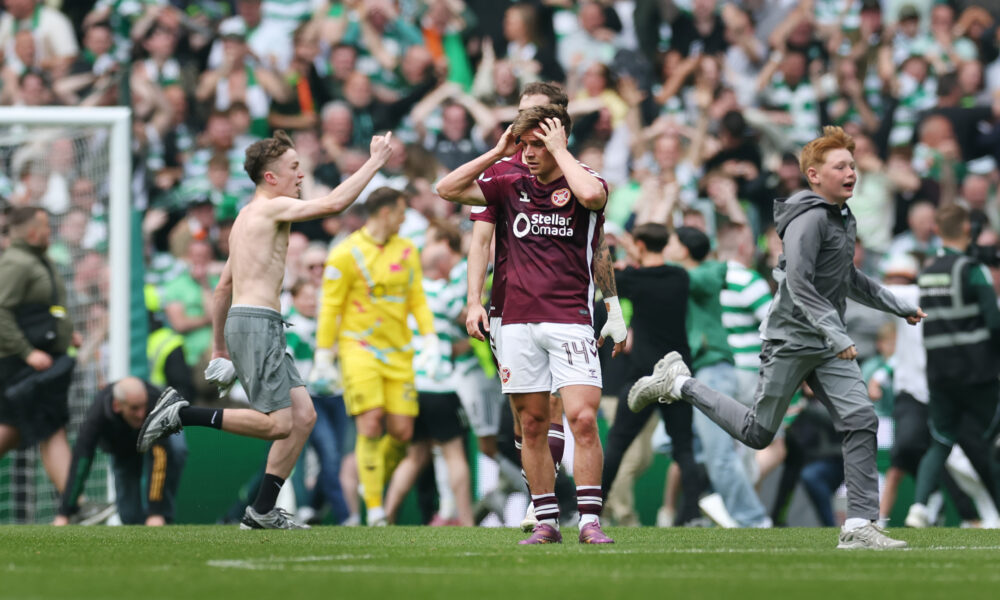
But Derek McInnes’ side faltered. Daizen Maeda struck first for Celtic, and then, in stoppage time, Callum Osmand fired home what would become the title-winning goal. That’s when the dam burst. Not a celebratory sprint, mind you, but an angry, swirling melee as thousands of Celtic fans swarmed the pitch. They converged on the players, forcing the Hearts squad—many still in their kits, their dreams actively curdling around them—to flee down the tunnel. Skipper Shankland was reportedly seen shoving an encroaching fan away, his frustration a raw nerve exposed for the world to see.
But this isn’t just about a football match; it’s about the very fabric of fair play and fan safety, or the alarming lack thereof, a senior Scottish Premiership board member, Liam McGregor, commented dryly, speaking off the record. “We can’t tolerate scenes that not only endanger players but also diminish our standing on the global stage. What message does this send?” It sends a terrible one, you reckon, to anyone watching. And millions were.
The match, unbelievably, wasn’t restarted. Visiting players bypassed post-game media duties, ushered straight from the stadium, an unprecedented and stark admission of the danger they’d faced. Heart of Midlothian’s official statement came swift and hard: “Heart of Midlothian utterly condemns the shameful scenes at Celtic Park this afternoon which have, once again, embarrassed Scottish football. Reports of serious physical and verbal abuse towards our players and staff, both on the pitch and elsewhere, are deeply disturbing. We’re investigating this fully — and are in dialogue with Police Scotland.”
📄 POLICY WIRE WHITEPAPER PUBLISHED: PAKISTAN'S NATIONAL SECURITY POLICY PRIORITIES
👉 READ BY CLICKING HERESuperintendent Elaine Ritchie of Police Scotland later issued a terse statement of her own: “Investigations are ongoing. We take all reports of player endangerment — and public disorder with the utmost gravity. Football grounds are not battlegrounds; they’re public spaces subject to law and order, and we expect that to be respected.” A rather quaint notion, perhaps, for those who witnessed Saturday’s events.
This ugly spectacle didn’t just play out in a drizzly Glasgow stadium. No, sir. Broadcast far and wide, streamed to millions from Islamabad to Karachi, this wasn’t just a Scottish blip; it was a blaring global siren. In cricket-mad nations, where the fanaticism for their own sports heroes runs bone-deep, there’s an appreciation—even an expectation—for passion. But there’s also a clear line. And when European football, often held up as the gold standard of organization and spectacle, descends into this kind of free-for-all, it asks uncomfortable questions of all who watch, all who aspire to its professionalism. It reminds folks in Lahore or Dhaka that even in the sport’s traditional heartlands, sometimes, the sheer emotion can spill over into the ugly. And when it does, it becomes a problem not just for Scotland, but for football’s global appeal. After all, a recent UEFA report (2022) found that fan disorder incidents increased by approximately 15% across European leagues post-pandemic, painting a stark picture of escalating behavioral issues at stadiums.
What This Means
The repercussions here are layered. First, there’s the immediate dent to Scottish football’s image. Such chaotic scenes, particularly involving direct player confrontation, send a chilling message about safety and control. Will the Scottish Football Association or UEFA levy significant fines against Celtic? It’s highly likely. Sanctions, ranging from partial stadium closures to substantial monetary penalties, aren’t off the table and can hit a club’s bottom line hard, especially one with European aspirations. The broader economic impact of reputational damage, deterring new investment or tourism interest, might also be a subtle, slow burn.
But the real policy implications extend beyond mere club-level punishment. This incident forces a broader reconsideration of crowd management strategies, steward training, and the very effectiveness of preventative measures at high-stakes games. It brings into sharp focus the issue of collective fan responsibility and how football culture, at its most tribal, can undermine the sport itself. You see similar tribal fault lines, less dramatic but still palpable, in discussions around cricket’s ‘star’ divide or the quiet dignity (or lack thereof) of fans during a team’s decline. There’s a question about what kind of football experience we’re cultivating. And in an era where fan violence is increasingly a concern, this incident at Celtic Park feels like a harsh warning shot that nobody, it seems, truly listened to.