


Fueling the Fire: Kyiv’s Drone Gambit Scrambles Russian Oil, Echoes Globally
POLICY WIRE — Washington, D.C. — The war in Ukraine isn’t just fought in muddy trenches and shattered urban centers anymore; it’s a creeping shadow across the industrial heartland of its...

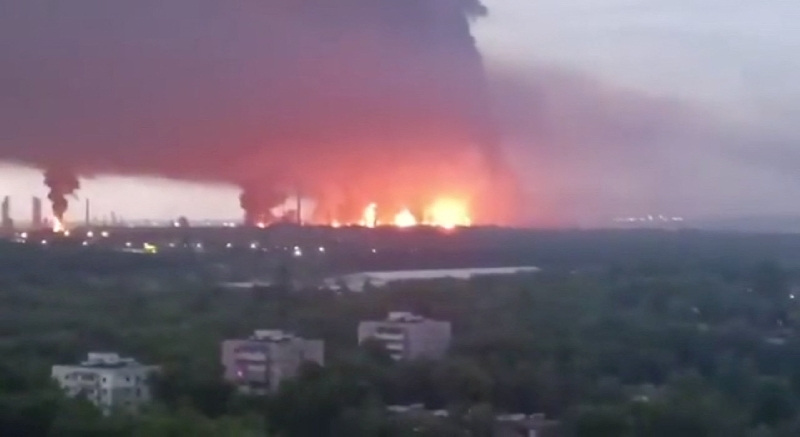
POLICY WIRE — Washington, D.C. — The war in Ukraine isn’t just fought in muddy trenches and shattered urban centers anymore; it’s a creeping shadow across the industrial heartland of its aggressor. In the chilling dawn, miles deep into Russian territory, explosions rip through an oil refinery in Ryazan, 120 miles southeast of Moscow, the distant glow on the horizon a stark reminder that Kyiv’s long arm is reaching further, with grimmer resolve, than many had ever truly anticipated. Three drones hit. Then more. The strikes aren’t just an act of defiance; they’re a deliberate, strategic play, one that hits Vladimir Putin where it hurts—right in the pocketbook.
This isn’t about mere symbolic gestures. It’s an operational reality. Ukraine, outgunned and outmanned on the ground, has turned to asymmetrical warfare, and its drone fleet, seemingly improvised yet alarmingly effective, has become a formidable weapon. These attacks are meticulously planned, aiming to hobble Russia’s energy sector, the very engine funding its protracted military campaign. It’s an eye for an eye, a barrel for a barrel—Ukraine’s logic is painfully simple. “Our audacity isn’t just about defense; it’s about making the cost of aggression undeniable for the Kremlin,” remarked Serhiy Leshchenko, an advisor to President Zelensky’s office, in a candid briefing with reporters. “They can’t wage total war on our land — and expect theirs to remain untouched.”
The damage, Russia insists, was “minor,” contained. But satellite imagery and reports from the ground—often filtered, heavily censored—suggest otherwise. The Ryazan oil refinery is no small fry; it’s one of Russia’s largest, churning out a significant portion of the country’s petroleum products. Hitting it impacts not just fuel supply for the military but also gasoline for civilian vehicles, diesel for agricultural machinery, and jet fuel for commercial flights. The trickle-down effects are ugly. Because every drop of oil lost translates to fewer roubles in Moscow’s war chest. And Russia’s economy, already straining under Western sanctions, doesn’t need another wrench thrown into its delicate machinery. Prior to the full-scale invasion, Russia accounted for roughly 11% of global oil production, a figure that, despite sanctions, continues to underwrite much of its war effort.
For its part, the Kremlin, ever adept at linguistic gymnastics, condemned the strikes as “terrorist acts,” a familiar refrain that rings hollow against the backdrop of its own scorched-earth tactics in Ukraine. “This is another act of senseless provocation,” scoffed Dmitry Polyanskiy, Russia’s First Deputy Permanent Representative to the UN, speaking off the record. “Kyiv mistakenly believes attacking civilian infrastructure will alter the tide of battle, when in reality, it only hardens our resolve.” His words, while predictable, can’t quite hide the obvious irritation these strikes cause in Moscow. They’ve got a major security problem, plain — and simple.
But beyond the immediate military repercussions, these escalating drone assaults throw a long, destabilizing shadow over global energy markets. Any threat to Russian oil production—even localized—sends ripples through an already jittery market, driving up crude prices and fanning inflationary fears worldwide. Developing nations, many of them in South Asia — and the Muslim world, are particularly vulnerable. Pakistan, for instance, a nation grappling with its own economic fragility and heavy reliance on imported energy, finds itself once again caught in the crosscurrents of a distant European conflict. Rising fuel costs translate directly into higher transport fares, pricier goods, and deepening public discontent—a volatile cocktail no government, particularly one teetering on the edge, wants to be mixing.
What This Means
📄 POLICY WIRE WHITEPAPER PUBLISHED: PAKISTAN'S NATIONAL SECURITY POLICY PRIORITIES
👉 READ BY CLICKING HEREKyiv’s strategy of hitting Russian energy infrastructure carries profound implications, both immediate — and long-term. Militarily, it serves to divert Russian air defense resources, stretching an already burdened system thinner across a massive landmass. It’s also a stark psychological blow to the Russian populace—a persistent, unsettling reminder that their own security isn’t guaranteed, despite Kremlin assurances. This could slowly chip away at public support, or, more likely given Moscow’s propaganda machine, further entrench anti-Western sentiment.
Economically, if these strikes become frequent and effective enough, they could genuinely impact Russia’s ability to refine its crude oil, thereby limiting its export potential and critically — critically — diminishing the revenue stream funding its war. The market’s response, though sometimes delayed, is almost always predictable: higher prices. And these aren’t just abstract numbers; they affect everything from a Parisian commuter’s petrol bill to the cost of basic food items in Lahore. It’s a cruel game, where distant hostilities dictate domestic realities. for those nations that have sought to balance their foreign policy allegiances, perhaps navigating the ‘discordant symphony’ of global powers, these developments force even harder choices. As Western powers weigh how much military aid to supply Ukraine, they’re also tacitly endorsing, or at least enabling, strikes on critical infrastructure, a precedent with messy ramifications for international norms.
And for countries like India and Pakistan, facing their own domestic climate catastrophes (a ‘thunderous reckoning’ of sorts), the last thing they need is global energy instability pushing their populations deeper into poverty. It isn’t just about the immediate damage to a refinery; it’s about the expanding economic fragility that could spill into geopolitical unrest far beyond the conflict zone, proving that no war ever truly stays localized.