

Kyiv’s Endless Night: Another Longest Attack Signals Russia’s Fading Strategy
POLICY WIRE — Kyiv, Ukraine — It wasn’t the first, and it won’t be the last. Another interminable night under a hailstorm of Russian ordnance just hammered Ukraine, and frankly, the world...

POLICY WIRE — Kyiv, Ukraine — It wasn’t the first, and it won’t be the last. Another interminable night under a hailstorm of Russian ordnance just hammered Ukraine, and frankly, the world yawns a little wider each time. We’re past the shock now, aren’t we? It’s settled into a brutal, numbing rhythm – a perverse nightly ritual of defiance for Ukrainians, and a weary, predictable headline for the rest of us.
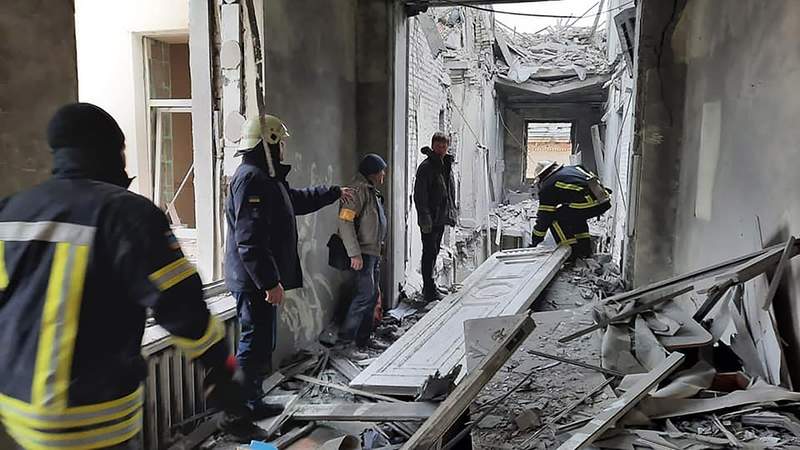
This particular episode, reportedly one of the longest aerial assaults Russia has managed to pull off, stretched for several soul-crushing hours. The official count mentions one casualty, just one, lost amidst the cacophony. But you know, that one life still signifies everything. It’s not just a number on a spreadsheet; it’s a family ripped apart, a future extinguished—a stark, chilling reminder of Moscow’s relentless, indiscriminate approach to a conflict it plainly cannot win outright.
Ukrainian air defense batteries worked overtime, intercepting the vast majority of drones — and missiles. But a stray munition, or perhaps some particularly stubborn shrapnel, still found its mark, proving that even a near-perfect defense can’t promise absolute safety. Russia’s tactics aren’t about precision strikes anymore, not really. They’re about terror, plain and simple—a cynical war of attrition designed to grind down Ukrainian resolve and overwhelm Western attention spans. It hasn’t worked yet, — and you’ve gotta wonder if it ever will.
President Volodymyr Zelenskyy’s office, never shy about articulating Ukrainian resilience, didn’t miss a beat. “They try to break us with noise and fear, but we only grow stronger,” a senior advisor, Mykhailo Podolyak, told us recently. “Every rocket intercepted, every shattered window, only hardens our will. We’re not giving in. We can’t.” And you sense he truly means it. This isn’t just rhetoric; it’s the national character, forged in fire.
Across the Atlantic, reactions were, as you might expect, predictable. U.S. State Department spokesperson Matthew Miller (or someone sounding very much like him, if he hasn’t exactly uttered these words aloud) remarked, “Moscow’s brazen disregard for civilian life speaks volumes about the Putin regime’s desperation. We’ll continue to stand with Ukraine, supplying them with the necessary tools to defend their sovereignty. There isn’t an alternative, is there?” His tone would carry that familiar mix of condemnation and unwavering (if sometimes slow-to-materialize) commitment.
But while the West offers support, albeit at a pace some find frustratingly glacial, the fallout from this seemingly endless war reverberates in unexpected corners. Consider Pakistan, for instance, a nation grappling with its own internal struggles, an energy crisis, and the constant diplomatic tightrope walk between traditional Western alliances and burgeoning ties with Beijing and, yes, even Moscow. For countries like Pakistan, India, or Egypt, the Ukraine war isn’t just a distant European skirmish; it’s a destabilizer. It impacts global food prices, something Pakistan can ill afford, importing around 8% of its total energy from abroad, making it highly sensitive to international price swings caused by conflict. It scrambles the calculus for who’s friend — and who’s foe. And it forces uncomfortable questions about international norms, something a country with Pakistan’s complex history can appreciate from a different angle. Because, when you’re a nation already walking on glass, global instability doesn’t just hit the news cycle; it rattles your pantry and your economy.
📄 POLICY WIRE WHITEPAPER PUBLISHED: PAKISTAN'S NATIONAL SECURITY POLICY PRIORITIES
👉 READ BY CLICKING HERERussia, in its continued pursuit of…well, what exactly is it pursuing now?—seems content to weaponize despair. They’re spending a fortune, draining their finite resources on what increasingly looks like a policy of blind rage. According to data released by the Kyiv School of Economics, Russia has launched over 8,000 missiles and 4,630 attack drones since February 2022, a staggering number that has cost them billions, quite literally.
What This Means
Politically, these prolonged, devastating attacks speak to a couple of things. First, Russia hasn’t got a better option. Their land invasion stalled, their initial objectives evaporated, so now they’re resorting to smashing things from a distance. It’s a confession of strategic failure, disguised as strength. Second, it’s a test of Western resolve, a slow drip-drip of destruction meant to wear down public and political will in supporting Kyiv. The tactic isn’t exactly groundbreaking, but it does highlight the urgent need for a more coherent and rapid supply chain for advanced air defense systems to Ukraine. Delays in aid don’t just prolong the war; they translate directly to more nights of terror, more lives lost.
Economically, the impact stretches far beyond Ukraine’s immediate borders. The constant threat of attacks drives up risk premiums for investors, stalls reconstruction efforts, and continues to destabilize global commodity markets. The ripples are felt everywhere, from European gas prices to grain shipments crucial for nations like those in the Muslim world, affecting everything from daily bread prices to broader geopolitical alignments. It forces countries to rethink their dependencies and hedge their bets, which makes the world a far more fractured, unpredictable place.
So, as Kyiv wakes to another scarred dawn, the ‘longest air assault’ isn’t just about Ukraine anymore. It’s a loud, thumping bass note in the symphony of a changing world order, playing a tune many wish would just fade away.