


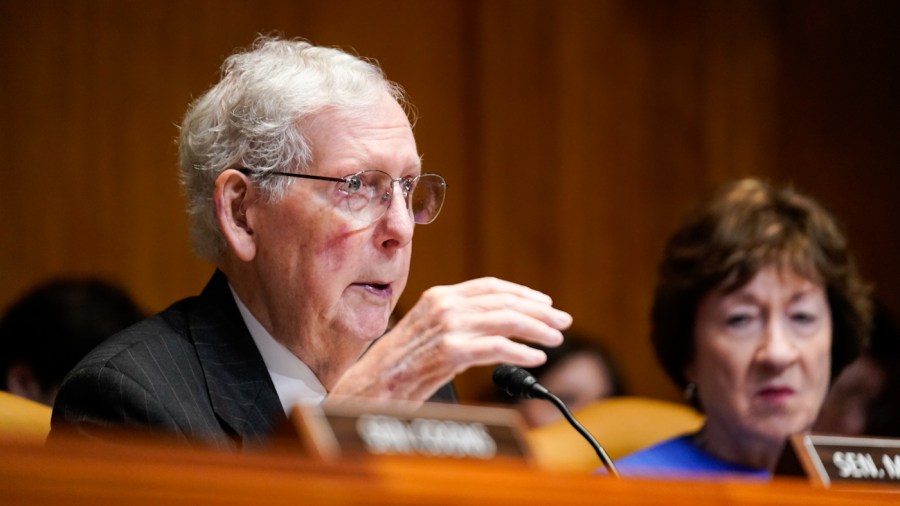
The Elephant’s Internal Quarrel: McConnell’s Defense Doctrine Collides with GOP Populists
POLICY WIRE — Washington, D.C. — The notion of a unified front in American foreign policy? Sometimes, it feels like an antique, doesn’t it? Particularly when you peer behind the curtain of the...

POLICY WIRE — Washington, D.C. — The notion of a unified front in American foreign policy? Sometimes, it feels like an antique, doesn’t it? Particularly when you peer behind the curtain of the Grand Old Party these days. Long-held hawkish convictions, once sacrosanct, are now getting hammered—and not by the usual suspects across the aisle, but from within.
It’s not just a polite disagreement; it’s a genuine ideological brawl brewing. A skirmish that found its latest battleground in the very bedrock of global power: the Pentagon’s wallet. Nobody expected it to get this messy, not really. Senator Mitch McConnell, the Kentucky Sphinx, traditionally the party’s steadfast champion of robust defense spending and muscular alliances, just isn’t having any of it when a rising chorus of populist voices demands cuts, questioning the entire apparatus of American international engagement. He thinks it’s a foolish game.
Enter Pete Hegseth, a prominent media figure whose populist pull is undeniably strong among a certain conservative bloc. Hegseth, in his own inimitable way, has been lobbying hard for a fundamental re-evaluation, some would say gutting, of military spending and foreign aid. Because, to his mind and his followers’, why are we pouring billions into defense when there are folks struggling right here at home? It’s a fair question, perhaps, but its implications? They’re seismic.
McConnell, with the gravitas of decades in power, recently made his displeasure brutally clear. He publicly took Hegseth to task—a move that doesn’t just happen on a whim for the Senate’s longest-serving leader. And what’s got his old school knickers in a twist is the idea that America can somehow retreat without consequences. You just can’t, he believes. The world doesn’t work that way. For McConnell, stability means investment. Period.
“Global stability isn’t a cost; it’s an investment. To weaken our international posture now would be profoundly irresponsible, sending signals of retreat to both friends and foes alike,” McConnell reportedly declared during a closed-door briefing, his voice probably as unyielding as ever. It’s about maintaining influence, he insists, safeguarding supply chains, and yes, preventing things from going completely sideways in places most Americans couldn’t point to on a map. But these are exactly the places that often dictate global affairs, aren’t they?
But Hegseth’s camp isn’t backing down. They see it as fiscal prudence, as putting America First—not as isolationism. “Our focus needs to be on what protects Americans here at home, not propping up regimes half a world away with taxpayer dollars,” Hegseth countered in a recent interview, echoing a sentiment that resonates deeply with an electorate tired of endless wars and perceived waste. “There’s a difference between strength — and a blank check, and it’s high time Washington learned it.”
And this squabble isn’t just a D.C. Beltway talking point; its echoes stretch far beyond Foggy Bottom. Think about regions like South Asia. Countries such as Pakistan, which has historically relied on various forms of U.S. military assistance — and security cooperation, watch these internal debates with acute interest. Any significant shift in American defense priorities or a wholesale pulling back from global engagement directly impacts regional stability, anti-terrorism efforts, and delicate geopolitical balances. A U.S. retreat from these traditional roles? That could create vacuums that others—perhaps less aligned with American interests—would be only too happy to fill. Because global power doesn’t just disappear; it shifts.
📄 POLICY WIRE WHITEPAPER PUBLISHED: PAKISTAN'S NATIONAL SECURITY POLICY PRIORITIES
👉 READ BY CLICKING HEREThe U.S. defense budget, by the way, remains gargantuan. It accounted for approximately 3.5% of its GDP in 2023, according to the Stockholm International Peace Research Institute (SIPRI)—a staggering figure compared to most nations, yet still deemed necessary by some. The issue here isn’t just about the number; it’s what that number is meant to achieve, and whose interests it ultimately serves. This friction isn’t new, mind you. But it feels sharper now. More urgent.
This whole kerfuffle exposes a wider fault line within the Republican party: the ongoing struggle between traditional conservative foreign policy — which championed global engagement and a muscular military — and the ascendant populist wing advocating for a more insular, protectionist stance. It’s a clash over the very definition of American leadership in the 21st century. And it has genuine consequences, not just for domestic politics, but for how the U.S. navigates complex global challenges, from climate change to security threats in regions already grappling with their own environmental and political fragilities.
What This Means
This internal spat isn’t merely about budget figures; it’s a proxy war for the soul of the Republican Party’s foreign policy. On one side, you’ve got the institutionalists like McConnell, who maintain that American security is inextricably linked to its global presence—that abandoning alliances and shrinking the Pentagon’s reach creates instability that eventually rebounds on U.S. shores. Their view suggests that defense cuts aren’t savings; they’re deferred costs, potentially much higher ones, down the line. It’s about maintaining a complex, expensive chessboard, even if it appears to involve entrenched power dynamics far away.
On the other, the Hegseth wing sees the current approach as an albatross. They argue that billions spent abroad could be better utilized at home, contending that the U.S. military-industrial complex has become a self-perpetuating entity disconnected from ordinary American needs. Economically, this translates to debates over industrial policy versus traditional free-market tenets, and politically, it represents a direct challenge to the establishment. If this populist push gains more traction, expect further friction. It’ll make legislative battles over defense authorizations and appropriations far more contentious, potentially leaving defense strategy in a lurch, beholden to unpredictable political tides.
This division doesn’t just weaken the GOP’s ability to project a unified stance internationally; it injects a dose of uncertainty into America’s global commitments. Allies, friends, — and even rivals, they’re all watching this unfold. They’re trying to figure out which version of American power will eventually prevail, and what that means for their own security and economic interests. It’s a serious question, with no easy answers. Not yet.