


Beyond the Octagon: When Geopolitics and Performative Fandom Collide
POLICY WIRE — New York, United States — The theatre of professional combat sports often thrives on exaggerated rivalries and engineered drama, but a recent episode involving top UFC figures Sean...

POLICY WIRE — New York, United States — The theatre of professional combat sports often thrives on exaggerated rivalries and engineered drama, but a recent episode involving top UFC figures Sean Strickland and Khamzat Chimaev pulled back the curtain on something far more discomfiting. It wasn’t just the staged animosity that drew ire, but the disconcerting blend of manufactured feuds with genuine, real-world political commentary — a cocktail that leaves fans questioning what’s authentic and what’s merely content.
We saw Sean Strickland, the pugilistic philosopher king — or perhaps court jester, depending on your perspective — navigate a PR maelstrom following remarks on the Israel-Palestine conflict. His initial, fervent stance shifted, later couched in a lukewarm apology that, for many, rang hollow. Then came the ‘beef’ with Khamzat Chimaev, framed by many as purely commercial choreography. You’ve got to wonder what sells tickets more: genuine vitriol or a carefully constructed narrative arc. But when that performative antagonism clashes with actual global tensions, things get messy, fast.
Ariel Helwani, a seasoned combat sports journalist, didn’t pull any punches regarding Strickland’s retraction on his political comments, describing it as ‘fraud’ and ‘cowardly sh*t.’ It’s clear he wasn’t alone in that sentiment. “Integrity isn’t a coat you can put on and take off as the wind blows, or as your sponsors dictate,” Helwani asserted recently on his podcast. “Audiences aren’t stupid; they’ll recognize a calculated retreat when they see one. And that diminishes public trust not just in the individual, but in the entire ecosystem where such commentary happens.”
Because, for many fans, particularly those from places like Pakistan or the broader Muslim world, a fighter’s outspokenness — or lack thereof — carries weight. Khamzat Chimaev, himself of Chechen Muslim heritage, is watched closely, his image and actions often interpreted through a prism of identity and faith. His very presence on a global stage sometimes represents more than just athleticism; it becomes a soft power statement. So, when a supposed rivalry looks too convenient, it breeds cynicism about deeper issues. You don’t have to be a geopolitics expert to see that much.
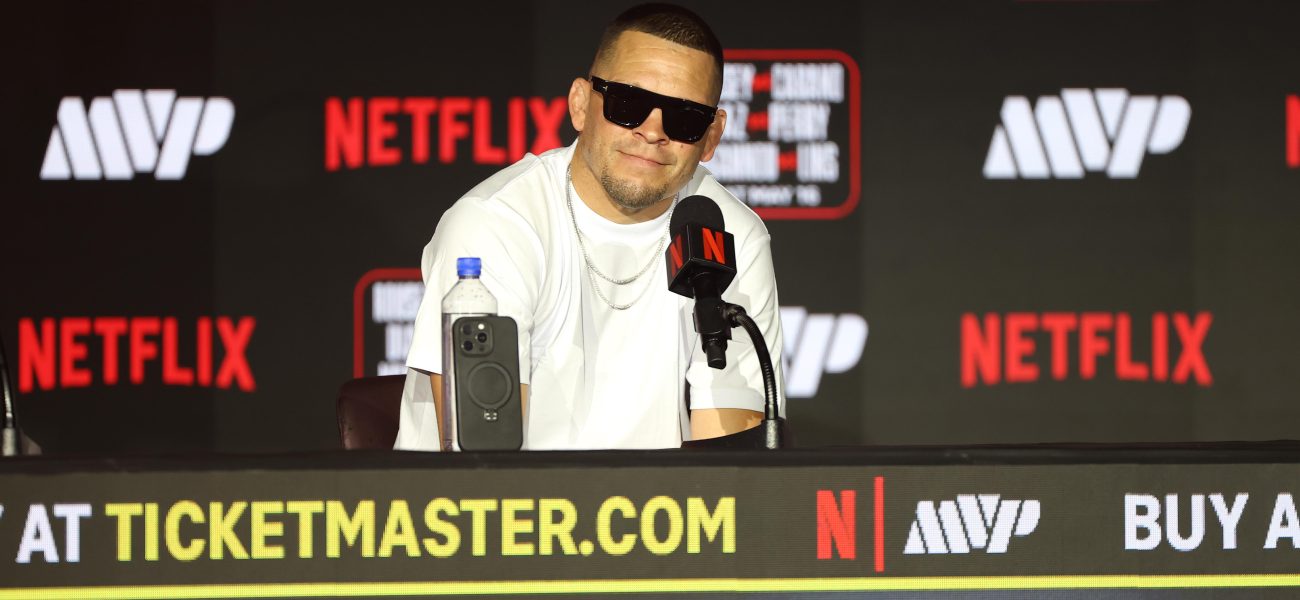
The veteran provocateur Nate Diaz weighed in, articulating what many spectators likely felt about the perceived artifice. He lashed out at Strickland — and Chimaev for “hugging and showing love like some bitches. Fake f*cking puppets.” His words cut through the noise, albeit crudely, speaking to a collective fatigue with engineered narratives. It really feels like an admission from a fight insider, doesn’t it?
Meanwhile, the raw, undeniable talent still surfaces, sometimes bypassing the melodrama entirely. Joshua Van, an emerging talent, has reportedly achieved the fastest 1,000 significant strikes in UFC history, eclipsing even established veterans at this stage of his career, according to analytics compiled by fight statistician Nate Latshaw. But does anyone really care about a new record when the primary discussion revolves around who’s faking what?
And it’s this blend of high-level performance — and low-level theatrics that creates the modern combat sports spectacle. Promoters walk a tightrope, knowing full well that genuine drama sells, but manufacturing it often yields diminishing returns. What happens when the lines blur beyond recognition? It erodes credibility, sure, but it also creates a vacuum where genuine discussions about critical issues become mere background noise to shouting matches about imagined grievances.
📄 POLICY WIRE WHITEPAPER PUBLISHED: PAKISTAN'S NATIONAL SECURITY POLICY PRIORITIES
👉 READ BY CLICKING HEREAnother official, Dr. Fatima Khan, a cultural anthropologist specializing in digital public spaces and South Asian diaspora studies, highlighted the long-term impact. “For communities who crave authentic representation in global media, seeing public figures pivot so clumsily on deeply felt geopolitical issues or engage in clearly manufactured rivalries can be truly alienating,” she noted. “It reinforces a sense that their experiences are just props in someone else’s marketing scheme. But, they’ve got sharp eyes.” The financial incentives in this dynamic are, of course, astronomical.
This entire dynamic, whether a political retraction or a manufactured rivalry, points to an interesting moment in how public figures manage their personas. Authenticity is often touted as king, yet the constant push for engagement often leads to its antithesis. Fans demand truth, yet are simultaneously fed a steady diet of the constructed — and the carefully curated.
What This Means
This entire spectacle isn’t just about fighting; it’s a stark commentary on the contemporary information landscape and the economic incentives that shape it. The political implication is simple: when prominent figures muddy the waters of sincere discourse with performative antics, it creates an environment of skepticism for all public messaging. It trains audiences to doubt, which in turn makes it harder to distinguish genuinely important narratives from noise.
Economically, it’s a double-edged sword. Short-term, contrived drama might boost pay-per-view numbers or social media engagement, but in the long run, it corrodes brand loyalty and the perception of sport as a meritocracy. When audiences can’t trust what they’re seeing, the value of the ‘product’ diminishes. It also normalizes an ethical fluidity in public commentary that could, frankly, spill over into other domains — where the symbolic value of words and actions carries tangible weight.