

Gravity-Defying Wreckage: A High-Wire Act of Urban Decay
POLICY WIRE — New Haven, CT — The scene played out like absurdist theater, except the stakes were brutally real. For a few confounding hours yesterday, commuters found themselves rubbernecking not at...

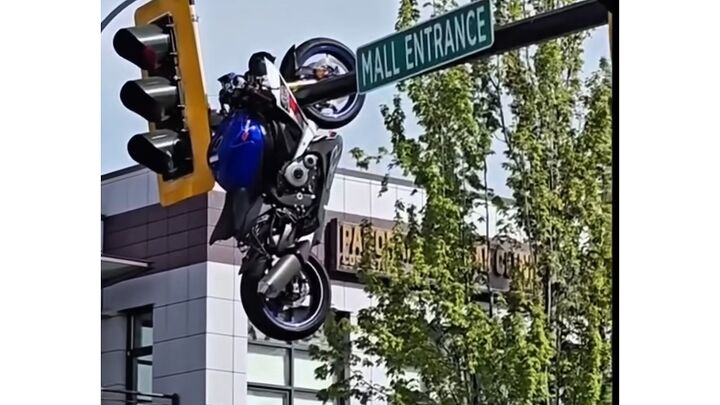
POLICY WIRE — New Haven, CT — The scene played out like absurdist theater, except the stakes were brutally real. For a few confounding hours yesterday, commuters found themselves rubbernecking not at typical fender-benders, but at a motorcycle suspended mid-air—its mangled frame snared improbably, almost elegantly, on a traffic signal overhead. It wasn’t a scene from a Hollywood stunt gone wrong; it was the grim, silent tableau of urban collapse, neatly packaged and presented at a busy intersection.
It’s the sort of image that sticks with you. One moment, a rider’s fighting for street space, the next, his machine’s a grotesque ornament, testament to an impact no one should ever experience. The accident, which involved a high-speed collision between the motorcycle and a sedan near the junction of Maple and Oak Streets, left one individual hospitalized in critical condition. But it left countless others with a stark, tangible question mark hovering over the competence of their city’s arteries. You don’t often see a vehicle trying to mimic an urban gargoyle. This wasn’t some minor bump—it was a forceful, almost physics-defying propulsion that defied common sense, leaving authorities and onlookers scratching their heads, and likely, their consciences.
“We’re looking at everything from vehicle speed to signal pole integrity,” said Eleanor Vance, a city council member known for her blunt assessments of municipal shortfalls, her voice tight with thinly veiled exasperation. “But let’s be real, you don’t get a bike tangled in a traffic light unless something went catastrophically wrong with human judgment or, frankly, sheer luck. Or, perhaps, a wicked combination of all three. Our streets, bless their concrete hearts, aren’t built for this kind of aerial acrobatics.” Vance didn’t mince words; she rarely does. But it wasn’t just local negligence. This spectacle, however localized, speaks volumes about a larger, often unaddressed truth.
Because cities around the globe, from the planned gridiron of American metropolises to the swirling chaos of Karachi or Delhi, grapple with the twin demons of infrastructure decay and increasingly aggressive road users. There’s a shared global narrative in scenes like this—the battle against vehicular entropy. While the details of the New Haven incident are under investigation, it’s illustrative of a broader predicament: an accelerating dance with danger that’s playing out on two wheels (or four) worldwide.
Dr. Rahim Ahmed, a sociologist specializing in urban development from Lahore University in Pakistan, remarked on the grim universality. “The dynamics might differ—a traffic signal pole in New Haven is, perhaps, more robust than one in a bustling Pakistani city. But the core issues of driver training, vehicle maintenance, pedestrian safety, and governmental investment in robust infrastructure are identical,” he explained in a phone interview. “When public systems falter, — and personal responsibility waivers, you get these moments of spectacular, tragic failure. It’s not just a North American problem; it’s a symptom of a larger struggle for order in our ever-expanding urban centers. We see bikes become air-bound regularly here, sometimes due to a pothole the size of a crater, other times sheer disregard.” Ahmed paused, then added, “It’s often a mirror of underlying economic pressures, too—poorly regulated transport being the default for so many. And poor regulation often comes hand-in-hand with inadequate state capacity.”
And those pressures are considerable. Globally, road traffic injuries are a leading cause of death for young people aged 5-29 years, with motorcyclists accounting for a staggering 28% of all road traffic deaths, according to the World Health Organization. This isn’t just a freak incident; it’s part of a pervasive pattern of fatalities — and systemic fragility. The human toll is immeasurable; the economic cost to communities, too, runs deep, from emergency services to long-term care for survivors.
📄 POLICY WIRE WHITEPAPER PUBLISHED: PAKISTAN'S NATIONAL SECURITY POLICY PRIORITIES
👉 READ BY CLICKING HEREThe city’s engineering department, naturally, deflected immediate blame, pointing instead to vehicle speed as a likely primary factor. Yet, how long can cities ignore the growing chorus of voices demanding more than just investigations, but proactive redesign and aggressive enforcement? It’s not an unsolvable mystery. But it requires genuine political will. Not just talk, you know?
It’s about budgets, yes, but it’s also about a deeper cultural understanding of urban spaces—shared spaces, mind you—and the need to prioritize human lives over a few seconds gained in traffic. This event—this suspended, tragic tableau—isn’t merely an anomaly. It’s a flashing red light for urban policymakers, shouting that ignoring the symptoms only leads to more dramatic, gravity-defying consequences.
What This Means
This bizarre incident, though visually unique, functions as a powerful, albeit grim, allegory for systemic vulnerabilities in urban environments across both developed and developing nations. Economically, such events strain municipal budgets, not only through direct costs of emergency response and infrastructure repair but also through decreased public trust and reduced economic activity around accident sites. Politically, the immediate response often focuses on culpability—either driver error or infrastructure failure—but savvy officials know it’s rarely that simple. It prompts an uncomfortable, necessary examination of city planning priorities, particularly in resource allocation for road maintenance, traffic enforcement technologies, and public awareness campaigns. Because who’s going to invest when it seems like the entire system is held together by hope — and duct tape?
For regions like South Asia, where motorcycles are often the backbone of personal transport and infrastructure can be highly uneven, such an incident underscores the persistent public safety challenges. It highlights the urgent need for a holistic approach to urban mobility that combines strict enforcement with modern traffic management, and—importantly—sufficient funding. Ignoring these persistent structural weaknesses is no longer an option; the cost, both human and fiscal, is just too damn high.