
Albuquerque’s Bus Gambit: A Bold Re-routing, or Just Kicking the Can Down the Road?
POLICY WIRE — Albuquerque, N.M. — For years, the dusty streets of Albuquerque’s South Valley have felt like a world apart, tethered by threadbare bus routes that often missed the...

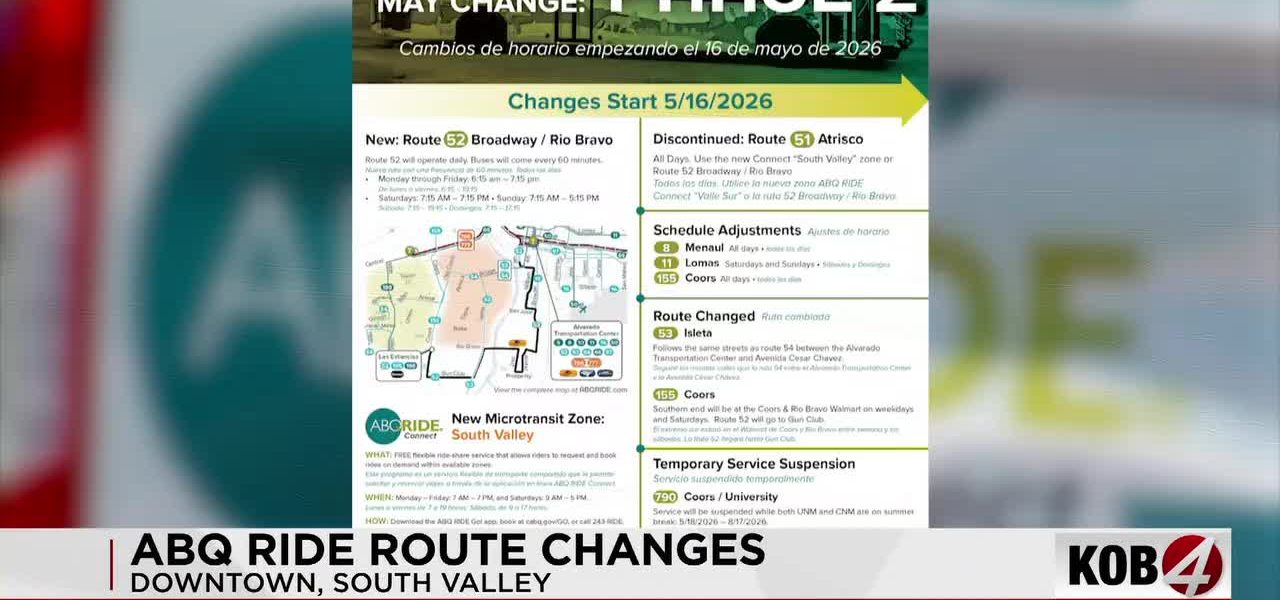
POLICY WIRE — Albuquerque, N.M. — For years, the dusty streets of Albuquerque’s South Valley have felt like a world apart, tethered by threadbare bus routes that often missed the beat of daily life. Now, the city’s transit overlords — ABQ Ride, bless their bureaucratic hearts — are making some big noise about fixing it. They’re not just tweaking the schedule; they’re pulling the plug on one old friend, Route 51, introducing a shiny new one, Route 52, and, for a flourish, rolling out something called ABQ RIDE Connect. It’s all kicking off this Saturday, a grand re-jigging they’re calling phase two of ABQ RIDE Forward. Call it progress. Call it disruption. But don’t call it business as usual, not in this town.
The whole enterprise, for those keeping score, means that old Route 51 — a fixture for longer than some of us care to remember — is hitting the great bus depot in the sky. In its stead, Route 52 promises to be the new artery, connecting downtown with places like Barelas, the city zoo (because, obviously, people need to get to the animals), the National Hispanic Cultural Center — a big deal for identity and connection here — and those sprawling Valle del Sol and Las Estancias shopping centers. Plus all the neighborhoods caught in their orbit. Routes 53 and 155? They’re getting shifted around, too, chasing the elusive ‘busier areas’ — a constant urban planner’s fantasy.
And then there’s ABQ RIDE Connect, the on-demand ‘microtransit’ option. It’s meant to cover the nooks and crannies that conventional buses just can’t seem to reach: the swathe south of Central, west of the Rio Grande River, north of Rio Bravo, and east of Coors. You book it on an app — because of course you do — or you call 243-RIDE. Imagine it: a little bespoke taxi service, but for the masses. It’s a concept that sounds slick on paper, aiming for flexibility in an area that often feels anything but connected. But does it truly democratize access, or just add another layer of tech-savvy complexity for folks already struggling with basic utilities?
“Look, we’re not just moving buses around,” Mayor Tim Keller reportedly quipped, sounding a bit tired of endless debates over public infrastructure. “We’re untangling decades of inertia. This — this is about giving folks in the South Valley a genuine shot at moving freely, accessing jobs, clinics, opportunity. It’s about building a healthier, more vibrant community, one bus route at a time.” It’s a line often heard in city halls: transit as the ultimate social equalizer. Yet, the question always lingers: how many folks truly catch that ride to upward mobility?
Transit Director Leslie Keener was a bit more direct. “It’s simple math,” she explained, cutting straight to the chase. “Better access means better lives. You’re talking about getting people to work, to their kids’ schools, to critical medical appointments. And this micro-transit piece? It’s a game-changer — getting people where the old routes just couldn’t reach, quick and clean.” Her words echo the sentiments found in burgeoning global cities, too. In places like Karachi or Dhaka, where formal public transport often buckles under sheer human mass, informal micro-transit like ‘Chingchis’ or rickshaws are, quite literally, the lifeline for millions, covering the ‘last mile’ that formal systems simply miss. Albuquerque’s bet on micro-transit, then, isn’t some wild experiment; it’s a scaled-down echo of urban innovation seen on a far grander, more chaotic scale across South Asia.
📄 POLICY WIRE WHITEPAPER PUBLISHED: PAKISTAN'S NATIONAL SECURITY POLICY PRIORITIES
👉 READ BY CLICKING HEREThe city’s bet on this new model also brings to mind the ongoing challenges of urban neglect and the push for greater dignity on demand in communities that feel left behind. For the average South Valley resident, whose average household income, according to recent census data, is roughly 25% lower than the city’s overall average, these transit changes aren’t just about convenience; they’re about economic survival.
What This Means
This ABQ Ride restructuring is more than just a logistical reshuffle; it’s a political tightrope walk. Mayor Keller, a progressive Democrat, clearly views robust public transit as central to his vision of an equitable city. By targeting the South Valley — a demographically rich, historically underserved area — he’s consolidating a key electoral base while trying to demonstrate tangible results. But here’s the catch: the success of ABQ RIDE Connect hinges on technology adoption, digital literacy, and smartphone access. If you’re a senior citizen or a low-income worker without a reliable data plan, an app-based service might feel like another barrier, not a solution. Because let’s be real, public transit is, at its heart, a public good, and its accessibility should never be contingent on owning the latest gadget. Economically, better transit access should unlock new job opportunities and better access to healthcare for residents who currently face hours-long commutes or depend on expensive private alternatives. And for retailers — and businesses along the new Route 52? It’s a potential influx of customers, a boon for local commerce. But for every hopeful bus stop, there’s an old one being removed. What happens to those folks? The success — or failure — of this ambitious redesign will offer a microcosm of challenges faced by cities globally as they grapple with 21st-century mobility, often with 20th-century budgets. And while we’re talking about access, one can’t help but wonder about the deeper implications of community trust in city services, particularly as Albuquerque continues to contend with its own unique struggles regarding its public institutions. It’s a complicated dance.
The new changes begin this Saturday, for better or worse. We’ll be watching to see if Albuquerque’s South Valley truly gets the ride it deserves, or if this latest round of fixes just sends residents searching for another way home.