


Europe’s Richest Showdown: When A Whistleblower’s Impartiality Holds Billions Hostage
POLICY WIRE — Geneva, Switzerland — The world’s delicate balance, often held together by tenuous agreements and carefully worded communiqués, sometimes finds its most jarring manifestation not...

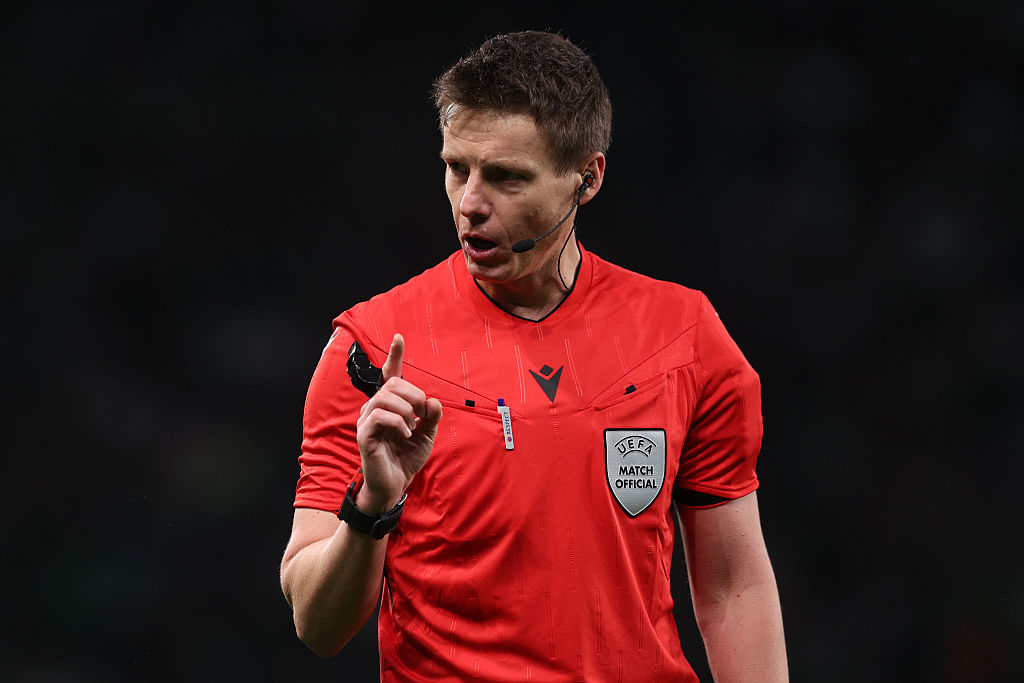
POLICY WIRE — Geneva, Switzerland — The world’s delicate balance, often held together by tenuous agreements and carefully worded communiqués, sometimes finds its most jarring manifestation not in hallowed diplomatic halls but on a meticulously manicured patch of grass. An arbitrar’s call in Geneva can sway sovereign futures. Yet, tonight, it’s not a peace envoy we’re watching, but a German football official—Daniel Siebert, to be exact—who holds in his whistle the power to tilt a contest worth more than some nations’ annual budgets.
It’s the quiet moments before the roar, isn’t it? That’s when the real pressure lands. For UEFA, the continental footballing leviathan, the seemingly mundane appointment of a referee for its crown jewel event—the Champions League final between Paris Saint-Germain (PSG) and Arsenal—is never just about football. It’s about optics. About fairness. About maintaining the facade of objective justice when literally billions of eyes, and an unfathomable amount of global capital, are fixated on 22 men and a single ball. Siebert’s name, murmured through media circuits mere hours ago, carries a weight that would crush lesser mortals.
Siebert, an arbiter of considerable standing, isn’t new to this high-stakes dance. He’s presided over four Arsenal victories in as many appearances—a spotless record for the Gunners. PSG, his other recurring charge, holds a slightly less flattering 3 wins — and a draw across his four prior outings. Small numbers, to be sure, but in the fevered calculations of fan forums and punditry, they’re transmuted into prophecies, portents of doom, or assurances of triumph. One wonders if state department officials receive similar statistical breakdowns before embarking on sensitive negotiations.
And let’s be frank, the scrutiny doesn’t stop with the man in the middle. His crew—Jan Seidel and Rafael Foltyn as assistants, Sandro Schärer as fourth official, and the VAR team of Bastian Dankert, Robert Schröder, and Spain’s Carlos del Cerro Grande—will be under a collective microscope. Every flicker of a flag, every delayed decision, every replayed angle will be diced, dissected, and debated with the fervor usually reserved for UN Security Council resolutions.
“We don’t take these appointments lightly,” explained a UEFA insider, speaking on condition of anonymity, much like a source confirming troop movements. “Months of assessment, performance metrics, and psychological evaluations go into ensuring the integrity of the game’s biggest stage. Mr. Siebert represents the highest standards of officiating we demand.” You’d almost think they were picking a head of state.
The stakes are simply astronomical. Beyond the glitz, the sponsorships, and the gargantuan media rights deals—estimated to exceed $4 billion annually for the Champions League alone, according to a recent Sports Business Journal report—lies the softer power. A successful showing for Arsenal, English football’s sleeping giant, injects fresh zeal into the Premier League’s brand across Africa and Asia. A triumph for Qatar-owned PSG—well, that’s another jewel in the crown for Doha’s relentless sports diplomacy agenda, a powerful counterpoint to narratives that seek to isolate certain regional players.
But the real theatre, often overlooked, is far from Europe. Think of the tea shops in Lahore, the cafes in Cairo, the teeming street markets of Dhaka—millions there will hang on every moment of this match, their loyalties fiercely divided, often extending beyond national boundaries. They’ve invested not just emotion, but often hard-earned cash, into betting markets or merchandising that drives a significant portion of the global football economy. A controversial call, a perceived injustice—it doesn’t just create outrage in Paris or London. It reverberates, fuelling conspiratorial whispers and eroding trust thousands of miles away, an unsettling echo of broader international relations.
“Consistency is all we ask for,” offered a representative from one of the finalist clubs, maintaining a carefully neutral public posture that masked weeks of internal lobbying. “These games aren’t just entertainment; they’re global statements. The impact of a single questionable call… well, it goes without saying it’s colossal. Everyone wants a fair fight.” It’s that subtle undercurrent of ‘colossal’ consequence that elevates these sporting events far beyond mere sport. The financial ecosystems intertwined with football are too vast, too deeply rooted, to be brushed aside as simple diversion. There’s a delicate diplomacy at play, even in sports.
What This Means
This referee appointment, while seemingly administrative, carries significant political — and economic weight. From a political perspective, UEFA needs to maintain an unimpeachable image of impartiality, particularly given the varying national and corporate interests tied to these mega-clubs. Any perception of bias—even if unfounded—can fuel nationalistic narratives, harm diplomatic relationships between footballing bodies and even nations, and invite scrutiny from powerful stakeholders like national federations and governments.
Economically, a major final decision isn’t just about who wins the trophy. Billions are spent globally on advertising, sponsorship, betting, and media rights, all of which rely on the legitimacy and perceived fairness of the game. A contentious call could spark regulatory reviews, shareholder anger, and even litigation if major betting outcomes are influenced. Brands pour hundreds of millions into these associations, expecting not just exposure, but alignment with integrity. The economic fallout of a widely perceived ‘robbery’ could dent a brand’s reputation for years, not to mention impacting market confidence in UEFA’s ability to govern its own product. for a region like Pakistan or other parts of South Asia, where football fandom is fervent and betting—both legal and illicit—is prevalent, decisions from Europe resonate powerfully, sometimes becoming local flashpoints or simply another example for disillusioned citizens to point to the perceived unfairness of international systems. This single football match, overseen by Daniel Siebert, isn’t just about a ball; it’s about global governance, financial markets, and the brittle nature of trust in a spectacle designed to unite, but sometimes, only highlights our deepest divisions. And frankly, that’s what makes it worth watching.