


Silent Sentinels: When Russian Troops Bowed to Ukraine’s Robot Vanguard
POLICY WIRE — Kyiv, Ukraine — They weren’t battling flesh-and-blood, not exactly. Out in the desolate, scarred landscape near Avdiivka—a name synonymous with grinding attrition—Russian...

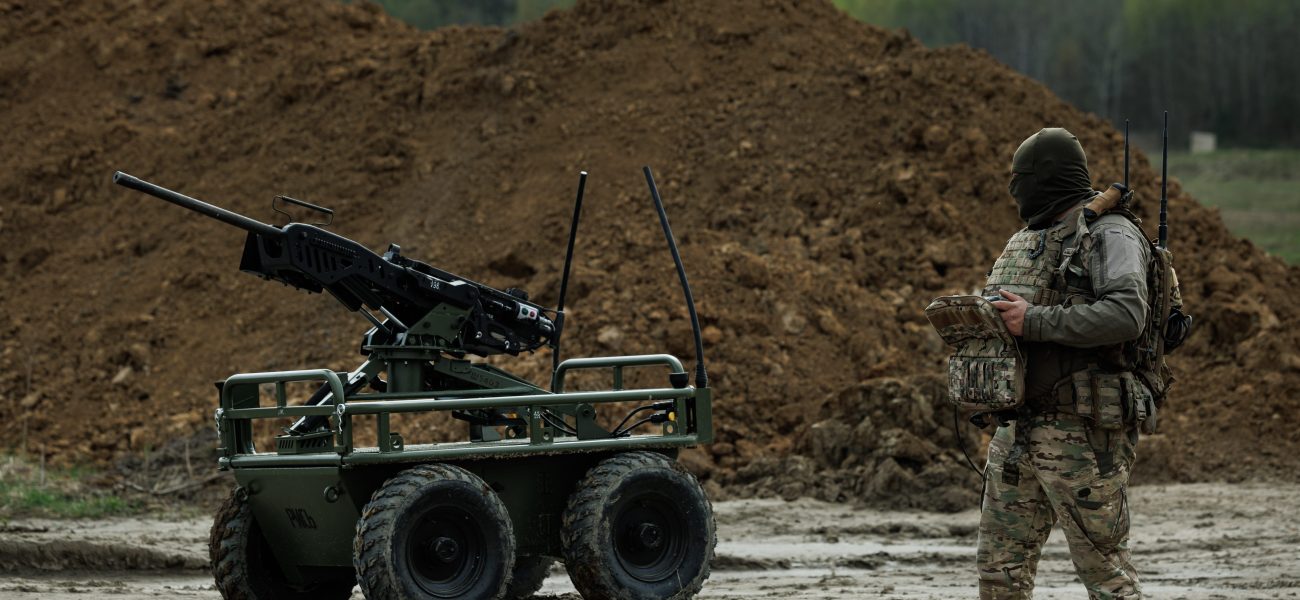
POLICY WIRE — Kyiv, Ukraine — They weren’t battling flesh-and-blood, not exactly. Out in the desolate, scarred landscape near Avdiivka—a name synonymous with grinding attrition—Russian combatants, entrenched and seemingly resilient, did the unthinkable. They laid down arms. Not to Ukrainian infantry, though plenty were lurking, but to an unblinking, four-wheeled autonomous unit, barely taller than a well-fed badger, broadcasting a disembodied voice in broken Russian.
It’s a scenario ripped from a half-finished science fiction script, yet it played out in brutal, dusty reality just weeks ago. A Ukrainian arms manufacturer, RobiT Systems, developed these remote-controlled, increasingly autonomous vehicles. But even they weren’t expecting such a profound psychological capitulation. “We designed them for reconnaissance, for breaching fortified positions, maybe even carrying supplies forward,” noted Volodymyr Dubinin, CEO of RobiT Systems, his face etched with a mix of weary pride and bewildered concern. “But for surrender negotiations? Never crossed our minds, honestly. It’s a surreal moment for everyone involved. For humanity, perhaps.”
And ‘surreal’ barely covers it. Imagine: no human threatening with a rifle, just cold steel and code advancing, patiently broadcasting a surrender offer translated from Kyiv’s war room. It seems the sheer dehumanizing dread, that absolute certainty of facing something unfeeling, unbroken by morale or fear, pushed these men over the edge. One moment, they were defying artillery; the next, they were responding to a metallic chirrup from a drone they couldn’t even wound.
This incident—a morbid curio today—is likely a dark portent of what’s coming. Because the rules of engagement, the very fabric of warfare, they’re dissolving into algorithms. You’ve got to wonder what the grizzled generals, those who’ve seen too many messy battles fought by sweating, breathing people, are making of all this. It’s an unnerving thought, isn’t it?
The Ministry of Defense in Moscow, predictably, dismissed the reports as Ukrainian propaganda, a fantasy spun to boost morale. But satellite imagery and intercepted communications tell a different story, hinting at demoralized units unable to distinguish a probe from a fully armed combat robot. Dr. Anya Sharma, a senior defense analyst at the Stockholm International Peace Research Institute (SIPRI), specializing in autonomous warfare, puts it starkly: “The psychological dimension of facing an autonomous system is incredibly complex. It’s not just the lethality, but the sheer alien nature of an adversary that feels no fear, requires no sleep. That’s a game-changer for troop cohesion — and willpower, even among hardened veterans.”
Her assessment rings true, particularly when one considers global defense expenditures. According to recent projections from Jane’s, global investment in military AI and robotics is on track to exceed $50 billion by 2028. That’s a sharp climb, driven by the perceived advantages these technologies offer in casualty reduction — and precision. Every nation with the means, from Washington to Beijing, is racing to catch up or push ahead in this new, dispassionate arms race.
📄 POLICY WIRE WHITEPAPER PUBLISHED: PAKISTAN'S NATIONAL SECURITY POLICY PRIORITIES
👉 READ BY CLICKING HEREThe implications aren’t confined to European battlefields, either. Think about the developing world, especially regions like South Asia. Countries like Pakistan, for instance, a nation locked in a persistent geopolitical dance with neighbors, are increasingly eyeing these technologies. Pakistan’s strategic thinkers, already adept at asymmetric warfare and robust in drone development, aren’t blind to what’s happening in Ukraine. They’re acutely aware of how robotics could redefine border security, intelligence gathering, and even direct engagements. If machines can induce surrender, if they can hold territory with minimal human risk, then the calculus for defense spending and troop deployment shifts dramatically across the board. The debate isn’t just about ethical concerns—though those remain paramount—but about tactical necessity in a world where technological superiority often equals survival.
The incident marks a terrifying new chapter in modern combat, where the line between operator and killing machine blurs, where empathy gets programmed out of the equation. What does it mean when the fear of robots replaces the fear of soldiers?
What This Means
This episode, bizarre as it might sound, is far from an isolated curiosity. It represents a paradigm shift, signaling an acceleration in the integration of autonomous systems into frontline military operations. For one, it suggests that advanced robotics aren’t just for surveillance or logistics anymore; they can—and will—directly impact human behavior in combat, influencing surrender decisions through psychological pressure. It’s a deeply uncomfortable thought, but one that militaries worldwide will have to grapple with.
Economically, expect an even greater surge in defense contracts for AI — and robotics firms. Nations that haven’t heavily invested yet will now view this as a strategic imperative, fearful of being outmaneuvered by automated forces. Smaller, agile tech companies in Ukraine and elsewhere, those pushing the envelope on combat autonomy, stand to gain significant geopolitical leverage and capital. But, of course, that cash injection comes with its own thorny ethical debates about responsibility, accountability, and the nature of humanity in an age of machine warfare. Political leaders will find themselves wrestling with legislation that’s perpetually playing catch-up to technological advancement, trying to regulate a beast that’s already out of the cage.