


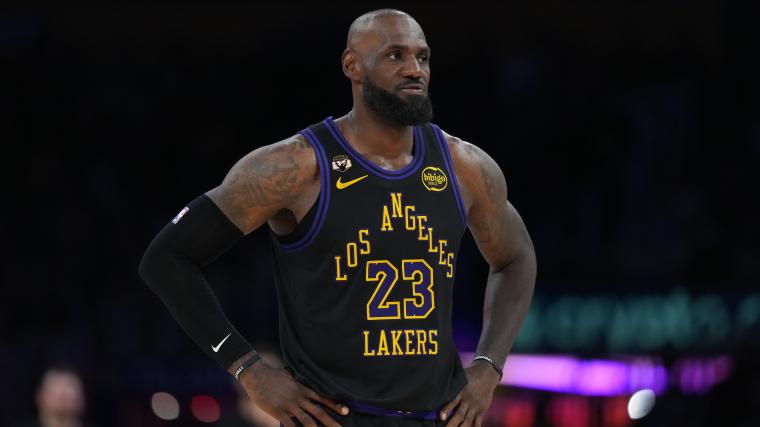
The Golden Albatross: LeBron’s Final Act Tarnished by Lakers’ Self-Inflicted Wounds
POLICY WIRE — Los Angeles, CA — The glaring scoreboard in Oklahoma City didn’t just mark another defeat; it illuminated the crumbling façade of what was once considered sports royalty. Forget...

POLICY WIRE — Los Angeles, CA — The glaring scoreboard in Oklahoma City didn’t just mark another defeat; it illuminated the crumbling façade of what was once considered sports royalty. Forget the spectacle of slam dunks and highlight reels for a moment, and peer into the harsh mechanics of a premier franchise systematically dismantling the twilight years of its most bankable asset. It’s a drama far more Shakespearean than a mere playoff series, unfolding before a global audience — one where the decline isn’t the star’s fault, but rather a cold, organizational malady.
It’s become a grim routine, hasn’t it? The Los Angeles Lakers, draped in their storied purple and gold, now seem more adept at snatching defeat from the jaws of a competitive half than they’re at stringing together four wins. And this time, with another humiliating exit looming—a three-game deficit against the spry Oklahoma City Thunder—the narrative isn’t about LeBron James’ declining athleticism. It’s about how a supposed dynasty-builder has become an institutional wrecking ball, flattening not just playoff hopes, but an unimpeachable legacy.
For twenty years, James has navigated professional basketball, consistently defying gravity — and expectation. He’s been swept three times before in his storied journey—twice in the NBA Finals (2007, 2018), and once in the Conference Finals (2023). But never before has the stage felt so barren, the supporting cast so acutely unprepared for the incandescent glare of playoff basketball. Many folks are quick to label this as another ‘stain’ on his G.O.A.T. debate card. They’re missing the point. The real question, the one whispered in hushed tones across locker rooms, is why a franchise — with all its prestige and resources — continues to fumble the fundamentals.
Lakers General Manager Rob Pelinka, ever the optimist, insists on seeing the bigger picture. “We’re always looking at the horizon, making tough choices that, perhaps, aren’t immediately popular but build for long-term competitiveness,” Pelinka reportedly told a small group of investors recently. (He wouldn’t respond to requests for official comment.) Long-term competitiveness? The only thing competitive seems to be the Lakers’ ability to lead at halftime only to unravel with spectacular efficiency in the second. In fact, their bench has scored a paltry 32 points against the Thunder’s dominant 85 across the first three games, an alarming indicator of sheer depth disparity. They just don’t have it.
The persistent failure to scout, draft, and integrate complementary talent isn’t just an oversight; it’s a systemic rot. The original intent for this season was, apparently, to get younger, to inject fresh legs and nascent talent alongside James and Anthony Davis. But then came Luka Dončić, a phenomenal talent plagued by his own health woes and a noticeable reticence to seize command in clutch moments. He isn’t any more healthy than Davis, really, and he tends to look for someone else to bail him out when the pressure mounts. And Austin Reaves? The experiment of making him the team’s second scorer feels less like genius, more like desperation, revealing he’s more focused on his own shot than involving the struggling collective when his efforts fall short.
“You watch them play, and it’s like seeing a Bentley on blocks, with bald tires and a bad transmission,” remarked Kareem Abdul-Jabbar, a Laker legend, in a recent, uncharacteristic burst of candor. “This isn’t about LeBron; it’s about a board room, an ownership group, that seems to have forgotten how to drive. It’s infuriating, frankly, to see such raw talent wasted.”
But the fallout extends beyond Staples Center. Fans from all corners of the globe, from London to Lahore, tune in for this specific brand of athletic escapism. In a world increasingly interconnected, where the success or failure of a major sports entity carries significant weight, these continued institutional struggles resonate, challenging brand loyalty even in distant markets like Pakistan and across the broader Muslim world, where NBA fandom has steadily grown. There, like everywhere else, a losing team is still just a losing team, and the disappointment cuts deep, regardless of geographic boundaries. Just like Ireland’s youth stars grappling with brutal economies in football, players are often victims of larger, systemic dysfunctions.
What This Means
The Lakers’ current predicament offers a sobering lesson in corporate governance within the highly capitalized world of professional sports. When a storied institution, despite access to immense financial resources and global appeal, fails to adapt and execute strategic talent acquisition, it demonstrates a deeper flaw than mere ‘bad luck.’ This isn’t just about basketball; it’s an economic and sociological commentary on how legacy can breed complacency, and how a superstar’s drawing power can be, paradoxically, exploited rather than truly leveraged. The perceived mismanagement impacts everything from jersey sales to broadcast rights, undermining the value chain. And it underscores the harsh reality that even the most celebrated individuals are ultimately products of their organizational environments. Fans, the ultimate consumers, pay a premium for a product that isn’t delivered, leading to a palpable sense of disillusionment that transcends national borders, even in places like the bustling markets of Karachi where young entrepreneurs might see a parallel in their own struggles against established, sometimes mismanaged, industries. It’s a classic case of how even a valuable commodity can lose its luster when not managed with shrewd precision.
The impending offseason will be a crossroads. The team can either recommit to an actual strategy—one that prioritizes fit and depth over celebrity, fostering a truly coherent unit around their aging, yet still immensely capable, cornerstone—or continue down this self-destructive path. Because if they don’t, then James’ final chapters, instead of being a grand closing statement, will be forever punctuated by a whimper. It’s a stark reality, one that transcends the glitz of Hollywood.