

Octagon’s Iron Will: Jim Miller Fights a Harder Battle Than the UFC Cage
POLICY WIRE — Newark, New Jersey — They don’t give out championship belts for navigating cancer wards or wrestling with mounting medical bills. But if they did, Jim Miller—the ironman of the...

POLICY WIRE — Newark, New Jersey — They don’t give out championship belts for navigating cancer wards or wrestling with mounting medical bills. But if they did, Jim Miller—the ironman of the UFC octagon—would certainly be a reigning champion. Because for all his storied longevity, his record-breaking fights and wins in the world’s premier mixed martial arts organization, the true fight Miller has been engaged in lately makes any brutal five-round war look almost serene.
It wasn’t a snapped limb or a brutal knockout that kept Miller sidelined for 13 agonizing months; it was a microscopic, malignant presence in his teenage son Wyatt’s left eye socket. Rhabdomyosarcoma, they called it. A rare, aggressive beast of childhood cancer. And while Wyatt—bless his ‘stud’ heart, as his dad puts it—has now rung the bell of remission, the echoes of that ordeal reverberate far beyond the Miller household, slicing straight to the core of athlete welfare, healthcare access, and the precarious perch of independent contractors in America’s billion-dollar sports machine.
For two decades, Miller’s made a living carving up opponents, building a reputation as one of the sport’s most dependable, if unsung, warriors. He’s the guy who always shows up, always fights, always gives it hell. But even the toughest fighter finds themselves vulnerable when life throws a haymaker. And boy, did it ever. Miller’s joy, once rooted in the primal thrill of victory, had ‘dimmed’, as he put it. His fight week schedule traded for hospital corridors. His focus, usually on footwork — and submissions, now fixed squarely on a young boy’s recovery.
The numbers don’t lie. While the UFC flaunts eye-watering revenues and a global footprint, a 2020 report from the Harvard Law School Labor and Worklife Program estimated that UFC fighters receive only about 16-18% of the promotion’s revenues, starkly lower than the 50% often seen in major team sports. That’s a grim financial picture, one where individual athletes are largely on their own, especially when disaster strikes. Miller, like all UFC athletes, operates as an independent contractor, not an employee. This little contractual nuance means no guaranteed health insurance, no retirement plans—just the purse money and what you manage to scrape together. And this is where the policy discussion really heats up, affecting not just millionaires, but ordinary folks working contract jobs everywhere.
But Miller’s a grinder. He wasn’t surprised by the financial squeeze, or by having to foot the bills for his son’s extensive treatment—two courses of chemotherapy, five weeks of proton radiation at Rutgers University Cancer Institute. ‘It’s what it’s, right? We’re contractors — and that’s the way it goes,’ Miller admitted, a hint of resignation and defiance in his tone. He’s lucky he had ‘a bit more of a financial cushion,’ a privilege not afforded to many. And the medical bills? They piled up. Quickly.
Wyatt, the ‘amazing young man,’ needs follow-up scans and MRIs every three months for a year, and regular check-ups into his twenties. This is an ongoing saga, a silent, unseen opponent that taxes not just the body, but the bank account — and the soul. Many aspiring fighters in countries like Pakistan, where the sport of MMA is slowly gaining traction amidst challenging socio-economic landscapes, face an even harsher reality. They dream of the UFC, but often grapple with limited training resources, informal employment, and absolutely no safety net for personal or family health crises. The cost of even minor ailments can derail an entire career, let alone a battle against a rare cancer. It’s a global tale of grit meeting vulnerability.
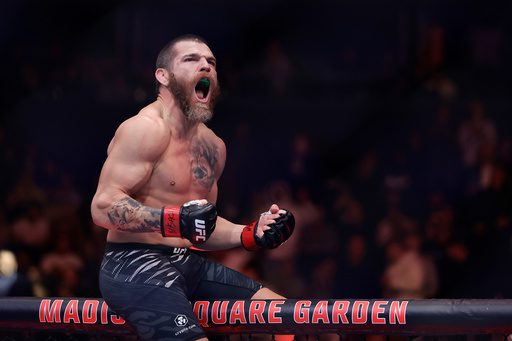
So when Miller steps into the cage Saturday night at UFC 328 in Newark to face Jared Gordon, it’s not just another fight for his 47th career UFC appearance or a shot at his 28th win. It’s a primal scream. It’s a celebration of resilience. ‘I’m not just out there just to win,’ Miller had once said. ‘I’m out there to win to make me happy; to make me excited with the way that happens.’ This time, it’s personal in a way few other fights ever have been.
The UFC, naturally, revels in stories like Miller’s. ‘While we can’t comment on individual fighter contracts, the UFC stands by its commitment to provide an unparalleled platform for athletes to compete and build their careers. Jim’s story is a testament to the grit and determination our fighters embody,’ a UFC spokesperson stated, requesting anonymity when pressed on specific compensation policies. But policy-makers are taking note. ‘The growing reliance on contract work in industries across America leaves too many families vulnerable when faced with catastrophic health events,’ asserted Senator Anya Sharma, a vocal proponent of labor reform. ‘Even in sports where billions change hands, we see a stark reminder that basic protections shouldn’t be a luxury.’
But as Miller often demonstrates in the cage, sometimes you just have to adapt — and fight the opponent in front of you. He missed the ‘push, the grind of it’ during his forced sabbatical, longing for the familiar cadence of training camps. Now, he’s back. At 40, turning 43 in August, with a record no one’s likely to touch. And for this one, his wife and four kids—including Wyatt—are expected to be cageside, a rare sight, and a testament to the magnitude of the moment. It’s a personal triumph, sure, but it also shines a harsh spotlight on the economic tightropes even ‘successful’ athletes must walk. We saw similar debates erupt around player welfare in India’s Premier League (IPL) recently. The financial behemoths falter, but the individual player still carries immense personal risk.
What This Means
Jim Miller’s return is more than a feel-good sports story; it’s a sobering mirror reflecting the ongoing policy debates around labor classification and healthcare in America—and indeed, globally. His family’s battle underscores the fundamental flaw in classifying high-risk professionals like UFC fighters as independent contractors. This designation absolves companies of providing essential benefits like health insurance, leaving individuals to shoulder immense financial burdens, even in multi-billion-dollar industries. The consequence is not just individual hardship, but a systemic vulnerability that impacts families at all income levels, from the middle-class fighter to a burgeoning college sports star navigating the NIL era, as seen in Texas Titans and Dollar Signs. This incident revitalizes the conversation around universal healthcare access, athlete unions, and legislative efforts to mandate employee benefits for workers currently classified as contractors. It’s a reminder that beneath the glitz of professional sports, a human-scaled struggle for basic economic security rages on, impacting policies far beyond the octagon.