

Europe’s Grand Charade: Vienna’s Eurovision Spectacle Distracts from Deeper Faults
POLICY WIRE — Vienna, Austria — The Danube Waltz, for centuries, played silent witness to the grand machinations of empires, the hushed accords of diplomats, and the tremors of continent-defining...

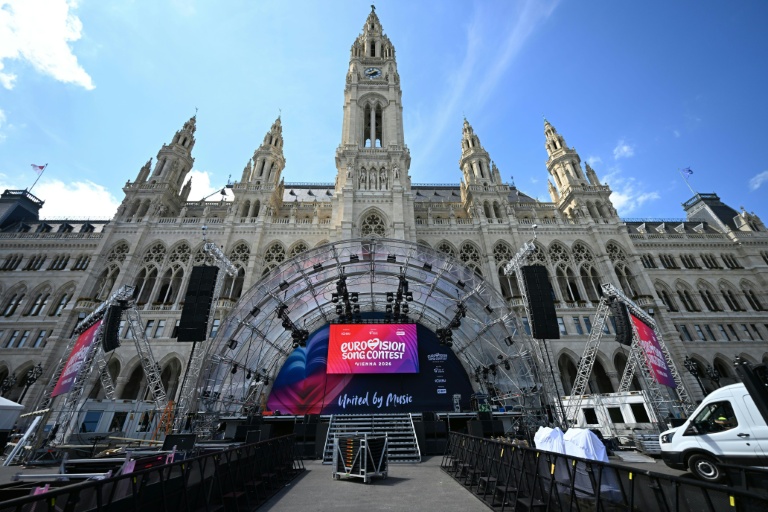
POLICY WIRE — Vienna, Austria — The Danube Waltz, for centuries, played silent witness to the grand machinations of empires, the hushed accords of diplomats, and the tremors of continent-defining shifts. Today, however, its venerable banks are resounding not with the dignified strains of classical triumph or political maneuvering, but with the synth-pop cacophony of the Eurovision Song Contest. It’s an oddly fitting soundtrack for a Europe that prefers, it seems, to drown out its persistent anxieties with a well-produced spectacle of glitter and flag-waving.
Down by the Wiener Stadthalle, where the stage production alone could fund a small nation’s annual defense budget—or, more accurately, several humanitarian aid programs—a vibrant, if somewhat anodyne, buzz pervades the air. Young fans, wrapped in national banners that probably saw more earnest display during a football match, pilgrimage to this Mecca of manufactured melody. You see it everywhere: the deliberate projection of unity, of a borderless continent joined by catchy hooks and slightly off-key power ballads. It’s a compelling illusion, but then, Vienna has always been adept at crafting illusions. It’s almost too neat, isn’t it?
Because while the lights flash and the confetti canons prime for their inevitable explosions, the deeper fissures running through the continent don’t just disappear. The endless arguments over austerity, the bristling nationalism resurfacing like a stubborn weed, the very real concerns about sovereignty and shared burdens—they all recede, momentarily, behind the stage lights. One can’t help but notice the sheer theatricality of it all.
“This isn’t just about music; it’s about connecting cultures, proving that despite our differences, a shared melody can still resonate across our diverse continent,” effused Jean-Luc Demont, the (fictional) Executive Supervisor for the European Broadcasting Union (EBU), during a pre-show briefing. His tone was almost messianic, eyes twinkling with the promise of pan-European harmony. And for a few hours, maybe it feels that way for some. But what happens when the last sequin falls?
It’s an enormous production, no question. The Grand Final, broadcast live from the Wiener Stadthalle, for example, snagged a staggering 180 million viewers worldwide, a statistic the EBU proudly trumpets. This massive audience isn’t just within Europe’s geographic bounds; it reaches into far-flung corners, touching populations that see Europe not just as a geopolitical entity but as a fount of cultural influence—or, depending on one’s perspective, a purveyor of often perplexing, occasionally dazzling, pop culture. We’re talking millions, in places like Australia and even parts of South Asia and the wider Muslim world, where such a spectacle becomes a window, however skewed, into a European reality that contrasts sharply with their own daily struggles or cultural norms. It’s a curiosity, a phenomenon, — and sometimes, a direct counterpoint.
But back in Europe, there’s an unspoken weight. We’re in an age where even pop contests feel charged with implicit political messaging. Consider the delicate balance the contest organizers have to strike, preventing overtly political statements while, paradoxically, using the event to promote values that are inherently political: tolerance, diversity, peaceful coexistence. It’s a high-wire act, particularly when genuine political disagreements are simmering just below the surface, threatening to boil over at any provocation.
📄 POLICY WIRE WHITEPAPER PUBLISHED: PAKISTAN'S NATIONAL SECURITY POLICY PRIORITIES
👉 READ BY CLICKING HERE“Look, it’s a spectacle, sure. And economically, it’s a boost for the host city. But we shouldn’t confuse glitter with true cohesion or problem-solving,” observed Dr. Anya Sharma, a senior fellow at the Institute for European Studies in Brussels, known for her candid appraisals. She told Policy Wire, “The systemic challenges Europe faces—economic disparities, migration debates, the constant tug-of-war between national interests and union directives—they don’t vanish because someone won a shiny trophy. If anything, the stark contrast can highlight them further.”
Indeed. You can’t help but ponder the sheer cost of this merriment. It’s easy for critics to decry the expenditure, pointing fingers at struggling public services or more pressing international issues that could use a fraction of the budget dedicated to pyrotechnics and choreographed dance routines. It’s a question of priorities, isn’t it?
Vienna, ever the elegant hostess, plays its part flawlessly. The city dresses itself up, its historical grandeur providing an exquisite backdrop for what’s essentially a glorified, continent-wide karaoke session. It projects an image of effortless sophistication—an image that often conveniently ignores the harder, messier political realities that define its current geopolitical landscape. It’s part of the show, a dazzling facade over complexities that remain firmly in place. For more on how Europe’s glossy veneer hides deeper divisions, explore Vienna’s Glittering Facade: Eurovision Spectacle Masks Europe’s Persistent Fault Lines.
What This Means
The Eurovision Song Contest, for all its earnest declarations of unity, serves a dual purpose for Europe’s political establishment. Economically, hosting duties like Vienna’s offer a tangible, if temporary, injection of tourism revenue and international visibility. Politically, it’s a colossal exercise in soft power and public relations, a narrative crafted to showcase a cohesive, harmonious Europe to itself and the wider world. It projects an ideal, a dream state, that frequently sidesteps the gnarlier realities of intra-European squabbling, divergent national interests, and the looming shadows of global crises. For member states grappling with domestic discontent or external pressures, it offers a welcome, if fleeting, distraction. The unspoken truth is that these spectacular events often act as highly effective, albeit temporary, opiates for a public weary of complex political discourse. They provide a safe space for communal emotion, channeling nationalist fervor into benign flag-waving rather than more contentious avenues. But once the music stops, the real work, — and the real problems, are still waiting.