


Old Salts, New Peril: Britain’s Warship Heads East, Again
POLICY WIRE — London, UK — There’s an almost cinematic quality to it, isn’t there? The silent launch, the solemn pronouncements, a lone grey hull cutting through grey Channel waters, bound for...

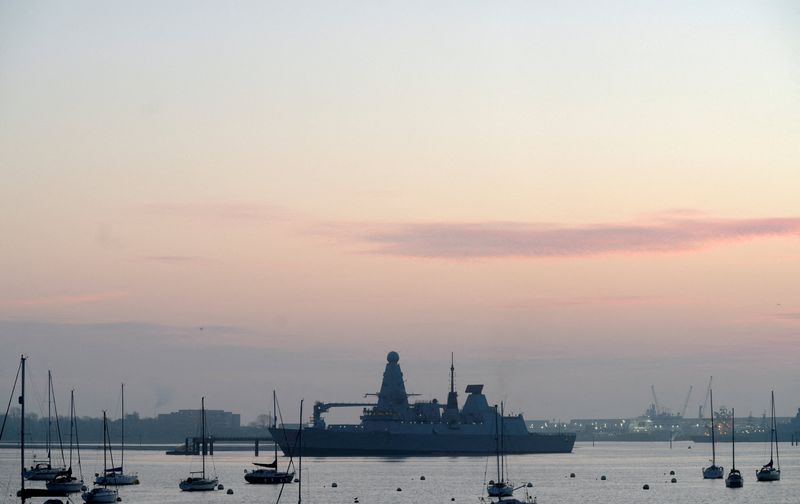
POLICY WIRE — London, UK — There’s an almost cinematic quality to it, isn’t there? The silent launch, the solemn pronouncements, a lone grey hull cutting through grey Channel waters, bound for troubles a thousand leagues away. For all the talk of a new ‘Global Britain,’ some things—like dispatching a Royal Navy warship to the Strait of Hormuz—feel strikingly familiar, a subtle, perhaps weary, nod to a past empire’s persistent ghost. It’s less a roaring assertion of power and more a quiet, diplomatic cough in a crowded room, reminding everyone, ‘We’re still here, sort of.’ But its implications, particularly for a nervously watching South Asia, are anything but subtle.
HMS Richmond, a Type 23 Frigate, is the latest to join this perpetually simmering cauldron. Its mission? Ostensibly, to ensure the unfettered passage of international shipping through one of the world’s most claustrophobic maritime choke points. We’re talking about a pinch point where, according to the U.S. Energy Information Administration, roughly 20% of the world’s total petroleum consumption, alongside a significant chunk of global liquefied natural gas, slithers through each day. It’s a route whose disruption could send the global economy—already teetering—into a tailspin that’d make the 2008 crash look like a minor blip.
And let’s not pretend this deployment happens in a vacuum. It comes amid rising regional tensions; drone attacks from Yemen’s Houthis continue to menace commercial traffic in the Red Sea, threatening to funnel more shipping around Africa’s southern tip—a costly, time-consuming detour. But this new British foray leans toward the perennial Persian Gulf chess game, an enduring standoff where the UK’s presence is, frankly, something of an anachronism for some. Others see it as a necessary if minimal, contribution to global maritime security.
But how much weight does one warship really carry these days? Defence Secretary Grant Shapps—or, if he were talking off the record, might as well be—would likely argue the symbolic capital is still quite large. He’d probably tell you, “Britain’s resolve to keep the seaways open for global commerce remains unshakeable. It’s about protecting more than just our own ships; it’s about the principles of free navigation for everyone.” And he wouldn’t be wrong about the *principle*. It’s a nice sentiment. And one that makes excellent copy.
Because principle often butts heads with reality. “One ship won’t deter a committed aggressor,” opined Dr. Tariq Mahmood, a Gulf security analyst with the London-based Royal United Services Institute. “It’s a symbolic gesture, sure, a nod to old empires, but it doesn’t change the region’s power dynamics in any material way. What it does, perhaps, is allow London to maintain a seat at the table when the inevitable crises flare up.” A blunt assessment, but hardly surprising to anyone who’s watched the slow, steady erosion of Western influence in that particularly unruly corner of the world. It’s not just about protecting tankers; it’s about protecting face.
The geopolitical stakes in a flashpoint like Hormuz aren’t lost on nations thousands of miles away, particularly in South Asia. Countries like Pakistan, with its burgeoning energy demands, depend heavily on the uninterrupted flow of oil and gas through these contested waters. Just ponder how such economic chokeholds leave Asia’s breadbasket bracing for an invisible economic war. Any hiccup in that shipping lane, any closure—even temporary—sends shivers down spines in Karachi and beyond. They’ve seen this movie before, multiple times. They know the ending isn’t usually good for energy prices.
What This Means
This deployment isn’t about smashing adversaries with overwhelming force; it’s about reassurance. For shipping companies, for jittery insurance markets, for allies—even for a domestic audience yearning for proof that ‘Global Britain’ isn’t just a catchy phrase on a foreign policy white paper. Economically, any perceived threat to Hormuz translates immediately into higher oil futures, increasing the cost of everything from transportation to manufacturing across the globe. For developing economies in South Asia, it could mean devastating inflation — and energy scarcity.
Politically, it allows the UK to maintain a modicum of diplomatic leverage in regional discussions and to stand shoulder-to-shoulder with its allies, especially the US, even if that shoulder is getting a bit bony. But it also highlights the dwindling scale of European military contributions to global security hotspots, putting the onus disproportionately on America. The strategic implications are clear: these are not deterrent deployments as much as they’re defensive escorts, trying to keep a lid on a pot that just won’t stop boiling. It’s a high-stakes, low-return kind of gig, isn’t it? A game of very careful signalling, with the global economy holding its breath right alongside.