
Moscow’s Diplomatic Diktat: Putin Extends a ‘Peace’ Offer, With Strings Attached and Iron Bars in Plain Sight
POLICY WIRE — Washington D.C., USA — It’s not an olive branch so much as a gauntlet tossed across the battle lines, complete with fine print legible only to those firmly ensconced within the...

POLICY WIRE — Washington D.C., USA — It’s not an olive branch so much as a gauntlet tossed across the battle lines, complete with fine print legible only to those firmly ensconced within the Kremlin’s orbit. Moscow, you see, is now quite amenable to peace discussions regarding Ukraine. But only, — and this is the delicious irony, if those talks happen on its home turf. No Swiss chalets. No neutral ground. Just Moscow.
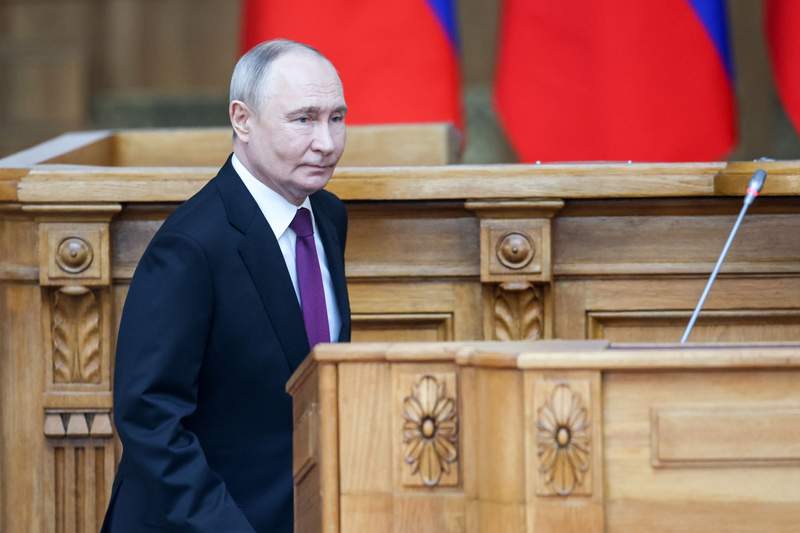
Vladimir Putin’s recent pronouncement – less an invitation, more a dictate – lands with all the subtlety of a sledgehammer, even if he presents it as a step toward de-escalation. Western observers, naturally, aren’t buying what he’s selling. They’ve heard this tune before, usually just as Moscow is consolidating gains or attempting to sow division among allies.
“It’s a masterclass in performative diplomacy, isn’t it?” quipped a senior EU diplomat who spoke on background, citing sensitivities. “You offer ‘talks,’ but under conditions designed to be rejected. It looks good for domestic consumption, maybe for those nations who crave an easy answer to a brutal war. But it’s not serious engagement. It’s theater, pure and simple.”
But theater can still have real-world consequences. This maneuver comes at a rather tricky moment. Kyiv’s anticipated counteroffensives haven’t quite reshaped the frontlines as dramatically as hoped, and the specter of what many call “Ukraine fatigue” seems to loom larger in some Western capitals. Putin, never one to miss an opportunity to press a perceived advantage, clearly senses this shift in the winds. And he’s got history on his side. Throughout its sprawling conflicts, Russia has shown a consistent preference for keeping key negotiations geographically proximate, reinforcing its own power projection.
Take, for instance, the broader global chessboard. Russia’s gambit here isn’t just aimed at the West. It’s also a dog whistle to countries navigating an increasingly multi-polar world, those perhaps chafing under long-standing Western hegemony. Nations like Pakistan, which has historically maintained a complex dance between Western ties and a growing necessity to diversify partnerships, would observe such a development with keen interest. Russia offers an alternative narrative—a vision of diplomacy on one’s own terms, free from perceived Western meddling. This aligns, at least superficially, with some South Asian countries’ own desires for greater strategic autonomy.
It’s an awkward fit, though. A report from the Stockholm International Peace Research Institute (SIPRI) last year noted that global military spending surged to an unprecedented $2.24 trillion in 2022, with Russia’s own outlay skyrocketing by an estimated 9.2%. That’s hardly the budget of a nation eager to sue for peace without substantial concessions. You don’t offer to host “peace” in your own besieged capital if you don’t think you hold some upper hand.
Ukrainian President Volodymyr Zelenskyy, or at least his senior staff, seems to interpret it that way too. They’re quick to dismiss such overtures as poisoned chalices. “We’re not naive. Russia’s idea of ‘peace’ means capitulation,” declared Ukrainian Foreign Minister Dmytro Kuleba via a translated statement released by his ministry. “Any talks must respect our sovereignty — and territorial integrity, based on international law. Period. Not some charade staged in a hall full of state security agents.”
Because that’s the rub, isn’t it? For Ukraine and its Western backers, negotiations must start from a position of restored sovereignty, not from an acknowledgement of Russia’s illegal annexations. But Moscow’s current proposal insists on the inverse – that any discussion inherently accepts the Kremlin’s revised map.
What This Means
Putin’s ‘Moscow peace talks’ proposal isn’t about genuinely seeking a negotiated end to the conflict right now. No. It’s a multi-pronged psychological — and political operation. Firstly, it aims to fracture the unity of Ukraine’s Western supporters. It gives ammunition to those in Europe — and the U.S. who advocate for a quick, if unjust, resolution to the conflict, framing Kyiv as the intractable party if it refuses this ‘generous’ offer. Secondly, it sends a strong signal to non-Western nations, especially those in the Global South, that Russia is the reasonable actor, open to dialogue, while the West is the warmonger. This strengthens Russia’s bid for a revised world order—one where it commands respect, perhaps even awe, from powers like China, India, and parts of the Muslim world that eye Western posturing with growing skepticism. It forces Western capitals to perform a careful balancing act, appearing open to diplomacy without legitimizing Russia’s aggression.
Thirdly, it’s a classic play to solidify domestic support, burnishing Putin’s image as a strong leader offering peace, even as he demands victory. He’s not just talking to Kyiv or Washington; he’s speaking to Beijing, to Delhi, to Tehran, and yes, even to Islamabad, portraying himself as a pragmatic global player, not an isolated pariah. The implications for nations navigating regional instability, like Pakistan which still grapples with the fallout from its own protracted conflicts, are subtle but real. Russia wants these nations to see an iron fist cloaked in a velvet glove of diplomacy, making its own model of sovereign strength – and aggression – appear viable.
And finally, it’s a test. Can the West hold its nerve? Can Kyiv maintain its principled stance against a strategically timed, politically convenient overture that carries all the allure of a cobra’s charming sway? We’ll see. The chess game continues, but one thing’s for certain: Moscow sets the table on its own terms, or it’s not playing at all.