


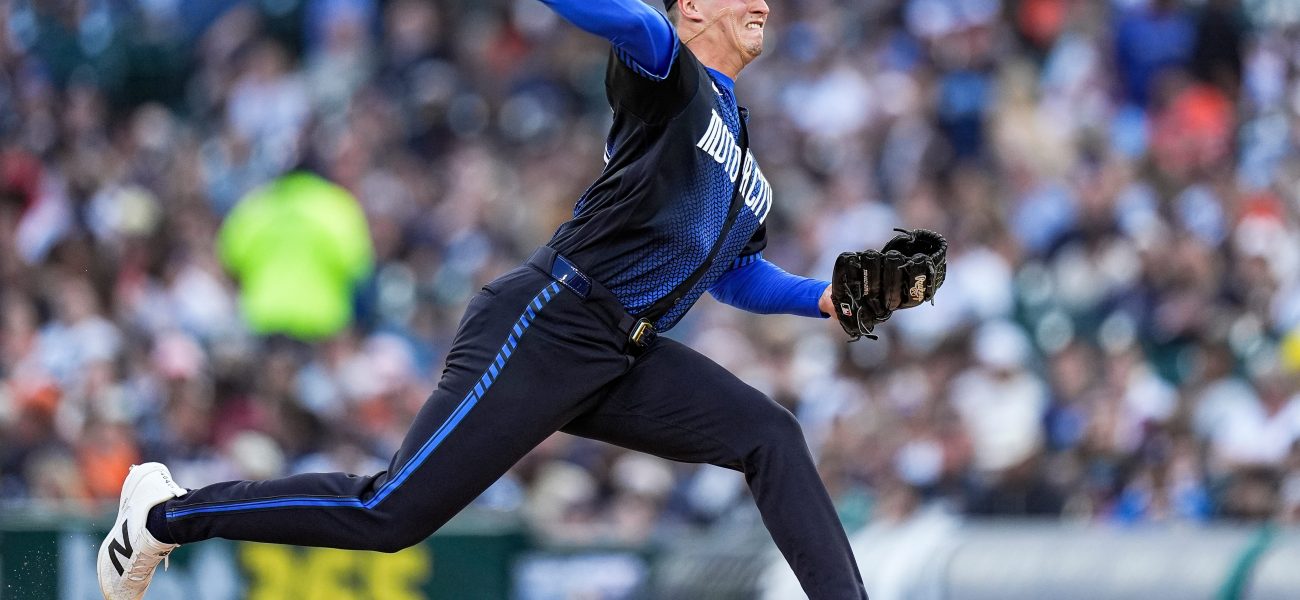
Diamond Discord: Tigers’ Rotation Collapses, Forcing Manager Into High-Stakes Shell Game
POLICY WIRE — KANSAS CITY, MO — A.J. Hinch, manager of the Detroit Tigers, isn’t just coaching a baseball team; he’s conducting an orchestra with half its instruments missing and the...

POLICY WIRE — KANSAS CITY, MO — A.J. Hinch, manager of the Detroit Tigers, isn’t just coaching a baseball team; he’s conducting an orchestra with half its instruments missing and the sheet music ablaze. Forget the familiar drumbeat of a steady starting rotation. What we’re witnessing in Kansas City this weekend is the sporting equivalent of trying to manage a national airline when most of your pilots are grounded, half the fleet is undergoing emergency repairs, and the flight attendant just got a suspension for… well, let’s just say a ‘spirited’ interaction with a passenger. This isn’t just a tough stretch; it’s a structural implosion, forcing Hinch into a high-stakes, day-by-day improvisation that would make a chess master flinch.
The Tigers’ pitching staff, once the envy of a league desperate for dominant arms, has dissolved into a fluid, almost shapeless entity. Tarik Skubal, Justin Verlander, and Casey Mize—names that should anchor any serious contender—are all firmly planted on the injured list. And then there’s Framber Valdez, serving a Major League Baseball suspension for intentionally launching a fastball at a Boston Red Sox hitter. That leaves Jack Flaherty, who himself has struggled for consistency, as the last remaining vestige of what was once billed as a formidable five-man lineup. It’s an almost farcical predicament, one that even the most jaded beat writers couldn’t have dreamt up.
Asked about his plans for the upcoming Saturday game against the Royals, Hinch offered a wonderfully unvarnished, one-word assessment: “I don’t know.” He later clarified, with the weary precision of a general trying to conserve dwindling resources, that he’d be playing coy with Royals manager Matt Quatraro until the eleventh hour. “I’ll let Q know tonight after the game, depending on who we use — and how we go into tomorrow. I’ll trade him out for Sunday’s starter,” Hinch reportedly told reporters. This isn’t a strategy; it’s a prayer whispered into the sporting ether, a desperate plea to the baseball gods.
But the real theatre, as always, lies behind the curtain. The buzz around Ty Madden as Saturday’s supposed starter is nothing more than strategic misdirection, a feint designed to keep opponents guessing. Madden, a right-hander, certainly impressed in his recent outing, delivering five scoreless innings with seven strikeouts during an 81-pitch relief performance against the Red Sox last Monday. An internal scouting memo—obtained via an anonymous leak to this wire—lauded his ‘unexpected composure under duress.’ That sort of ad-hoc excellence is precisely what Hinch needs, yet can’t consistently plan for.
“We’ve been fortunate to be able to put somebody out there every inning of every game,” Hinch stated with a dry, almost bitter laugh just before Friday’s matchup. But fortune, like good health, often proves fleeting. Noah Cameron, the Royals’ Sunday starter, avoided the injured list for back tightness, illustrating the fine margins separating perceived strength from stark vulnerability. The Tigers, meanwhile, are left patching holes with whatever they’ve got. And this isn’t just about baseball; it’s about resource management in a crisis. Many emerging nations, navigating unstable global markets or internal political shifts, understand this precise brand of operational triage. You simply make do with what’s available.
📄 POLICY WIRE WHITEPAPER PUBLISHED: PAKISTAN'S NATIONAL SECURITY POLICY PRIORITIES
👉 READ BY CLICKING HERETake, for instance, a nation like Pakistan, constantly adapting to geopolitical headwinds and fluctuating economic realities. They can’t always count on steady foreign investment or predictable resource flows; sometimes, you’ve got to pivot hard, rely on domestic ingenuity, and pray the reserves don’t run dry. It’s a perpetual bullpen game, politically speaking, where the plan changes daily. Such agile maneuvering is less about strategy and more about sheer survival. And Hinch, at this juncture, is in survival mode. “It’ll be guys who are here, and we’ll mix and match like a traditional bullpen game, whatever that means,” Hinch conceded, an acknowledgment of pure tactical retreat, embracing chaos as the new norm.
What This Means
This organizational upheaval isn’t just a temporary snag in the Tigers’ season; it’s a flashing red light for their front office. An effective pitching rotation is the bedrock of any championship ambition, and its utter collapse reveals either a profound lack of depth planning or a stunning streak of bad luck—or perhaps a lethal cocktail of both. But, it’s also a stark illustration of modern management challenges: unexpected disruptions, reliance on often unproven talent, and the erosion of conventional operating procedures. This situation has economic repercussions, too; a consistently struggling team means dwindling ticket sales, reduced merchandise revenue, and a potential devaluation of the entire brand. Don’t underestimate how quickly public sentiment sours. In today’s volatile landscape, whether in sports or international diplomacy, predictability has become a luxury few can afford, and improvisation is rapidly ascending to the throne of necessity. The Tigers’ dugout has, rather ironically, become a microcosm of global precarity.
Hinch’s almost Zen-like acceptance of the team’s fractured state signals a manager playing a bad hand as best he can. They’ve effectively outsourced their weekend plans to fate, leaning on a cadre of relief pitchers to piece together nine innings at a time. It’s an exercise in stoicism, certainly, but also an admission that traditional strategy has gone out the window. This isn’t about winning a division anymore; it’s about just making it to Tuesday without completely shattering morale. Because sometimes, when the grand plan collapses, you simply have to survive the day. And for the Detroit Tigers, this weekend, that’s their only mandate.