


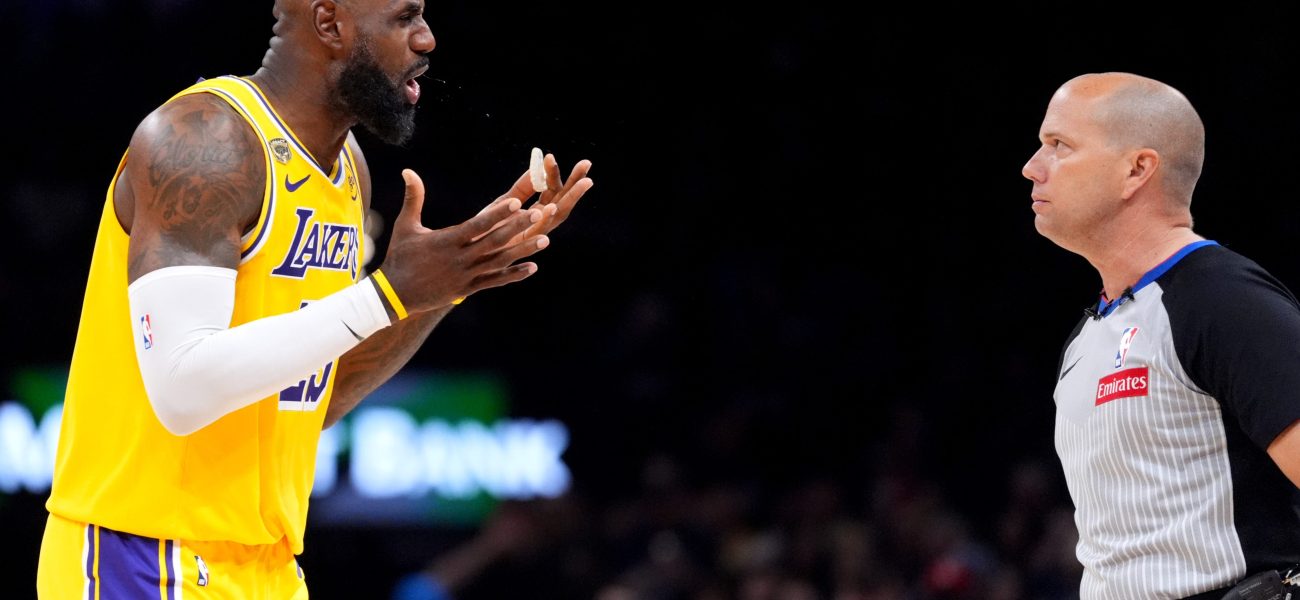
Whistleblower Blues: NBA Officiating Under Fire as Credibility Takes a Hit
POLICY WIRE — Los Angeles, United States — In the high-stakes theater of professional sports, where billions are traded on allegiance and narrative, nothing undermines the spectacle quite like a...

POLICY WIRE — Los Angeles, United States — In the high-stakes theater of professional sports, where billions are traded on allegiance and narrative, nothing undermines the spectacle quite like a whispered suggestion of institutional partiality. When the spotlight shifts from athletic brilliance to the quiet hand of the rule enforcers, a distinct, unsettling echo begins to ripple. And that’s precisely where the NBA finds itself.
It’s not just the thud of the basketball or the roar of the crowd anymore; it’s the gnawing suspicion that something’s amiss with the men (and women) in stripes. Two powerhouse teams, the Los Angeles Lakers and the Phoenix Suns, have, perhaps inadvertently, lifted the lid on an uncomfortable truth regarding officiating during their playoff clashes with the Oklahoma City Thunder. Their recent series losses haven’t just been about missed shots; they’ve been a public forum for thinly veiled accusations.
Take the Suns’ All-Star, Devin Booker. Back in November, after a particularly bruising encounter with Oklahoma City, he didn’t mince words. “The secret is out,” Booker observed dryly. “They do speed you up. They play aggressive. They’ll grab, they’ll hold, but it’s never like when you’re in a shooting position. It’s always on the handle or on your drives when they get away with it.” Months later, post-sweeping by the Thunder in the first round, his frustrations boiled over into a remarkably public display. Following a pivotal Game 2 defeat, he pointed a finger directly at an official, telling reporters, “In my 11 years, I haven’t called a ref out by name, but James was terrible tonight through and through.” That’s a bold statement, isn’t it?
But the Lakers now echo that sentiment, fresh off a 2-0 hole against the same Thunder outfit. Head Coach JJ Redick, a man known for his incisive basketball mind, couldn’t quite contain his ire after his team’s Game 2 drubbing. “I sarcastically said the other day that they’re the most disruptive team without fouling,” Redick quipped, the sarcasm dripping. Then, he delivered the payload: “They’ve a few guys that foul on every possession and all the good defenses do.” But this wasn’t about the Thunder’s gritty play; it was about the lack of corresponding whistles. He’d even gone further, stating LeBron James, perhaps the most iconic player globally, “has the worst whistle of any star player I’ve ever seen,” clarifying this wasn’t limited to a single crew or series.
It’s a peculiar phenomenon, isn’t it? This notion of an implicit ‘beneficial’ whistle for certain players or teams has always been part of basketball’s folklore. But when seasoned professionals, risking hefty fines and the wrath of the league office, speak out with such candid exasperation, it invites deeper scrutiny. It makes one wonder if the official narrative — that the officials are just calling it straight — is getting tougher to sell, particularly to a discerning global audience that’s increasingly attuned to issues of fairness and transparency.
Indeed, from the bustling cricket pitches of Karachi to the marble halls of international sporting federations, the perception of biased officiating or a rigged system isn’t merely an inconvenience; it can undermine the entire fabric of institutional trust. For fans across the Muslim world and South Asia, deeply passionate about sports and often hyper-aware of power dynamics, these whispers in the NBA carry a weight beyond the scoreboard. They inadvertently touch upon a universal concern for justice, for rules applied equally, a sentiment often invoked in broader political and economic discourse. Because if the referees can’t be trusted, what can be?
📄 POLICY WIRE WHITEPAPER PUBLISHED: PAKISTAN'S NATIONAL SECURITY POLICY PRIORITIES
👉 READ BY CLICKING HEREThe numbers themselves offer a stark perspective. While physicality is undeniably a component of Oklahoma City’s league-leading defense, the disparity in foul calls and free throw attempts is striking. In their Game 2 loss to the Thunder, the Lakers committed 26 fouls to Oklahoma City’s 21. But here’s the kicker: the Thunder shot 26 free throws, sinking 21, while the Lakers managed only 21 attempts, converting 18. Oklahoma City forces turnovers at a rate that consistently ranks them in the NBA’s top three in both the regular season and playoffs, according to official NBA league data. But what portion of those ‘forced’ turnovers verge on uncalled fouls? That’s the question haunting L.A. and Phoenix, — and frankly, the league itself.
For context, remember Booker’s Game 2 grievance? He wasn’t just fined $35,000 for his public critique, but the NBA quietly rescinded the technical fouls handed out during the game to him, Brooks, and Dort. As Booker dryly observed afterward, it essentially read: “you were right, but you can’t say anything about it.” A curious kind of vindication, isn’t it? And perhaps an unintended admission from the league’s high command.
What This Means
The controversy surrounding NBA officiating is more than just locker-room griping; it signals a potential erosion of trust that could have significant economic and political implications for the league. As professional basketball aggressively expands into global markets – particularly in regions like South Asia and the Muslim world, where fairness and equitable treatment are not just values but often deeply ingrained cultural tenets – the perception of biased refereeing becomes a serious reputational liability. It can dampen fan engagement, impact viewership numbers, and ultimately, devalue media rights, merchandise sales, and franchise valuations. Think about the intricate dance of international sports diplomacy, the investments pouring into expanding fanbases; all of it predicated on a belief in fair play. When that faith wavers, the entire enterprise feels the tremor. this kind of public challenge to an established institution like the NBA’s officiating body invites comparisons to other regulated sectors, from financial markets to judicial systems. The perceived legitimacy of rule enforcement, whether on the court or in global trade, dictates public confidence. If fans begin to see basketball as a roulette wheel where the house always has a subtle advantage, its coveted position as a premier global entertainment product starts looking a little shaky.