


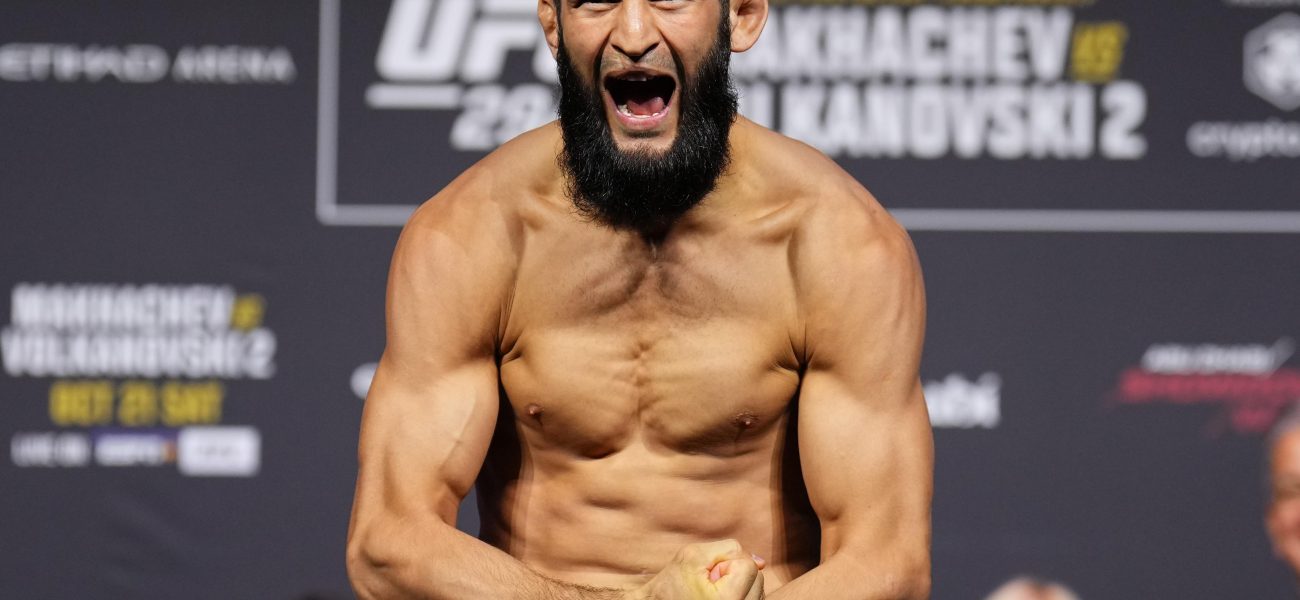
Muscles, Millions, and the Crucible: UFC 328 Weigh-ins Strip Bare Global Sporting Imperatives
POLICY WIRE — Newark, N.J. — It wasn’t just a flexing of sinew and muscle mass on a Friday morning in Newark; it was a ritual—a meticulously choreographed act of public humiliation and...

POLICY WIRE — Newark, N.J. — It wasn’t just a flexing of sinew and muscle mass on a Friday morning in Newark; it was a ritual—a meticulously choreographed act of public humiliation and calculated menace—all in service of a multi-billion dollar empire. Before a single punch lands Saturday night, the pre-fight weigh-in at UFC 328 distilled the brutal essence of combat sports: the stripping down, literally and figuratively, for global consumption. And, boy, do the cameras love to devour it.
At the center of this gladiatorial theater stood two men who couldn’t be more diametrically opposed, yet both exist within the same brutal economic framework. Khamzat Chimaev, the undefeated force of nature, often draped in flags, now stepping on the scale ostensibly representing the UAE, embodies the sport’s global expansion, particularly into the resource-rich, fight-hungry Middle East. Across from him, Sean Strickland, the pugnacious former champion, whose blunt, sometimes outrageous, American candor — a marketable defiance — cuts through the noise like a serrated edge. This isn’t just a fight; it’s a cultural clash packaged for pay-per-view, a raw nerve exposed for millions.
Because, for all the talk of honor — and legacy, the scale’s true measure is always cold, hard cash. Fighters like Chimaev aren’t just athletes; they’re walking, talking, brawling economic engines. His appeal, resonating deeply in Muslim-majority nations and across South Asia, translates directly into viewership, merchandise sales, and ever-growing arenas. The very public act of reaching the precise 185-pound middleweight limit, a battle often harder than the fight itself, signals the beginning of an elaborate revenue-generating machine. All twenty-six fighters lined up for their turn, their bodies sculpted to extremes, each hoping for a piece of a pie that’s gotten unbelievably rich.
“We’ve seen what a disciplined fighter can do for their career, their fans, and ultimately, our bottom line,” remarked UFC President Dana White, a master of marketing his product. “These guys are pros. They get it. Missing weight isn’t an option when there’s this much at stake.” He’s not wrong; even the mild hiccup with Jeremy Stephens, who tipped the scales five pounds over and sacrificed 30% of his purse, simply became part of the drama. But the bigger picture, the relentless pursuit of peak physical condition for the camera, that’s where the spectacle truly lives.
Strickland, ever the provocateur, had his own colorful commentary. “Look, I ain’t here to make friends, alright? I’m here to get paid and crack skulls. This whole weigh-in thing, it’s just the foreplay before we actually, you know, do the damn thing.” His brand of unapologetic bravado might seem like an anachronism, but it works—it connects with a segment of the audience fatigued by corporate gloss, seeking something more… unvarnished. It reminds you this isn’t just ballet, it’s primal. This is the fight game, buddy.
📄 POLICY WIRE WHITEPAPER PUBLISHED: PAKISTAN'S NATIONAL SECURITY POLICY PRIORITIES
👉 READ BY CLICKING HEREThe main event, Chimaev’s defense of his middleweight belt, is set to be a global draw. His ascent, fueled by an undeniable talent and a charismatic ferocity, has tapped into massive fan bases far beyond Western shores. According to a recent Endeavor earnings report, UFC viewership saw a 20% year-over-year increase from key MENA and South Asian markets in the last fiscal quarter. That’s a staggering jump, evidence of the burgeoning appetite for combat sports where narratives of individual triumph against all odds — or just sheer, unadulterated aggression — truly resonate. From Karachi to Cairo, the legend of ‘Borz’ sells.
What This Means
The carefully staged ritual of the weigh-in at UFC 328 offers a stark, public glimpse into the true drivers of modern professional combat sports. It’s less about simple athletic competition — and more about global geo-economics and cultural engineering. The presence of fighters like Chimaev, carefully positioned as a bridge to untapped international markets, is critical for the UFC’s continued, ravenous growth. We’re talking billions. This isn’t merely sport; it’s an economic machine adept at monetizing spectacle — and leveraging cultural identity. But there’s a flip side: the brutal demands placed on athletes, the often-exploitative pay structures compared to revenue, and the constant pressure to perform, to be a character, not just a fighter. The delicate balance between commercial imperatives and fighter welfare remains an open question—one that seldom makes headlines until it’s too late. It mirrors how larger organizations are globalizing their brands; think about the NFL’s global gambit. The human cost of the hyper-commercialization of sport, the relentless demands for content and characters, leaves scars. Even the rising tide of fighter endorsement deals, echoing Kohli’s Reckoning in cricket, doesn’t erase the stark realities for the majority of the roster.
Beyond the headliners, other fights punctuated the morning’s proceedings. Joshua Van and Tatsuro Taira hit their flyweight marks, primed for a co-main event that’ll test Van’s nascent title reign after his predecessor’s injury-shortened run. Alexander Volkov and Waldo Cortes-Acosta, Sean Brady and Joaquin Buckley — each pairing has its own intricate narrative, its own potential for triumph or crushing defeat. All 26 fighters passed the test of the scale (mostly), now ready for the real test: stepping into the octagon. It’s a grueling grind, this fight business. And we’re all watching, aren’t we? Hooked by the promise of primal, unpredictable violence—and the economic currents flowing underneath it all.