


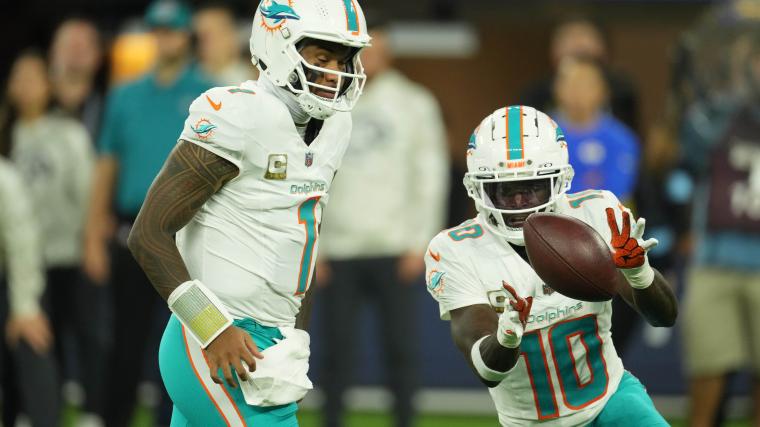
Gridiron Purge: Dolphins’ Stark Lesson in Athletic Austerity as Cap Conquers Continuity
POLICY WIRE — Miami, USA — It wasn’t the roar of the crowd, nor the snap of a breaking tackle, that echoed loudest in Miami this offseason. Instead, a far colder, more unforgiving sound...

POLICY WIRE — Miami, USA — It wasn’t the roar of the crowd, nor the snap of a breaking tackle, that echoed loudest in Miami this offseason. Instead, a far colder, more unforgiving sound reverberated through the Dolphins’ meticulously constructed (and subsequently deconstructed) roster: the inexorable grind of the salary cap. You see, the dazzling feats on the field? They’re mere illusions, a distracting sleight of hand hiding the true puppeteers pulling the strings—the accountants, the financial strategists, the men and women who see multi-million-dollar athletes not as heroes, but as liabilities on a spreadsheet. They’ve decided.
Because, make no mistake, what happened down in South Florida wasn’t a coaching whim or a strategic pivot born of creative genius. No, this was an organizational exorcism, a budget-dictated purge. New head coach Jeff Hafley—a man thrust into a fiscal maelstrom barely after unpacking his boxes—inherited not a championship contender, but a gaping monetary abyss. His predecessors, it seems, spent as if the future was a generous abstract, not a concrete, dollar-denominated reckoning. Now, that bill’s come due.
The casualty list reads like a farewell tour of recent Dolphins stardom: quarterback Tua Tagovailoa, the enigmatic passer; wide receivers Tyreek Hill, the ‘Cheetah,’ and Jaylen Waddle, his electrifying counterpart. All gone. Waddle, reportedly, was a trade, a slightly more polite dismissal than the outright releases for Hill — and Tagovailoa. But the end result is the same: an abrupt, almost clinical severing of ties, predicated not on declining talent—though, in the cutthroat world of pro sports, yesterday’s hero is today’s cap casualty—but on raw, undeniable numbers.
Hafley, a rookie head coach grappling with the consequences of others’ fiscal exuberance, painted a grim picture. “Jon-Eric and I,” he reportedly explained to an attentive, if shell-shocked, media scrum, referring to General Manager Jon-Eric Sullivan, “walked into a really difficult situation. There were thirty-three players headed for free agency—and the cap? It was a nightmare. We had no choice but to get ourselves into a healthier financial spot. It means making terribly hard decisions about truly good players, — and I’ve got nothing but respect for them. But we just couldn’t carry that freight anymore.” He said this with the weary resignation of a CEO announcing corporate restructuring.
And indeed, the business of football often mirrors corporate capitalism. Teams, much like multinational corporations, grapple with revenue streams, asset management, and crucially, operating budgets. The NFL’s salary cap, for instance, soared to $255.4 million per team in 2024, a 13.6% increase from the previous year, as reported by Spotrac. Yet, even with that uptick, historical mismanagement can lead to painful austerity measures. It’s a financial chokehold.
“They talk about player loyalty, team spirit—all that sentimental guff,” quipped Marcus Thorne, a former NFL linebacker turned sports analyst, during a recent podcast. “But when the owner looks at the balance sheet, every last drop of that disappears faster than a summer thunderstorm. It’s always been about the money, pal. Always.” Thorne’s cynicism, however pointed, reflects an undeniable truth.
This stark reality isn’t just an American anomaly; it’s a global current. Just look at economies like Pakistan, perpetually navigating IMF demands for fiscal discipline, forcing hard choices on subsidies and public services—decisions mirroring, in miniature, the Dolphins’ cold calculation. The interconnectedness of global finance means even an American football franchise isn’t entirely immune to the larger, global economic climate that makes belt-tightening a familiar narrative for millions across continents. Austerity, whether it’s in Islamabad or Miami, means cuts.
“We believe in sustainable growth,” declared Dolphins owner Stephen Ross, via a statement from the organization’s media relations department, avoiding direct interaction with the press corps—a customary move. “This rebuild, though challenging, sets us on a trajectory for long-term competitiveness, built on fiscal prudence and developing young talent.” Sustainable growth. Translation: fewer expensive veterans, more rookies on entry-level deals. Because that’s what a ‘rebuild’ usually means. It isn’t pretty. But it’s cost-effective.
What This Means
The Dolphins’ purge isn’t just a football story; it’s a corporate lesson writ large on the national stage. It shows how even in a hyper-profitable league, financial solvency trumps sentiment — and immediate success. For Miami, this means a probable regression in the win column for the immediate future. They’ve effectively punted on the upcoming season—maybe two—to reset the financial clock. Young players, fresh faces from the recent draft, are now tasked with shouldering the weight of an entire franchise. The implications for player movement in the NFL are clear: performance guarantees nothing without a favorable cap number. Agents will increasingly scrutinize team finances. Executives, particularly new ones, will wield the cap like a surgeon’s scalpel. It’s a harsh reminder that sports, at its highest echelons, remains a business, where the bottom line dictates strategy, not the glory of a Sunday afternoon touchdown. And that’s the raw, unvarnished truth, whether you like it or not.