


Shadow Play: Australia’s Immigration Debate Drowned in Digital Deceit
POLICY WIRE — Canberra, Australia — It’s a familiar script these days, isn’t it? The online echo chamber, thick with malice and misdirection, churning out narratives that have little to do with...

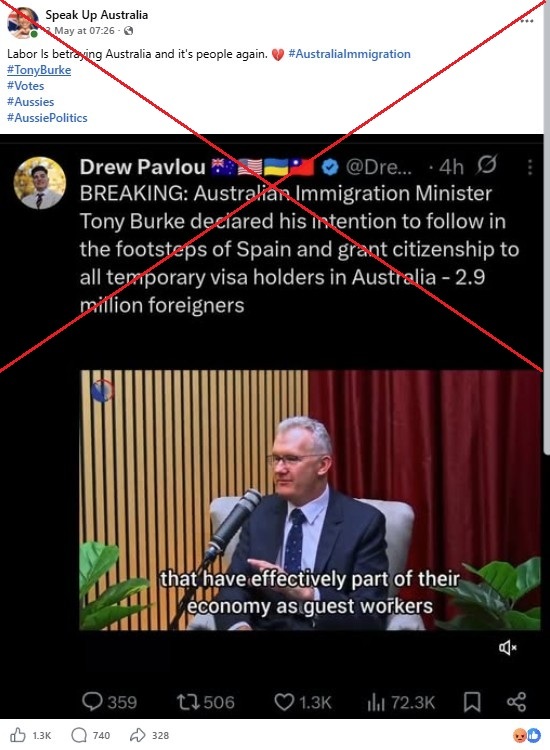
POLICY WIRE — Canberra, Australia — It’s a familiar script these days, isn’t it? The online echo chamber, thick with malice and misdirection, churning out narratives that have little to do with actual reality. Australia, a continent usually insulated from the world’s messier digital proxy wars, is discovering just how thin that digital veneer can be. Because some insidious little fabrications, spreading like wildfire across social media, have aimed squarely at a federal minister’s comments on citizenship—not just muddling the message, but fundamentally warping it into something ugly, divisive, and entirely false.
This isn’t a slip of the tongue or a minor misunderstanding; we’re talking about a full-blown disinformation campaign. Specific posts, crafted to look legitimate, have claimed a senior Australian government figure suggested a radical overhaul of citizenship requirements for immigrants, hinting at pathways that don’t, in fact, exist. The minister, whose portfolio touches the often-combustible area of immigration, found themselves staring down a digital mob, riled by words they never spoke.
“We’ve seen a cynical, deliberate attempt to inject discord into our national conversation,” remarked Minister for Home Affairs, Amelia Caldwell, during a terse press conference yesterday. She didn’t mince words. “The idea that we’d unilaterally alter the very foundation of Australian citizenship without public consultation or due process is not just absurd; it’s an outright lie designed to prey on anxieties.” And she’s right; these fictions are weaponized. They’re built to generate heat, not light. You don’t have to look hard to find similar tactics poisoning political discourse elsewhere. Remember the digital outrage surrounding the ‘perilous reign’ of online mobs in Europe? Same playbook, different target.
But the damage is already done, folks. These fake statements have circulated rapidly among Australia’s diverse migrant communities, causing palpable fear and confusion. People from nations like Pakistan and other South Asian countries, who comprise a significant and contributing part of Australia’s social fabric, suddenly felt their hard-earned stability under threat. Imagine, if you will, the gnawing anxiety when your right to belong, or the future of your children, feels jeopardized by some anonymous meme. It’s corrosive. “The impact on communities is not negligible,” observes Dr. Imran Khan, a professor of political science at the University of Sydney, who often consults on immigrant affairs. “These false narratives erode trust, not just in government, but within communities themselves. They foster an environment where integration becomes harder, where a sense of ‘othering’ can be reinforced through a click or a share. It’s quite insidious.”
Official sources within the government’s cybersecurity division, unwilling to speak on the record due to the ongoing investigation, confirmed an increase in sophisticated, foreign-influenced information operations targeting Australia’s domestic politics. They’re telling us a recent study by the Australian Cyber Security Centre (ACSC) found a disturbing 35% rise in politically motivated online disinformation campaigns targeting migrant and minority communities over the last eighteen months alone. Because misinformation, like pollution, doesn’t respect borders.
The truth, meanwhile, was far more mundane: the minister’s actual comments related to bolstering the integrity of existing immigration pathways, addressing administrative backlogs, and ensuring robust English language proficiency—standard stuff, really, designed to strengthen the system, not dismantle it. But the actual policy nuance is less viral than the shock-value lie. Who’d have thought?
What This Means
The Australian skirmish over digital falsehoods isn’t just about a minister and some misleading posts; it’s a canary in the coal mine for democratic processes globally. Politically, this incident threatens to deepen partisan divides and erode public trust in institutions, especially for minority communities already feeling scrutinized. When immigrants from, say, Punjab or Karachi in Pakistan are bombarded with scaremongering propaganda, their connection to their new homeland inevitably frays. This particular brand of mischief could galvanize extreme factions on both sides of the immigration debate, making sensible, nuanced policy discussions nearly impossible. Economically, prolonged uncertainty regarding immigration policies or a perceived lack of fairness can deter skilled migrants and investors, potentially hurting sectors reliant on international talent and capital. If communities are forced to grapple with issues like the ‘inferno on the Indus’ back home while simultaneously fighting for their status here, it’s a recipe for societal friction. the effort and resources required for governments to continuously fact-check and counteract these campaigns represent a significant, non-productive drain on public funds, diverting attention and money from tangible governance.
The bigger picture is stark: digital spaces have become battlegrounds, not just for clicks, but for truth itself. Governments around the world are struggling to navigate this treacherous terrain, where intent and consequence often become secondary to virality. It’s an information ecosystem under siege, — and Australia’s recent experience just proves it once more. We’re not just reporting on politics anymore; we’re covering psychological warfare waged through algorithms. And that’s something we should all be pretty damn worried about, don’t you think?