


The Shortstop Shuffle: Mets Grasp at Faded Glory Amidst Season’s Decline
POLICY WIRE — New York, United States — One could argue the American summer offers few spectacles quite as peculiar as a billionaire’s sports franchise, mired in systemic failure, turning its gaze...

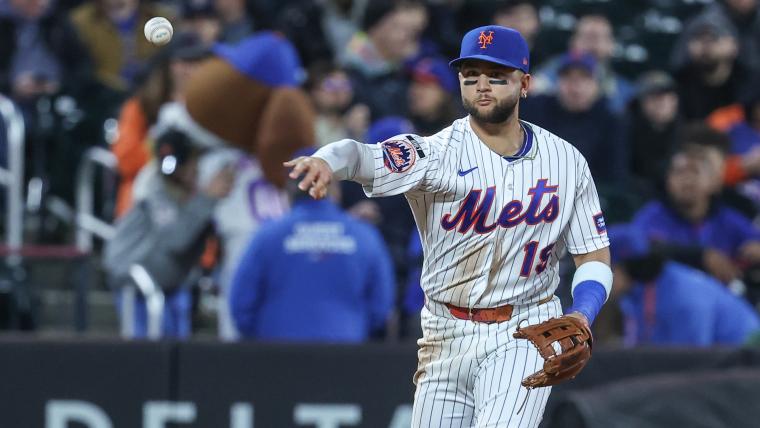
POLICY WIRE — New York, United States — One could argue the American summer offers few spectacles quite as peculiar as a billionaire’s sports franchise, mired in systemic failure, turning its gaze towards the minutiae of an athlete’s preferred fielding position as a potential panacea. The New York Mets, bleeding confidence and win-loss records, now find themselves grasping at such straws—or perhaps, crafting elaborate explanations—as they push embattled infielder Bo Bichette back to his familiar, if problematic, shortstop role.
It’s a peculiar brand of optimism, isn’t it? When a team with an astronomically bloated payroll flails about the league’s basement, its focus shifts from organizational overhaul to the tactical deployment of a single player, ostensibly hoping to reignite his batting average. Bo Bichette, late of the Toronto Blue Jays, has been an acquired taste for the Flushing faithful, oscillating between flashes of brilliance and the defensive gaffes that often define his tenure off the keystone. But now, amidst a fire sale brewing on the horizon, he’s back where he started.
“Good thing to see him go back to shortstop for a few weeks,” offered Mets legend Jose Reyes, whose own glittering career at the position certainly lends a certain weight, albeit nostalgic, to his assessment. “I think his confidence is going to be even better now. Hitting-wise, before Lindor comes back, it’s going to be way better. I’m telling you.” It’s a bold claim, one steeped more in hope than present performance, like a struggling nation banking on a bumper crop to offset decades of fiscal mismanagement.
And so, Bichette, whose season hasn’t been a complete disaster but hardly an inspiration, is relegated to shortstop—a move some characterize as ‘back to basics’ while others might gently suggest it’s merely moving deck chairs on the Titanic. His defensive metrics at the position, frankly, don’t scream ‘savior.’ Over his MLB career, Bichette boasts a career Defensive Runs Saved (DRS) at shortstop of a rather unimpressive -26, according to Fangraphs data. That’s not exactly inspiring much confidence for those who chart the subtle erosion of competence.
Because, really, when an institution hits rock bottom, there’s an almost primal urge to revert to what’s known, to grasp at the ghosts of past successes. This isn’t just about baseball. It’s a parable for policy-making. You see it in sputtering economies, in political systems trying to claw back public trust by invoking tired slogans or repositioning struggling ministers. It rarely works without deeper, systemic reforms, but the ritual is undeniably appealing.
The Mets’ President of Baseball Operations, David Stearns, speaking off-the-record during a recent press availability (a rare public outing, one might note), reportedly offered a slightly more pragmatic view. “Look, you try everything, don’t you?” he’s said to have murmured. “It’s about optimizing what you’ve got. This isn’t a silver bullet, but sometimes, restoring familiarity can spark something. We’re certainly hopeful, for Bo, and for the club’s—ahem—morale.” The ‘ahem’ hangs heavy in the air, laden with unspoken acknowledgement of the broader chaos.
It brings to mind certain emerging nations in the global South—like Pakistan, which despite its robust, even fanatical, love for cricket, often struggles with foundational economic policies. There, you’ll find brilliant individual talents on the pitch, but an inconsistent overarching strategy often derails larger aspirations. Sometimes, a promising player or a seemingly simple adjustment can become an oversized symbol of hope, deflecting attention from the truly difficult structural reforms required.
But the looming trade deadline, much like a fiscal austerity package, has everyone on edge. Players deemed ‘expendable’ will be jettisoned. This isn’t a moment for long-term vision; it’s triage. And Bichette, back at his nominal home, might just be another piece being primped for the inevitable asset redistribution—or perhaps, just perhaps, he’s a desperate last roll of the dice in a season where nothing’s gone right.
Don’t dismiss the human element in all this. These aren’t just statistics; they’re livelihoods, careers, and the collective psyche of a fanbase that, by this point, likely deserves hazard pay. When the chips are down, even the most cold-blooded executives revert to sentimental gestures—or at least, gestures that look like them.
What This Means
This positional adjustment isn’t just a baseball tactic; it’s a policy maneuver masquerading as one. For a major-market team hemorrhaging support and wins, re-centering a high-profile, underperforming asset in his ‘natural’ environment serves multiple, if subtle, functions. First, it offers a superficial narrative of improvement or a ‘return to fundamentals’ when systemic failures are too painful to confront directly. It’s PR, really. Second, it potentially inflates a player’s perceived value for a forthcoming trade—a common tactic during economic downturns when shedding underperforming subsidiaries. Because let’s face it, a struggling player in his ‘correct’ position looks better on paper for prospective buyers than one visibly miscast. Economically, this move embodies a microcosm of organizational despair: opting for incremental, almost nostalgic, adjustments over the wholesale structural changes necessary for sustained success. The expectation is that an individual’s localized comfort can offset vast organizational dysfunction, which—and history proves this again and again—it rarely can. It’s a small, symbolic move amidst a sprawling institutional crisis, a flicker of sentimentality before the inevitable axe falls. For a franchise often embroiled in soap opera levels of drama, this episode resonates with themes of shifting narratives and desperate portrayals, much like Hollywood’s attempts to rehabilitate reputations under scrutiny. It’s a calculated gamble on optics, nothing more, before the full scale of failure demands a much harsher accounting. Much like trying to stem the scorched-earth policies that grip regions like the Indus, sometimes the immediate, visible actions merely mask the deeper, unseen erosion.