


Beijing’s Service Sector Gambit: A Precarious Ascent Amid Global Headwinds
POLICY WIRE — BEIJING, China — The world watches Beijing’s economic machinations with an almost obsessive gaze, dissecting every data point, searching for harbingers of either a global boom or...

POLICY WIRE — BEIJING, China — The world watches Beijing’s economic machinations with an almost obsessive gaze, dissecting every data point, searching for harbingers of either a global boom or a prolonged bust. So it’s perhaps not entirely shocking — though certainly noteworthy — that while much of the developed West still grapples with a peculiar cocktail of persistent inflation and anemic growth, China’s often-maligned domestic services sector appears to have found a surprising, if precarious, equilibrium. It isn’t the roaring dragon of yesteryear, not yet, but it’s certainly not curled up in slumber either.
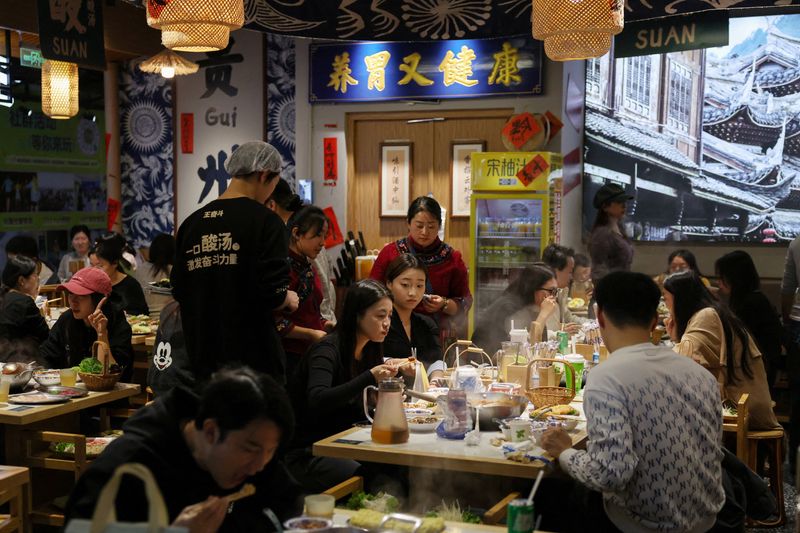
Behind the headlines of geopolitical tussles and industrial policy dictates, a quiet resurgence is unfolding in China’s sprawling service industries. The latest private sector Purchasing Managers’ Index (PMI) data, a bellwether often seen as a more candid reflection than official statistics, points to a discernible quickening of pace in April. And this isn’t just about burgeoning tourism or renewed retail therapy; it’s a broader embrace of consumption, the very engine Beijing has long sought to ignite as it recalibrates its export-heavy economy.
The Caixin/S&P Global services Purchasing Managers’ Index (PMI) clocked in at a robust 54.9 in April, a consequential uptick from March’s 52.7, according to recent data. A figure above 50, of course, signifies expansion, and this particular metric suggests an acceleration that’s giving some economists pause – a good kind of pause, mind you. New orders flowed in at a more vigorous clip, businesses expanded their payrolls, and perhaps most tellingly, business confidence edged higher. It’s a testament, some contend, to the enduring resilience of China’s domestic market, even as external demand remains a skittish variable.
But let’s not confuse a single month’s favorable wind with a perpetual tailwind. The underlying dynamics are far more nuanced. Beijing has, for years, championed a shift towards a consumption-led growth model, striving to shed its reputation as the world’s factory floor and elevate its citizens’ purchasing power. And this latest PMI reading offers a fleeting glimpse that maybe, just maybe, those protracted efforts are beginning to yield fruit. Though one must acknowledge (and it’s hard not to) that the sheer scale of the Chinese market itself means even modest per-capita gains translate into staggering aggregate figures.
“The resilience demonstrated by our service industries underscores the strategic wisdom of our dual circulation strategy,” contended Dr. Chen Wei, a senior economist at the People’s Bank of China, speaking at a recent state-sponsored forum. “We remain steadfast in our commitment to fostering a stable, high-quality growth environment for our people, prioritizing internal demand to buffer against global volatilities.” His pronouncements, predictably, echoed the official line – a blend of self-assurance and controlled optimism.
Still, not everyone shares Beijing’s unbridled enthusiasm. Eleanor Vance, a Senior Asia Economist at Sterling & Thorne, shot back with a more guarded assessment during a recent client brief. “It’s a bump, certainly, but let’s not mistake a single month’s momentum for a sustained surge,” Vance opined, her tone laced with characteristic skepticism. “Underlying consumer confidence remains a rather fragile beast, and the shadow of property sector woes—a rather large shadow, it must be said—hasn’t exactly evaporated from the economic landscape.” Indeed, that persistent malaise in the real estate sector continues to cast a long pall over household balance sheets and future spending plans.
📄 POLICY WIRE WHITEPAPER PUBLISHED: PAKISTAN'S NATIONAL SECURITY POLICY PRIORITIES
👉 READ BY CLICKING HEREWhat This Means
At its core, this uptick in China’s services activity presents a complex policy dilemma for the Communist Party leadership. On one hand, it validates their strategic pivot towards domestic consumption. It provides ammunition for their narrative of steady, internally-driven progress. On the other, it begs the question of sustainability. Can this momentum endure without significant structural reforms, particularly in addressing local government debt and the still-teetering property developers? Don’t bet the farm on it.
Politically, a buoyant services sector offers a crucial buffer against external economic pressures, granting Beijing more leverage in its ongoing friction with Washington and other Western capitals. Economically, a stronger domestic consumer base means less reliance on export markets, a long-term goal that’s proven agonizingly difficult to achieve. It also means that China’s economy isn’t just about manufacturing widgets anymore; it’s increasingly about catering to its own 1.4 billion citizens – a market, by any measure, that’s simply colossal.
For regions like South Asia and the broader Muslim world, China’s internal economic health isn’t a mere academic curiosity. Its dynamism, or lack thereof, ripples outward. Strong Chinese consumption could translate into increased demand for raw materials, energy, and even tourism from countries deeply integrated into Beijing’s ambitious Belt and Road Initiative (BRI). Pakistan, for instance, a linchpin in the China-Pakistan Economic Corridor (CPEC), keenly monitors these shifts. A more robust Chinese economy might mean renewed zeal and deeper pockets for investment in critical infrastructure projects and enhanced trade flows, potentially offering a crucial economic lifeline amidst Islamabad’s own perennial financial precarity. Conversely, a faltering Chinese growth narrative could starve these projects of capital and undermine regional economic confidence. It’s a delicate dance, where Beijing’s internal waltz dictates much of the global rhythm.