


From Campus Barricades to Alpine Altars: A Linebacker’s Ideological Migration Unpacks Broader Societal Divides
POLICY WIRE — Provo, Utah — It wasn’t the roar of the crowd or the tactical minutiae of defensive schemes that truly defined Cade Uluave’s collegiate pivot. Instead, it was an observation,...

POLICY WIRE — Provo, Utah — It wasn’t the roar of the crowd or the tactical minutiae of defensive schemes that truly defined Cade Uluave’s collegiate pivot. Instead, it was an observation, stark in its simplicity yet profound in its implications, that encapsulated his journey: he’d traversed from the clamor of Berkeley’s protest culture to the hushed sanctity of Provo’s prayers. This isn’t merely a tale of a gifted athlete shifting allegiances; it’s a microcosm of America’s increasingly bifurcated cultural landscape, played out on the gridiron.
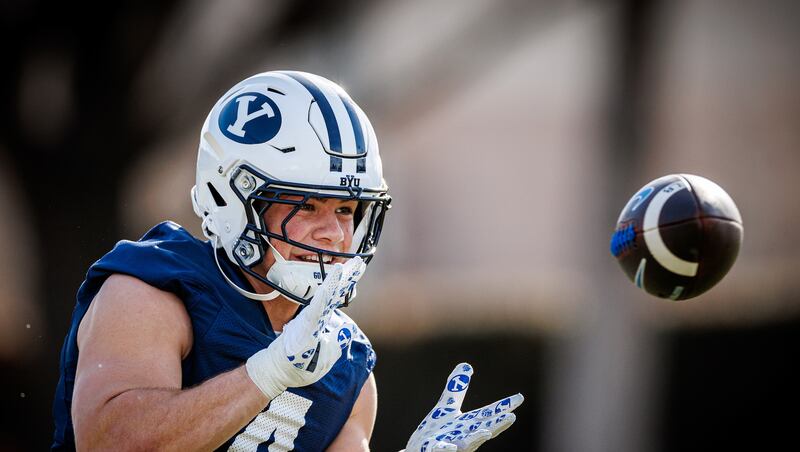
Uluave, a commanding 6-foot-1, 235-pound linebacker, arrived at Brigham Young University this spring, a senior with a single season of eligibility remaining. He’d previously anchored the defense for the California Golden Bears, earning All-ACC first-team honors in 2025 and tallying an impressive 237 tackles over three seasons. His departure from Cal wasn’t born of discontent, he insists, but rather a realignment of gravitational forces – familial, spiritual, and professional. Yet, the stark contrast he readily acknowledges between his previous Californian academic home and his current Utahn athletic one speaks volumes beyond personal preference.
At its core, Uluave’s transfer represents a cultural migration, a deliberate move from an institution often synonymous with progressive activism to one deeply embedded in the doctrines of The Church of Jesus Christ of Latter-day Saints. It’s a striking dichotomy: a place where societal reforms are often agitated for through public demonstration versus a community where individual and collective identity is frequently forged through faith and communal worship. And it isn’t just an anecdotal observation; it’s a structural tension that defines much of the Western world, including, perhaps more acutely, the socio-political dynamics seen in diverse nations across the globe, where questions of secularism versus religious identity routinely inflame public discourse. One might consider the perennial debates over religious expression in public life within Muslim-majority nations, or the struggles of diaspora communities in Europe, where the pull of ancestral faith often contends with the pluralistic demands of modern citizenship.
This isn’t to say Uluave arrived a political refugee. Far from it. His roots run deep in Provo soil; his grandfather, Peter Uluave, notably served as bishop of the first Polynesian ward in the area. "This place is in my blood," Uluave declared, acknowledging a familial gravitational pull that transcends football. His decision, he explained, involved "a lot of prayer and contemplation." Such a declaration would raise few eyebrows in Provo but might register differently in the more secular enclaves of academia. It’s a subtle, yet significant, reflection on the values prioritised in an athlete’s life choices – a choice that, in its own way, echoes the complex decisions individuals make across South Asia, for instance, when weighing opportunities that might demand a departure from deeply ingrained cultural or religious norms.
BYU’s defensive coordinator, Kelly Poppinga, didn’t delve into the cultural chasm. His focus was purely utilitarian. "He’s faster and more explosive than I thought he was," Poppinga observed dryly, referencing Uluave’s remarkable speed for his size – clocked at 22 miles per hour in practice – and his immediate impact. "When that guy pulls the trigger in the run game and comes downhill, it’s as quick and fast as I’ve seen." His former coach at Cal, Justin Wilcox, was fired after a 31-10 loss to Stanford, prompting Uluave’s entry into the transfer portal, where he was ranked the top linebacker by 247Sports. The market for talent is, after all, unforgivingly efficient.
Still, the notion of "home" played a pivotal role. Justin Ena, BYU’s special teams coordinator — and an NFL veteran himself, recognizes the intangible. "There’s no doubt in my mind that he’s going to be a huge contributor," Ena affirmed, pointing to Uluave’s relentless motor and meticulous film study. He noted the palpable drive; the calculated dedication to his craft that suggests a deep, internal motivation – perhaps even a spiritual one. It’s a form of intrinsic motivation that resonates globally, a desire for belonging and purpose that shapes decisions from a village in Punjab to a dormitory in Berkeley.
What This Means
Uluave’s journey isn’t just a feel-good sports story; it’s a policy case study in talent mobility and ideological gravity within the American collegiate system. The transfer portal, a relatively new mechanism, increasingly allows athletes to optimize not just their athletic prospects but also their personal environments. This represents a significant shift from an era where institutional loyalty often trumped individual agency. Economically, it signifies a market where cultural fit, alongside athletic prowess, holds tangible value, impacting recruitment strategies and ultimately, the financial health of athletic programs. the "protests to prayers" narrative underscores a widening chasm in American society’s ideological preferences, demonstrating how even highly sought-after individuals might gravitate towards communities that align more closely with their core values. It suggests that while economic opportunity remains paramount, the pursuit of a congruent socio-cultural milieu is becoming an equally consequential driver for talent allocation, with implications for everything from urban planning to education policy.
So, as Uluave prepares for his final collegiate season, aiming for the College Football Playoff, his narrative serves as a potent reminder: even in the hyper-commercialized world of NCAA athletics, deeply personal convictions and communal belonging continue to exert a powerful, sometimes decisive, pull.