

Moscow’s Gilded Cage: Drone Strike on Elite Tower Shatters Pre-Victory Day Calm
POLICY WIRE — MOSCOW — Luxury apartments in Moscow’s financial district, those gleaming towers of glass and steel, once offered their occupants an illusion of detachment from the brutal...

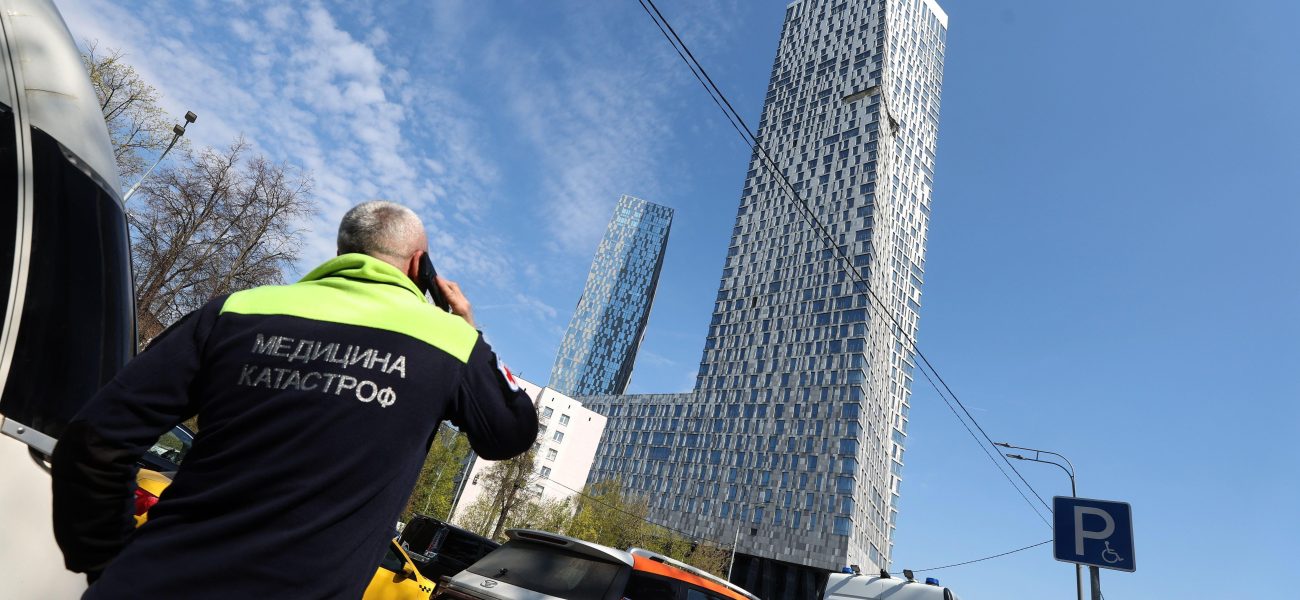
POLICY WIRE — MOSCOW — Luxury apartments in Moscow’s financial district, those gleaming towers of glass and steel, once offered their occupants an illusion of detachment from the brutal realities unfolding hundreds of miles to the south. That illusion, like glass, just splintered. A Ukrainian drone, a comparatively inexpensive piece of hardware, slammed into one such high-rise in the early hours, an unwelcome—and profoundly symbolic—prelude to Russia’s highly choreographed Victory Day celebrations.
The incident wasn’t catastrophic in terms of physical damage, but its psychological resonance vibrated acutely through the capital. This wasn’t a military target, nor was it a government edifice. It was a residential building, albeit one catering to the city’s affluent, a segment of society largely shielded from the kinetic violence consuming Ukraine. The message, delivered with cold precision, seemed clear: nowhere is truly safe, not even the Kremlin’s doorstep. And it’s a message that cuts deep when a nation is preparing to commemorate its greatest triumph of resilience and unyielding strength against an external foe.
For weeks, official Russian channels had been meticulously curating the narrative of an unassailable homeland, bolstered by sophisticated air defenses. But this strike, along with others preceding it, has chipped away at that carefully constructed façade. It’s an uncomfortable truth for a populace accustomed to seeing conflict as something that happens “over there.” Suddenly, the “special military operation” felt a good deal more special, and rather less remote. Moscow’s air defense grid, once vaunted, now faces questions it simply can’t deflect.
Still, the official reaction was predictably forceful. Maria Zakharova, Russia’s Foreign Ministry spokesperson, shot back, declaring, “This cowardly act of terrorism, deliberately targeting civilian infrastructure, only hardens our resolve. Kyiv’s desperation is on full display for the world to see.” Her words, delivered with customary fire, aimed to reframe the attack as an act of impotent rage rather than a calculated demonstration of expanding Ukrainian capabilities. It’s a familiar playbook, designed to galvanize rather than dismay, but one that perhaps resonates differently now that the conflict has found its way to upscale living rooms.
Meanwhile, in Kyiv, the response was a study in calculated ambiguity. Mykhailo Podolyak, a key advisor to President Zelenskyy, offered a cryptic observation. “The war, you see, isn’t just fought on our soil anymore. Moscow’s residents are now learning what many in Ukraine have endured for months. It’s a matter of perspective, isn’t it?” He didn’t claim explicit responsibility, yet the implication hung heavy in the air, a tacit acknowledgement of an expanding geographic and psychological front. Such veiled declarations have become a trademark of Ukraine’s information warfare strategy, sowing uncertainty and doubt within the Russian command structure and among its citizenry.
The drone, in many ways, represents a contemporary David against Goliath narrative. Defense analysts estimate that some of the commercial-grade drones repurposed for these attacks can cost as little as $2,000, while the sophisticated air defense systems supposedly protecting Moscow—like elements of the S-400 battery—can run into the billions of dollars for a full deployment. It’s a staggering disparity in cost-effectiveness, illustrating a profound shift in the brutal calculus of modern warfare. This asymmetry isn’t confined to Eastern Europe; it’s a global phenomenon. For instance, countries in South Asia, including Pakistan, have long grappled with drone incursions, whether from state actors or non-state groups, highlighting how easily relatively cheap technology can circumvent expensive traditional defenses and complicate regional security narratives. The threat isn’t just about direct damage; it’s about the psychological wear and tear, the constant low-level threat that strains resources and nerves.
📄 POLICY WIRE WHITEPAPER PUBLISHED: PAKISTAN'S NATIONAL SECURITY POLICY PRIORITIES
👉 READ BY CLICKING HEREAnd what about the global implications? The perceived vulnerability of Russia’s capital sends ripples. For nations like Pakistan, which has historically maintained complex strategic relationships with both Russia and the West, such incidents inform policy decisions. They observe how a major power’s perceived invulnerability can be so casually punctured. It makes one wonder about the long-term impacts on military alliances — and arms deals, doesn’t it?
Behind the headlines, this Moscow incident underscores a vexing challenge for Russia’s leadership: how to maintain public morale and project an image of control when the conflict repeatedly, and graphically, breaches the sanctity of the homeland. It’s not just a physical breach; it’s a psychological rupture, a testament to the fact that even in the age of advanced weaponry, sometimes the smallest, cheapest instruments can deliver the most potent political blows. This isn’t just about a drone; it’s about the erosion of a carefully constructed reality, a vulnerability laid bare for all to witness.
What This Means
The drone strike on an elite Moscow high-rise is far more than an isolated security incident; it’s a potent symbol with cascading political and economic implications. Politically, it dramatically weakens the Kremlin’s narrative of an unassailable Russia, particularly in the lead-up to Victory Day, a national holiday designed to reinforce unity and strength. For ordinary Russians, particularly those in the capital, it introduces an unsettling proximity to a war previously depicted as distant. This creates a difficult messaging challenge for President Putin’s administration, forcing them to choose between downplaying the threat—which risks looking weak—or escalating rhetoric, which could further fuel public anxiety. The perceived failure of air defenses also invites internal scrutiny and could potentially foster dissent among security hardliners.
Economically, while the direct damage was minimal, the incident imposes a new layer of risk — and uncertainty on Moscow. It’s an intangible but real “war premium” that could impact foreign investment, already reeling from sanctions, and domestic business confidence. Insurers might reassess policies, — and the real estate market in targeted upscale areas could see shifts. the need to bolster urban air defenses will divert significant resources, potentially billions of rubles, away from other critical sectors. The sheer cost-inefficiency of using high-value interceptors against low-cost drones represents a fiscal drain that Russia, under current sanctions, can ill afford. It essentially forces Russia into an asymmetric arms race on its own turf, where the defender constantly bleeds resources to counter relatively inexpensive threats. This financial strain, though not immediately visible, will contribute to the broader economic headwinds facing the country.